Quotessence
Home / Quotes / Quote by John Dewey

Quote by John Dewey

Work

Reconstruction in Philosophy: Top American Authors

The book delves into the philosophical contributions of key American thinkers, providing insights into their ideas and the historical context of the Reconstruction period. more

Author
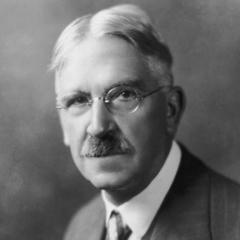
John Dewey
John Dewey

John Dewey was an American philosopher and educator, born on October 20, 1859, and died on June 1, 1952. He was a leading figure in the philosophy of pragmatism and had a profound impact on 20th-century education, philosophy, and the social sciences. more

You May Also Like

“Scientists, therefore, are responsible for their research, not only intellectually but also morally. This responsibility has become an important issue in many of today's sciences, but especially so in physics, in which the results of quantum mechanics and relativity theory have opened up two very different paths for physicists to pursue. They may lead us - to put it in extreme terms - to the Buddha or to the Bomb, and it is up to each of us to decide which path to take.”

“From the very beginning— from the first moment, I may almost say— of my acquaintance with you, your manners, impressing me with the fullest belief of your arrogance, your conceit, and your selfish disdain of the feelings of others, were such as to form the groundwork of disapprobation on which succeeding events have built so immovable a dislike; and I had not known you a month before I felt that you were the last man in the world whom I could ever be prevailed on to marry.”

“The essential fact which emerges ... is that the three smallest and most active reservoirs ( of carbon in the global carbon cycle), the atmosphere, the plants and the soil, are all of roughly the same size. This means that large human disturbance of any one of these reservoirs will have large effects on all three. We cannot hope either to understand or to manage the carbon in the atmosphere unless we understand and manage the trees and the soil too.”

“What I am going to tell you about is what we teach our physics students in the third or fourth year of graduate school... It is my task to convince you not to turn away because you don't understand it. You see my physics students don't understand it... That is because I don't understand it. Nobody does.”

“The tendency has always been strong to believe that whatever received a name must be an entity or being, having an independent existence of its own. And if no real entity answering to the name could be found, men did not for that reason suppose that none existed, but imagined that it was something peculiarly abstruse and mysterious.”

“The scientific method," Thomas Henry Huxley once wrote, "is nothing but the normal working of the human mind." That is to say, when the mind is working; that is to say further, when it is engaged in correcting its mistakes. Taking this point of view, we may conclude that science is not physics, biology, or chemistry — is not even a ”subject " — but a moral imperative drawn from a larger narrative whose purpose is to give perspective, balance, and humility to learning.”