Quotessence
Home / Quotes / Quote by George Berkeley

Quote by George Berkeley

“I am apt to think, if we knew what it was to be an angel for one hour, we should return to this world, though it were to sit on the brightest throne in it, with vastly more loathing and reluctance than we would now descend into a loathsome dungeon or sepulchre.”

Quote by George Berkeley

Work

The works of George Berkeley

This book includes Berkeley's major works, exploring his idealist philosophy and his contributions to metaphysics, epistemology, and aesthetics. more

Author
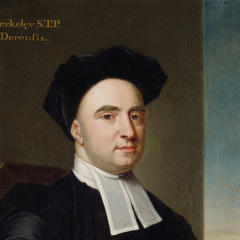
George Berkeley
George Berkeley

George Berkeley, born on March 12, 1685, and died on January 12, 1753, was a renowned philosopher of the 18th century. He is best known for his idealist philosophy, advocating the view that existence is dependent on perception. His major works include 'Principles of Human Knowledge' and 'A New Theory of Vision'. more

You May Also Like

“It is a mistake, to think the same thing affects both sight and touch. If the same angle or square, which is the object of touch,be also the object of vision, what should hinder the blind man, at first sight, from knowing it?”

“Denotation by means of sounds and markings is a remarkable abstraction. Three letters designate God for me; several lines a million things. How easy becomes the manipulation of the universe here, how evident the concentration of the intellectual world! Language is the dynamics of the spiritual realm. One word of command moves armies; the word liberty entire nations.”

“Most observers of the French Revolution, especially the clever and noble ones, have explained it as a life-threatening and contagious illness. They have remained standing with the symptoms and have interpreted these in manifold and contrary ways. Some have regarded it as a merely local ill. The most ingenious opponents have pressed for castration. They well noticed that this alleged illness is nothing other than the crisis of beginning puberty.”

“Tools arm the man. One can well say that man is capable of bringing forth a world; he lacks only the necessary apparatus, the corresponding armature of his sensory tools. The beginning is there. Thus the principle of a warship lies in the idea of the shipbuilder, who is able to incorporate this thought by making himself into a gigantic machine, as it were, through a mass of men and appropriate tools and materials. Thus the idea of a moment often required monstrous organs, monstrous masses of materials, and man is therefore a potential, if not an actual creator.”