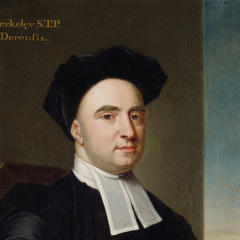
George Berkeley, born on March 12, 1685, and died on January 12, 1753, was a renowned philosopher of the 18th century. He is best known for his idealist philosophy, advocating the view that existence is dependent on perception. His major works include 'Principles of Human Knowledge' and 'A New Theory of Vision'.
Related Quotes
Source: Three Dialogues Between Hylas and Philonous
Source: Three Dialogues Between Hylas and Philonous
“Every knave is a thorough knave, and a thorough knave is a knave throughout.”
Source: Works: Account of His Life and Letters
Source: The Works of George Berkeley ...: Philosophical works, 1732-33: Alciphron. The theory of vision
“Whatever is immediately perceived is an idea: and can any idea exist out of the mind?”
Source: A Miscellany, Containing Several Tracts on Various Subjects
Source: Works: Account of His Life and Letters
Source: The Works of George Berkeley, D.D., Formerly Bishop of Cloyne: Philosophical works, 1732-33: Alciphron. The theory of vision
Source: Alciphron: Or, The Minute Philosopher. In Seven Dialogues Containing an Apology for the Christian Religion Against Those who are Called Free-thinkers
Source: Philosophical works
Source: A Treatise Concerning the Principles of Human Knowledge
Source: Principles of Human Knowledge: Human Understanding
Source: Principles of Human Knowledge
Source: A Treatise Concerning the Principles of Human Knowledge
Source: The applied philosophical works
Source: The works of George Berkeley
“I might as well doubt of my own being, as of the being of those things I actually see and feel.”
Source: Berkeley: Philosophical Writings
Source: Works, Including His Letters to Thomas Prior, Dean Gervais, Mr. Pope, &c. to which is Prefixed an Account of His Life
Source: Principles of Human Knowledge: Human Understanding
Source: Three Dialogues Between Hylas and Philonous
Source: Works: Account of His Life and Letters
“[Christianity] neither enjoins the nastiness of the Cynic, nor the insensibility of the Stoic.”
Source: Alciphron: or, The minute philosopher. 1732. Siris. 1744
Source: Works, Including His Letters to Thomas Prior, Dean Gervais, Mr. Pope, &c. to which is Prefixed an Account of His Life
Source: Works, Including His Letters to Thomas Prior, Dean Gervais, Mr. Pope, &c. to which is Prefixed an Account of His Life
Source: Alciphron: Or, The Minute Philosopher. In Seven Dialogues. Containing an Apology for the Christian Religion Against Those who are Called Free-thinkers ...
Source: A Treatise Concerning the Principles of Human Knowledge ...
Source: The works of George Berkeley
Source: The Works of George Berkeley, D.D., Bishop of Cloyne: Including His Letters to Thomas Prior, Esq., Dean Gervais, Mr. Pope, &c., &c. ; to which is Prefixed an Account of His Life
Source: Principles of Human Knowledge and Three Dialogues
Source: Berkeley: Philosophical Writings
Source: The Analyst: A Discourse Addressed to an Infidel Mathematician
Source: Principles of Human Knowledge: Human Understanding
“For my own private satisfaction, I had rather be master of my own time than wear a diadem.”
Source: The works of George Berkeley
“The fawning courtier and the surly squire often mean the same thing,--each his own interest.”
Source: Works: Account of His Life and Letters
Source: The Works of George Berkeley, D.D., Bishop of Cloyne: Including His Letters to Thomas Prior, Esq., Dean Gervais, Mr. Pope, &c., &c. ; to which is Prefixed an Account of His Life
Source: Principles of Human Knowledge: Human Understanding
Source: Works
Source: Works: Account of His Life and Letters
“Few men think, yet all will have opinions.”
Source: Works, Including His Letters to Thomas Prior, Dean Gervais, Mr. Pope, &c. to which is Prefixed an Account of His Life
“I had rather be an oyster than a man, the most stupid and senseless of animals.”
Source: Miscellaneous works. Index, v.1-3