Quotessence
Home / Quotes / Quote by Ray Bradbury

Quote by Ray Bradbury

“With school turning out more runners, jumpers, racers, tinkerers, grabbers, snatchers, fliers, and swimmers instead of examiners, critics, knowers, and imaginative creators, the word 'intellectual,' of course, became the swear word it deserved to be. You always dread the unfamiliar. Surely you remember the boy in your own school class who was exceptionally ‘bright,’ did most of the reciting and answering while the others sat like so many leaden idols, hating him. And wasn’t it this bright boy you selected for beatings and tortures after hours? Of course it was. We must all be alike. Not everyone born free and equal, as the Constitution says, but everyone made equal. Each man the image of every other; then all are happy, for there are no mountains to make them cower, to judge themselves against. So! A book is a loaded gun in the house next door. Burn it. Take the shot from the weapon. Breach man's mind. Who knows who might be the target of the well-read man? Me? I won't stomach them for a minute.”

Quote by Ray Bradbury

Work

Fahrenheit 451

Ray Bradbury's Fahrenheit 451 is a thought-provoking novel set in a future society where books are banned and firemen are employed to burn any that are found. The story follows a fireman named Guy Montag who begins to question the status quo and the role of literature in society. more

Author
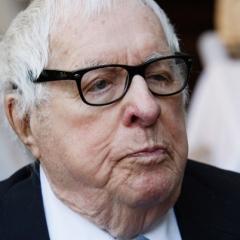
Ray Bradbury
Ray Bradbury

Ray Bradbury, born on August 22, 1920, and died on June 5, 2012, was an influential American science fiction writer, playwright, and poet. His works are known for their unique imagination and profound philosophical insights, which have had a profound impact on the science fiction genre. more

You May Also Like

“That, in my opinion, was the most diabolical aspect of those old-time big brains: They would tell their owners, in effect, 'Here is a crazy thing we could actually do, probably, but we would never do it, of course. It's just fun to think about.' And then, as though in trances, the people would really do it--have slaves fight each other to death in the Colosseum, or burn people alive in the public square for holding opinions which were locally unpopular, or build factories whose only purpose was to kill people in industrial quantities, or to blow up whole cities, and on and on.”

“I dislike interaction. The less I say the better I feel. I was naturally a loner. I didn’t want conversation, or to goanywhere. I didn’t understand other people who wanted to share their emotions. Parties sickened me. I was drawn to all the wrong things: I was lazy , I didn’t have a god, politics, ideas, ideals. I was settled into nothingness; a kind of non - being, and I accepted it. I didn’t make for an interesting person. I didn’t want to be interesting, it was too hard. What I really wanted was only a soft, hazy space to live in, and to be left alone. Relationships never worked with me. I alwayslost interest. I simply disliked people, crowds, anywhere, except at my readings.”

“Heresy is the eternal dawn, the morning star, the glittering herald of the day. Heresy is the last and best thought. It is the perpetual New World, the unknown sea, toward which the brave all sail. It is the eternal horizon of progress. Heresy extends the hospitalities of the brain to a new thought. Heresy is a cradle; orthodoxy, a coffin.”

“ABNORMAL, adj. Not conforming to standards in matters of thought and conduct. To be independent is to be abnormal, to be abnormal is to be detested. A striving toward the straiter [sic] resemblance of the Average Man than he hath to himself, whoso attaineth thereto shall have peace, the prospect of death and the hope of Hell.”

“I don't know what this great thing I'm meant to be doing is, and it looks to me as if I was supposed not to know. And I resent that, right? "The old me knew. The old me cared. Fine, so far so good. Except that the old me cared so much that he actually got inside his own brain--my own brain--and locked off the bits that knew and cared, because if I knew and cared I wouldn't be able to do it. [...] "But this former self of mine killed himself off, didn't he, by changing my brain? Okay, that was his choice. This new me has its own choices to make, and by a strange coincidence those choices involve not knowing and not caring about this big number, whatever it is. That's what he wanted, that's what he got. "Except this old self of mine tired to leave himself in control, leaving orders for me in the bit of my brain he locked off. Well, I don't want to know, and I don't want to hear them. That's my choice. I'm not going to be anybody's puppet, particularly not my own. [...] "The old me is dead! [...] Killed himself! The dead shouldn't hang about trying t0 interfere with the living.”

“When we strike a balance between the challenge of an activity and our skill at performing it, when the rhythm of the work itself feels in sync with our pulse, when we know that what we're doing matters, we can get totally absorbed in our task. That is happiness. The life coach Martha Beck asks new potential clients, "Is there anything you do regularly that makes you forget what time it is?" That forgetting -- that pure absorption -- is what the psychologist Mihaly Csikzentmihalyi calls "flow" or optimal experience. In an interview with Wired magazine, he described flow as "being completely involved in an activity for its own sake. The ego falls away. Time flies. Every action, movement and thought follows inevitably from the previous one, like playing jazz. Your whole being is involved, and you're using your skills to the utmost." In a typical day that teeters between anxiety and boredom, flow experiences are those flashes of intense living -- bright against the dull. These optimal experiences can happen when we're engaged in work paid and unpaid, in sports, in music, in art. The researchers Maria Allison and Margaret Duncan have studied the role of flow in women's lives and looked at factors that contributed to what they call "antiflow." Antiflow was associated with repetitive household tasks, repetitive tasks at work, unchallenging tasks, and work we see as meaningless. But there's an element of chaos when it comes to flow. Even if we're doing meaningful and challenging work, that sense of total absoprtion can elude us. We might get completely and beautifully lost in something today, and, try as we might to re-create the same conditions tomorrow, our task might jsut feel like, well, work. In A Life of One's Own, Marion Milner described her effort to re-create teh conditions of her own recorded moments of happiness, saying, "Often when I felt certain that I had discovered the little mental act which produced the change I walked on air, exulting that I had found the key to my garden of delight and could slip through the door whenever I wished. But most often when I came again the place seemed different, the door overgrown with thorns and my key stuck in the lock. It was as if the first time I had said 'abracadabra' the door had opened, but the next time I must use a different word. (123-124).”