Quotessence
Home / Quotes / Quote by Janet Fitch

Quote by Janet Fitch

“I wanted to tell her not to entertain despair like this. Despair wasn't a guest, you didn't play its favourite music, find it a comfortable chair. Despair was the enemy.”

Quote by Janet Fitch

Work

White Oleander

White Oleander is a work of fiction that follows the life of Astrid Magnussen, a girl whose mother, Ingrid, is a brilliant but narcissistic poet. After Ingrid is sentenced to prison for murder, Astrid is placed into a series of foster homes across Southern California. Each home presents a different set of challenges and influences, shaping Astrid's identity as she grows from a child into a young woman. The narrative explores themes of resilience, the search for belonging, and the powerful, often destructive, bond between mother and daughter. The title refers to a poisonous flowering shrub, serving as a metaphor for Ingrid's beautiful yet dangerous influence on her daughter's life. more
Author

Janet Fitch
Janet Fitch

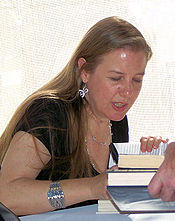
Janet Fitch is a renowned American contemporary author, born on November 9, 1955, in California. Her works are known for their profound character development and unique narrative style, with notable titles including 'The Geeks' and 'Paint It Black'. more

You May Also Like

“I sat up in the strange bed fearing it had been a dream, afraid I would never see her again. Not because I wanted anything from her, only her presence. The disappearance of the presence of beauty is the most despairing of events on this time-wheel of ours that rolls onward towards death.”

“There is a point when the anguished soul finally despairs. A moment in life when the heart, the will, even the spirit crumbles. Some say that after much grief and drowning in tears, it is possible to pick up the pieces and carefully repair what was shattered. I say nay. For the chains of despair have no key, and the soul destroyed by that monster can never hope to be unaffected. There are things done that cannot be undone.”

“Don’t be afraid of criticism; the tallest trees are always confronted by the strongest winds.”

“As always when he worked with this much concentration he began to feel a sense of introverting pressure. There was no way out once he was in, no genuine rest, no one to talk to who was capable of understanding the complexity (simplicity) of the problem or the approaches to a tentative solution. There came a time in every prolonged effort when he had a moment of near panic, or "terror in a lonely place," the original semantic content of the word. The lonely place was his own mind. As a mathematician he was free from subjection to reality, free to impose his ideas and designs on his own test environment. The only valid standard for his work, its critical point (zero or infinity), was the beauty it possessed, the deft strength of his mathematical reasoning. THe work's ultimate value was simply what it revealed about the nature of his intellect. What was at stake, in effect, was his own principle of intelligence or individual consciousness; his identity, in short. This was the infalling trap, the source of art's private involvement with obsession and despair, neither more nor less than the artist's self-containment, a mental state that led to storms of overwork and extended stretches of depression, that brought on indifference to life and at times the need to regurgitate it, to seek the level of expelled matter. Of course, the sense at the end of a serious effort, if the end is reached successfully, is one of lyrical exhilaration. There is air to breathe and a place to stand. The work gradually reveals its attachment to the charged particles of other minds, men now historical, the rediscovered dead; to the main structure of mathematical thought; perhaps even to reality itself, the so-called sum of things. It is possible to stand in time's pinewood dust and admire one's own veronicas and pavanes.”