Quotessence
Home / Quotes / Quote by Yongey Mingyur Rinpoche

Quote by Yongey Mingyur Rinpoche

“We choose ignorance because we can. We choose awareness because we can. Samsara and nirvana are simply different points of view based on the choices we make in how to examine and understand our experience. There’s nothing magical about nirvana and nothing bad or wrong about samsara. If you’re determined to think of yourself as limited, fearful, vulnerable, or scarred by past experience, know only that you have chosen to do so, and that the opportunity to experience yourself differently is always available.”

Quote by Yongey Mingyur Rinpoche

Work

The Joy of Living: Unlocking the Secret and Science of Happiness

This book explores the nature of happiness, offering practical advice and insights drawn from both personal experiences and scientific studies. It aims to help readers unlock the secrets to a joyful life. more

Author
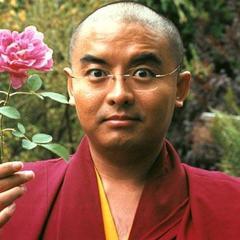
Yongey Mingyur Rinpoche

Yongey Mingyur Rinpoche is a renowned Tibetan Buddhist teacher and author, born in 1975. He is recognized for his engaging teachings that blend traditional Buddhist wisdom with contemporary life. more

You May Also Like

“Man cannot live as nothing but an object, as dice thrown out of a cup; he suffers severely when he is reduced to the level of a feeding or propagating machine, even if he has all the security he wants. Man seeks for drama and excitement; when he cannot get satisfaction on a higher level, he creates for himself the drama of destruction. [...] The human passions transform man from a mere thing into a hero, into a being that in spite of tremendous handicaps tries to make sense of life.”

“When . . . the therapist registers an unexpected shift of mood in herself when she is with a patient, she begins a private inner dialogue with herself as to what it might mean. First she checks herself out, as though she is an object of study. What does the patient evoke in her? Why did she feel uptight just then? Why did she feel sad when the patient was making a light remark? Did the patient hit a particularly personal nerve? Such emotional states, which the therapist notices in herself, are called the counter-transference. As she cordons off the feelings and reflects on them, their dissonance alerts her: something difficult needs understanding. Her body, her emotional state, become a stethoscope-like instrument for hearing what might be askew.”

“Mind Quotient (Sonnet 1209) Throw away all stupidity of IQ and EQ, They are but stain upon mind's honor. To quantify intelligence is stupid, To quantify emotion is even stupider. When the feeble psyche seeks reassurance, It craves comfort in all sorts of nonsense. Most times it resorts to the supernatural, Exhausting that it resorts to pseudoscience. It is no mark of mental progress to replace supernatural bubble with pseudoscience bubble. No matter how they try to sell you security, Know that, human potential is unquantifiable. IQ is no measure of intelligence, EQ is no measure of emotion either. But craving for IQ and EQ is symptom of a shallow and feeble character.”

“From the late 1800s to the late 1900s... science suggested that human beings are the direct byproduct of their own past. [...] Research now shows that a person’s past does not drive or dictate their actions and behaviors. Rather, we are pulled forward by our future. [...] From this view, [...] all human-action is goal-driven [or purpose-driven], even if the goal of the behavior isn’t consciously considered by the individual. [...] There is always a why for everything someone does. That why is their reason or goal for what they’re doing. [...] While [...] purpose may not [always] be conscious or inspiring, [a person's reason behind their behavior] still exists. Even if the goal is simply immediate gratification or escape, [as in the case of wasting time] on social media.”