Quotessence
Home / Quotes / Quote by Pablo Neruda

Quote by Pablo Neruda

Work

The Heights of Macchu Picchu

Browse quotes and source details for this work. more

Author
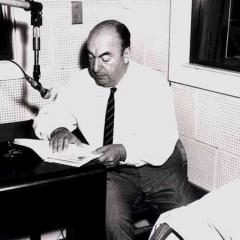
Pablo Neruda
Pablo Neruda

Pablo Neruda, full name Neftali Ricardo Reyes Basoalto, was a Chilean poet and politician who served as a Senator of Chile. Born on July 12, 1904, in Talcahuano, Chile, he passed away on September 23, 1973. Neruda is considered one of the greatest poets of the 20th century, known for his rich poetry and profound social commitment. more

You May Also Like

“History is the collective and ancestral shit of the human race, a great big and ever-growin pile of crap. Right now we're standin at the top of it, but pretty soon we'll be buried under the doodoo of generations yet to come. That's why folks' clothes look so funny in old photographs, to name but a single example. And, as someone who's destined to be buried beneath the shit of your children and grandchildren, I think you should be just a leetle more forgiving.”

“When sovereignty first expands to become the general organizing principle of a society, it is by turning violence into kinship. The early, spectacular phase of mass killing in both China and Egypt, whatever else it may be doing, appears to be intended to lay the foundations of what Max Weber referred to as a ‘patrimonial system’: that is, one in which all the kings’ subjects are imagined as members of the royal household, at least to the degree that they are all working to care for the king. Turning erstwhile strangers into part of the royal household, or denying them their own ancestors, are thereby ultimately two sides of the same coin. Or to put things another way, a ritual designed to produce kinship becomes a method of producing kingship.”

“La objetividad en el historiador es la inversion de las relaciones entre el querer y el saber y, a la vez, la creencia necesaria en la providencia, en las causas finales y en la teología. El historiador pertenece a los ascetas. "No soporto a estos concupiscentes eunucos de la historia, a todos estos reclutadores del ideal ascético; no soporto a estos sepulcros blanqueados que engendran la vida; no soporto a esos seres fatigados y abúlicos que se arropan con la sabidría y creen tener una mirada objetiva.”

“Once I went professionally to an archaeological expedition- and I learnt something there. In the course of an excavation, when something comes up out of the ground, evEryThing is cleared away very carefully all around it. You take away the loose earth, and you scare here and there with a knife until finally your object is there, all alone, ready to be drawn and photographed with no extraneous matter confusing it. That is what I have been seeking TO do- clear away the extraneous matter so that we can see the truth-the naked shining truth.”

“We are used to things starting out small and simple and then progressing--evolving--to become ever more complex and sophisticated, so this is naturally what we expect to find on archaeological sites. It upsets our carefully structured ideas of how civilizations should behave, how they should mature and develop, when we are confronted by a case like Göbekli Tepe that starts out perfect at the beginning and then slowly devolves until it is just a pale shadow of its former self.”