Quotessence
Home / Quotes / Quote by Alexandre Dumas

Quote by Alexandre Dumas

Work

La reine Margot, Tome I

Browse quotes and source details for this work. more

Author
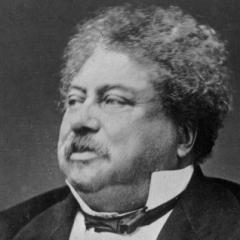
Alexandre Dumas
Alexandre Dumas

Alexandre Dumas, a renowned French writer, was born on July 24, 1802, and died on December 5, 1870. He is famous for his historical and adventure novels, with notable works including 'The Three Musketeers' and 'The Count of Monte Cristo'. more

You May Also Like

“Jean smirked and raised an eyebrow at Leor. “Would you like to fly through the Louvre?” Leor couldn’t perceive how that would even be possible. But Jean would inevitably find a way. “No, no!” Leor ardently replied. “Let’s just land there and take a walk. Look at some statues, get some air.” “Ah, but do we not have plenty of air, flowing around up here in the skies?” Jean asked, diving down towards the Seine, and then sharply pulling up along one of the slopes. “Would you like me to vomit again?” Leor asked, with a hand near his mouth.”

“[w]hat he had failed to take into account was the impact (...) of seeing the Arc de Triomphe and the Louvre lit up at night for the very first time. True, Sophia had seen them the day before (...) but just as the Count had imagined, she had seen them through the window of a bus. It was a different thing altogether to see them at the onset of summer having received an ovation, changed one's appearance, and escaped into the night. For while in the classical tradition there was no muse of architecture, I think we can agree that under the right circumstances the appearance of a building can impress itself upon one's memory, affect one's sentiments, and even change one's life. Just so, risking minutes that she did not have to spare, Sophia came to a stop at the Place de la Concorde and turned slowly in place, as if in a moment of recognition.”

“We use the effect of centrifugal forces on matter to offer insight into the rotation rate of extreme cosmic objects. Consider pulsars. With some rotating at upward of a thousand revolutions per second, we know that they cannot be made of household ingredients, or they would spin themselves apart. In fact, if a pulsar rotated any faster, say 4,500 revolutions per second, its equator would be moving at the speed of light, which tells you that this material is unlike any other. To picture a pulsar, imagine the mass of the Sun packed into a ball the size of Manhattan. If that’s hard to do, then maybe it’s easier if you imagine stuffing about a hundred million elephants into a Chapstick casing. To reach this density, you must compress all the empty space that atoms enjoy around their nucleus and among their orbiting electrons. Doing so will crush nearly all (negatively charged) electrons into (positively charged) protons, creating a ball of (neutrally charged) neutrons with a crazy-high surface gravity. Under such conditions, a neutron star’s mountain range needn’t be any taller than the thickness of a sheet of paper for you to exert more energy climbing it than a rock climber on Earth would exert ascending a three-thousand-mile-high cliff. In short, where gravity is high, the high places tend to fall, filling in the low places—a phenomenon that sounds almost biblical, in preparing the way for the Lord: “Every valley shall be raised up, every mountain and hill made low; the rough ground shall become level, the rugged places a plain” (Isaiah 40:4). That’s a recipe for a sphere if there ever was one. For all these reasons, we expect pulsars to be the most perfectly shaped spheres in the universe.”

“To escape the throngs, we decided to see the new Neil Degrasse Tyson planetarium show, Dark Universe. It costs more than two movie tickets and is less than thirty minutes long, but still I want to go back and see it again, preferably as soon as possible. It was more visually stunning than any Hollywood special effect I’d ever seen, making our smallness as individuals both staggering and - strangely - rather comforting. Only five percent of the universe consists of ordinary matter, Neil tells us. That includes all matter - you, and me, and the body of Michael Brown, and Mork’s rainbow suspenders, and the letters I wrote all summer, and the air conditioner I put out on the curb on Christmas Day because I was tired of looking at it and being reminded of the person who had installed it, and my sad dying computer that sounds like a swarm of bees when it gets too hot, and the fields of Point Reyes, and this year’s blossoms which are dust now, and the drafts of my book, and Israeli tanks, and the untaxed cigarettes that Eric Garner sold, and my father’s ill-fitting leg brace that did not accomplish what he’d hoped for in terms of restoring mobility, and the Denver airport, and haunting sperm whales that sleep vertically, and the water they sleep in, and Mars and Jupiter and all of the stars we see and all of the ones we don’t. That’s all regular matter, just five percent. A quarter is “dark matter,” which is invisible and detectable only by gravitational pull, and a whopping 70 percent of the universe is made up of “dark energy,” described as a cosmic antigravity, as yet totally unknowable. It’s basically all mystery out there - all of it, with just this one sliver of knowable, livable, finite light and life. And did I mention the effects were really cool? After seeing something like that it’s hard to stay mad at anyone, even yourself.”

“Remember how much it upset people when we were told that Pluto wasn't a planet anymore? I'm still mad about that. The only thing I knew for sure about space was "the order of all the planets" (My Very Educated Mother Just Served Us Nine Pizzas), and then that one bit of knowledge was ripped away from me. What mnemonic do kids even use now? I'm aware there are reasons Pluto was demoted, but in my heart, I do not care what Neil deGrasse Tyson says. (Even though I know in my mind he's right, in my heart, I feel he's wrong.)”

“America may be losing a competitive edge in many enterprises, from cars to space, riffed National Public Radio host Scott Simon in the summer of 2010, "but as long as we can devise a five-bladed, mineral-oil-saturated razor, we face the future well-shaved.”