Quotessence
Home / Quotes / Quote by Willard Van Orman Quine

Quote by Willard Van Orman Quine

Work

From a Logical Point of View: Nine Logico-Philosophical Essays

Browse quotes and source details for this work. more

Author
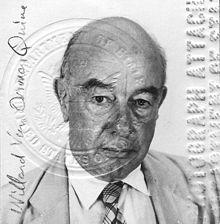
Willard Van Orman Quine

Willard Van Orman Quine was an American philosopher known for his work in logic, philosophy of science, and philosophy of language. He is considered one of the leading analytic philosophers of the 20th century. more

You May Also Like

“It is the only way I can express in words my clear and definite perception that one thing is quite distinct from another; that there is no logical connection between flying and laying eggs. It is the man who talks about “a law” that he has never seen who is the mystic. Nay, the ordinary scientific man is strictly a sentimentalist. He is a sentimentalist in this essential sense, that he is soaked and swept away by mere associations. He has so often seen birds lay and lay eggs that he feels as if there must be some dreamy, tender connection between the two ideas, whereas there is none. A forlorn lover might be unable to dissociate the moon from lost love; so the materialist is unable to dissociate the moon from the tide. In both cases there is no connection, except that one has seen them together. A sentimentalist might shed tears at the smell of apple-blossom, because, by a dark association of his own, it reminded him of his boyhood. So the materialist professor (though he conceals his tears) is yet a sentimentalist, because, by a dark association of his own, apple-blossoms remind him of apples. But the cool rationalist from fairyland does not see why, in the abstract, the apple tree should not grow crimson tulips; it sometimes does in his country.”

“Why, Anytos, I have fought as a democrat, here and in Samos, only because Sokrates taught me to think for myself. And Plato forsook the tyrants, though some were his kin, for Sokrates’ sake. He sets each man seeking the truth that is in him.” I could see him waiting for me to cease, to say what he had ready to say, exactly as if I had not spoken. I had felt easy with him, liking the way he treated every man as an equal; but it is strange to speak with someone one’s thoughts do not reach. Of a sudden it was as if a great desert surrounded me; I even felt the fear of Pan, driver of herds, as one does in lonely places.”