Quotessence
Home / Quotes / Quote by John Steinbeck

Quote by John Steinbeck

“Adam looked up with sick weariness. His lips parted and failed and tried again. Then his lungs filled. He expelled the air and his lips combed the rushing sigh. His whispered word seemed to hang in the air: "Timshel!" His eyes closed and he slept.”

Quote by John Steinbeck

Author
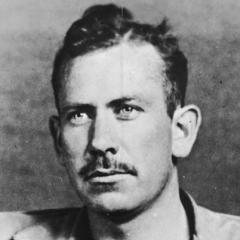
John Steinbeck
John Steinbeck

John Steinbeck was an American author renowned for his profound depiction of American society and the lives of farmers. His works often explore themes of poverty, social injustice, and human nature. Steinbeck was awarded the Nobel Prize in Literature in 1962 for his significant contribution to American literature. more

You May Also Like

“La palabra hebrea, Timshel, o sea, “tú podrás”, permite escoger. Quizás sea la palabra más importante del mundo, pues da a entender que el camino está abierto y plantea este acuciante problema: si dice “tú podrás”, también es cierto que podría decir “tú no podrás”. ¿No lo comprende? (…) El “tú podrás” hace grande al hombre, lo pone al lado de los dioses, porque a pesar de su debilidad, de su cieno y de haber dado muerte a su hermano, todavía le queda la gran libertad de escoger. Puede escoger su camino, luchar para seguirlo y vencer. La voz de Lee era un himno triunfal. -¿Y usted lo cree? –preguntó Adam. -Sí, lo creo. Lo creo. Es muy fácil salir de la pereza y de la ociosidad y arrojarse en el regazo de la divinidad, diciendo “No puedo evitarlo; el destino estaba escrito”. ¡Pero imaginen la gloria que representa la facultad de escoger! Gracias a ella el hombre es hombre. Un gato no puede escoger, una abeja está obligada a hacer miel. (…) Entonces siento que soy un hombre. Y también que un hombre es algo muy importante, acaso más importante que una estrella. (...) Experimento un nuevo amor por ese resplandeciente instrumento que es el alma humana; es algo maravilloso y único en el universo, siempre atacada y jamás destruida, gracias a ese “tú podrás”.”

“—Estaba pensando en aquel día en que Sam Hamilton, tú y yo tuvimos una larga discusión por una palabra —dijo Adam—. ¿Cuál era esa palabra? —Ah, sí. Esa palabra era timshel. —Timshel… Y tú dijiste… —Yo dije que en esa palabra se encerraba la grandeza de un hombre, si es que él quería aprovecharla. —Recuerdo que eso le causó un gran placer a Sam Hamilton. —Hizo que se sintiese libre —dijo Lee—. Le concedió el derecho de ser un hombre diferente de todos los demás. —Eso significa la soledad. —Todas las cosas grandes y preciosas son solitarias. —Dime otra vez cuál era esa palabra. —Timshel… Tú podrás.”

“Your conscience, dammit - doesn't it ever bother you?" "Why should it? I've never done anything dishonest." "Let me put it another way: do you agree things are a mess?" "Between us?" "Everywhere! The world!" She could be appallingly nearsighted. Whenever possible, she liked to reduce any generalization to terms of herself and persons she knew intimately. "Homestead, for instance." "What else could we possibly give the people that they haven't got?" "There! You made my point for me. You said, what else could we give them, as though everything in the world were ours to give or withhold." "Somebody's got to take responsibility, and that's just the way it is when somebody does." "That's just it: things haven't always been that way. It's new, and it's people like us who've brought it about. Hell, everybody used to have some personal skill or willingness to work or something he could trade for what he wanted. Now that the machines have taken over, it's quite somebody who has anything to offer. All most people can do is hope to be given something." "If someone has brains," said Anita firmly, "he can still get to the top. That's the American way, Paul, and it hasn't changed." She looked at him appraisingly. "Brains and nerve, Paul." "And blinders." The punch was gone from his voice, and he felt drugged, a drowsiness from a little too much to drink, from scrambling over a series of emotional peaks and pits, from utter frustration.”

“Legislators represent people, not trees or acres. Legislators are elected by voters, not farms or cities or economic interests. As long as ours is a representative form of government, and our legislatures are those instruments of government elected directly by and directly representative of the people, the right to elect legislators in a free and unimpaired fashion is a bedrock of our political system.”

“Representative democracy, however, harmonizes marvelously with the capitalist economic system. This new statist system, basing itself on the alleged sovereignty of the so-called will of the people, as supposedly expressed by their alleged representatives in mock popular assemblies, incorporates the two principal and necessary conditions for the progress of capitalism: state centralization, and the actual submission of the sovereign people to the intellectual governing minority, who, while claiming to represent the people, unfailingly exploits them.”

“The people are committed to ruinous policies, all without noticing. They have neither the experience nor the time to study all these laws and so they leave everything to their elected representatives. These naturally promote the interests of their class rather than the prosperity of the people, and their greatest talent is to sugarcoat their bitter measures, to render them more palatable to the populace. Representative government is a system of hypocrisy and perpetual falsehood. Its success rests on the stupidity of the people and the corruption of the public mind.”

“Representative democracy, as in, say, the United States or Great Britain, would be criticized by an anarchist of this school on two grounds. First of all because there is a monopoly of power centralized in the State, and secondly and critically—because representative democracy is limited to the political sphere and in no serious way encroaches on the economic sphere. Anarchists of this tradition have always held that democratic control of one's productive life is at the core of any serious human liberation, or, for that matter, of any significant democratic practice. That is, as long as individuals are compelled to rent themselves on the market to those who are willing to hire them, as long as their role in production is simply that of ancillary tools, then there are striking elements of coercion and oppression that make talk of democracy very limited, if even meaningful.”