Quotessence
Home / Quotes / Quote by Paramahansa Yogananda

Quote by Paramahansa Yogananda

“[The causal] body is a matrix of the 35 ideas required by God as the basic or causal thought forces. The subtle astral body [has] 19 elements The gross physical body [has] 16 elements. [These are] 16 gross metallic and nonmetallic elements. - The 19 elements of the astral body are mental, emotional and lifetronic. The 19 components are: [1] Intelligence [2] ego [3] feeling [4] mind (sense-cosnciousness) [5-9] five intruments of knowledge, the subtle counterparts of the senses of sight, hearing, smell, aste, touch, [10-14] five instruments of action, the mental correspondence for the executive abilities to procreate, excrete, talk, walk and exercise manual skill [15-19] five instruments of life force, those empowered to perform the crystallizing assimilating, eliminating, metabolizing, and circulating functions of the body. pg424, Chapter 43, The resurrection of Sri Yukteswar”

Quote by Paramahansa Yogananda

Work

Autobiography of a Yogi

This book is an autobiographical account of the Indian yogi and guru Paramahansa Yogananda. It describes his early life in India, his spiritual training under his guru Sri Yukteswar, and his eventual journey to the United States to spread the teachings of Kriya Yoga. The narrative includes stories of miraculous events, meetings with various spiritual figures, and insights into the philosophy of yoga and meditation. First published in 1946, it has been widely influential in introducing Eastern spirituality to the Western world. more

Author
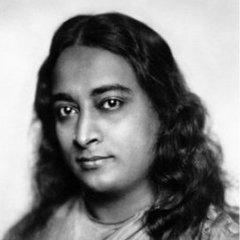
Paramahansa Yogananda

Paramahansa Yogananda was an Indian spiritual teacher born on January 5, 1893, and passed away on March 7, 1952. He is considered one of the key figures in spreading yoga and Indian spiritual philosophy in the Western world, profoundly influencing the understanding of Eastern spiritual traditions in the West. more

You May Also Like

“Is the princess still in the fitting room?" "Oh no, darling. She appeared about half an hour ago. Poured herself a black coffee, and looked longingly at the cakes. That child is starving herself if you ask me. Now she's definitely too thin. European men do like a woman to have a little meat on her bones." "And Prince Nicolas, have you seen him recently?" "I haven't seen him since lunch. I gather he and Antone went out to shoot. And I expect Max went with them. They're only happy when they're shooting something. Apart from sex of course." "Mother!" I gave her a warning frown. My mother glanced around at the other women, who were tucking into their tort with abandon. "They won't understand. Their English is hopeless, darling. Besides, it is about time you are acquainted with the facts of life. I've hopelessly neglected my duty in that area. Men only have two thoughts in their heads. And those are killing or copulating." "I'm sure there are plenty of men with finer feelings who are interested in art and culture." "Yes, darling. Of course there are. They are called ferries. And they are quite adorable. So witty and fun to be with. But in my long and varied life I've found that the ones who are witty to be with are no use in bed. And vice versa.”

“I find that some philosophers think that my whole approach to qualia is not playing fair. I don’t respect the standard rules of philosophical thought experiments. “But Dan, your view is so counterintuitive!” No kidding. That’s the whole point. Of course it is counterintuitive. Nowhere is it written that the true materialist theory of consciousness should be blandly intuitive. I have all along insisted that it may be very counterintuitive. That’s the trouble with “pure” philosophical method here. It has no resources for developing, or even taking seriously, counterintuitive theories, but since it is a very good bet that the true materialist theory of consciousness will be highly counterintuitive (like the Copernican theory--at least at first), this means that “pure” philosophy must just concede impotence and retreat into conservative conceptual anthropology until the advance of science puts it out of its misery. Philosophers have a choice: they can play games with folk concepts (ordinary language philosophy lives on, as a kind of aprioristic social anthropology) or they can take seriously the claim that some of these folk concepts are illusion-generators. The way to take that prospect seriously is to consider theories that propose revisions to those concepts.”