Quotessence
Home / Quotes / Quote by Iris Murdoch

Quote by Iris Murdoch

Work

The Green Knight

This classic tale of chivalry and adventure is set in the medieval period and explores themes of honor, bravery, and the supernatural. The protagonist, a knight, faces a daunting challenge from the enigmatic Green Knight, leading to a series of events that test his character and resolve. more
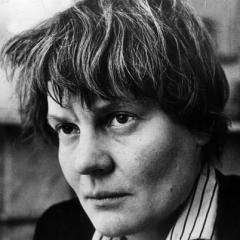
Author

Iris Murdoch
Iris Murdoch

Iris Murdoch was an Irish-Canadian philosopher and author, born on July 15, 1919, in Dublin, Ireland, and passed away on February 8, 1999. She is celebrated for her philosophical novels that intertwine moral and ethical dilemmas with complex narratives. Murdoch's work has left a lasting impact on the literary world, particularly in the latter half of the 20th century. more

You May Also Like

“In 1932 Pravda published a short story by Ilf and Petrov, titled 'How Robinson Was Created,' about a magazine editor who commissions a Soviet Robinson Crusoe from a writer named Moldavantsev. The writer submits a manuscript about a Soviet young man triumphing over nature on a desert island. The editor likes the story, but says that a Soviet Robinson would be unthinkable without a trade union committee consisting of a chairman, two permanent members, and a female activist to collect membership dues. The committee, in its turn, would be unthinkable without a safe deposit box, a chairman's bell, a pitcher of water, and a tablecloth ('red or green, it doesn't matter; I don't want to limit your artistic imagination'), and broad masses of working people. The author objects by saying that so many people could not possible be washed ashore by a single ocean wave: 'Why a wave?' asked the editor, suddenly surprised. 'How else would the masses end up on the island? It is a a desert island, after all!' 'Who said it was a desert island? You're getting me confused. Okay, so there's an island, or, even better, a peninsula. It's safer that way. And that's where a series of amusing, original, and interesting adventures will take place. There'll be some trade union work going on, but not enough. The female activist will expose certain deficiencies - in the area of due collection, for example. She'll be supported by the broad masses. And then there be the repentant chairman. At the end you could have a general meeting. That would be quite effective artistically. I guess that's about it.' 'But - what about Robinson?' stammered Moldavantsev. 'Oh yeah ..., thank for reminding me. I'm not wild about Robinson. Just drop him. He's a silly, whiny, totally unnecessary character.”

“All the mothers-in-law I have ever had were admirable. Yet the legend of the comic papers is profoundly true. It draws attention to the fact that it is much harder to be a nice mother-in-law than to be nice in any other conceivable relation of life. The caricatures have drawn the worst mother-in-law a monster, by way of expressing the fact that the best mother-in-law is a problem. The same is true of the perpetual jokes in comic papers about shrewish wives and henpecked husbands. It is all a frantic exaggeration, but it is an exaggeration of a truth; whereas all the modern mouthings about oppressed women are the exaggerations of a falsehood. If you read even the best of the intellectuals of to-day you will find them saying that in the mass of the democracy the woman is the chattel of her lord, like his bath or his bed. But if you read the comic literature of the democracy you will find that the lord hides under the bed to escape from the wrath of his chattel. This is not the fact, but it is much nearer the truth. Every man who is married knows quite well, not only that he does not regard his wife as a chattel, but that no man can conceivably ever have done so. The joke stands for an ultimate truth, and that is a subtle truth.”