Quotessence
Home / Authors / Abbas Kiarostami
Abbas Kiarostami

Abbas Kiarostami Quotes

Film director

Filter quotes by topic

Famous Abbas Kiarostami Quotes

“I want to create the type of cinema that shows by not showing. This is very different from most movies nowadays, which are not literally pornographic but are in essence pornographic, because they show so much that they take away any possibility of imagining things for ourselves. My aim is to give the chance to create as much as possible in our minds, through creativity and imagination. I want to tap the hidden information that’s within yourself and that you probably didn’t even know existed inside you.”

“I think a good film is one that has a lasting power, and you start to reconstruct it right after you leave the theater. There are a lot of films that seem to be boring, but they are decent films. On the other hand, there are films that nail you to your seat and overwhelm you to the point that you forget everything, but you feel cheated later. These are the films that take you hostage. I absolutely don’t like the films in which the filmmakers take their viewers hostage and provoke them. I prefer the films that put their audience to sleep in the theater. I think those films are kind enough to allow you a nice nap and not leave you disturbed when you leave the theater. Some films have made me doze off in the theater, but the same films have made me stay up at night, wake me up thinking about them in the morning, and keep on thinking about them for weeks. Those are the kinds of films I like.”

“What I am trying to say is that it is not without any value. The value of copies is that they can direct us towards the original. I was recently at the Louvre Museum and I was filming people who were viewing the Mona Lisa. I noticed the number of ordinary people, astonished, mouths agape, standing still for long stretches looking at the work, and I wondered, "Where does this come from? Are these people all art connoisseurs?" They are like me; through the years, we've seen this work in our schoolbooks or art history books, but when we stand before the original, we hold our breath.”

“I think the contrast between these two in the professional world of cinema mattered to me. One who has reached the ultimate point of being a star, who knows how to do everything very well, facing another person who would throughout the making of the film transfer his anxiety to both of us, to me and to Juliette, as to whether or not he would be capable of fulfilling his role. This in itself created a challenge that was actually very good for me, since I hadn't ever counterposed two such performers before, creating that challenge between someone who knows their part and someone who doesn't.”

“When the film [Certified Copy] was in the Cannes Festival, I realized that the fact of having it shot in a different culture, in a different language, in a different setting, that wasn't mine and that I didn't belong to, gave me a totally different relationship to the film. When I was sitting in the audience during the official screening in Cannes, I didn't feel that it was my film.”

“The kind of sleep that I had during my own film [Certified Copy] screening in Cannes is different. It's not because of the specificity of the film. It was because of my relationship as an author to this film. Usually when I take my films to festivals, I feel incredibly anxious about them. I wonder how it will be received, how the audience will react. I feel deeply responsible for them. Whereas this time, I didn't have that responsibility on my shoulders.”

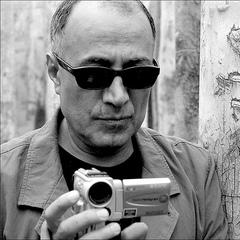
“I have received the digital camera as a blessing. It has really changed my life as a filmmaker, because I don't use my camera anymore as a camera. I don't feel it as a camera. I feel it as a friend, as something that doesn't make an impression on people, that doesn't make them feel uncomfortable, and that is completely forgotten in my way of approaching life and people and film.”

“With the RED, I didn't have this impression at all. I felt that it was as heavy as a film camera. Having this great crew, with the DP and his assistants, I found it making as much of an impression as a very big film camera. I didn't relate to it as much. I remember avoiding it during the shooting rather than paying attention to it.”

“Not that I ever felt the necessity of proving that all human beings suffer the same way, feel joy the same way, but it happened on my way - when I get close to these people, just by the simple intervention of translation I can actually reach them and ask them something, and their reaction is as I expected. I see that the relationship goes so smoothly, and I realize that cultural languages and specificities are nothing but simple obstacles that you can easily overcome. It's obvious that human beings are the same wherever they are.”

“The starting point and the ending point are nothing but two arbitrary choices. You make them as in soccer games, where they chose that it's 90 minutes, not less and not more. But the choices are the responsibility of the filmmaker. You have to choose to join the story at an arbitrary point, and you leave it at an arbitrary point.”

“Those same people, when they leave the theater, when they look behind the curtains they are curious about their neighbors, they can guess if their neighbors are siblings or a couple, how old they are, what their occupation is. They are curious about each other and they can understand each other without being fed information. Why should it be different in cinema?”