Quotessence
Home / Authors / Albert Einstein
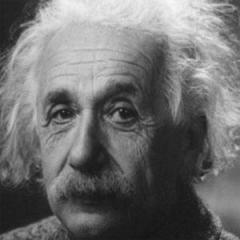
Albert Einstein

Albert Einstein Quotes

Theoretical Physicist

Filter quotes by topic

Famous Albert Einstein Quotes

“Nor do I take into account a danger of starting a chain reaction of a scope great enough to destroy part or all of the planet...But it is not necessary to imagine the earth being destroyed like a nova by a stellar explosion to understand vividly the grow ing scope of atomic war and to recognize that unless another war is prevented it is likely to bring destruction on a scale never before held possible, and even now hardly conceived, and that little civilization would survive it.”

“Human knowledge and skills alone cannot lead humanity to a happy and dignified life. Humanity has every reason to place the proclaimers of high moral standards and values above the discoverers of objective truth.”

“What Artistic and Scientific Experience Have in Common - Where the world ceases to be the scene of our personal hopes and wishes, where we face it as free beings admiring, asking, and observing, there we enter the realm of Art and Science. If what is seen and experienced is portrayed in the language of logic, we are engaged in science. If it is communicated through forms whose connections are not accessible to the conscious mind but are recognized intuitively as meaninful, then we are engaged in art. Common to both is the loving devotion to that which transcends personal concerns and volition.”

“Once again you are wrong sir, darkness does not exist either. Darkness is in reality the absence of light. Light we can study, but not darkness. In fact we can use Newton's prism to break white light into many colors and study the various wavelengths of each color. You cannot measure darkness. A simple ray of light can break into a world of darkness and illuminate it. How can you know how dark a certain space is? You measure the amount of light present. Isn't this correct? Darkness is a term used by man to describe what happens when there is no light present.”

“Evil does not exist sir, or at least it does not exist unto itself. Evil is simply the absence of God. It is just like darkness and cold, a word that man has created to describe the absence of God. God did not create evil. Evil is not like faith, or love that exist just as does light and heat. Evil is the result of what happens when man does not have God's love present in his heart. It's like the cold that comes when there is no heat or the darkness that comes when there is no light.”

“You are the only person I know who has the same attitude towards physics as I have: belief in the comprehension of reality through something basically simple and unified... It seems hard to sneak a look at God's cards. But that He plays dice and uses 'telepathic' methods... is something that I cannot believe for a single moment.”

“About God, I cannot accept any concept based on the authority of the Church... As long as I can remember. I have resented mass indoctrination. I cannot prove to you there is no personal God, but if I were to speak of him, I would be a liar. I do not believe in the God of theology who rewards good and punishes evil. His universe is not ruled by wishful thinking, but by immutable laws”

“I sometimes ask myself how it came about that I was the one to develop the theory of relativity. The reason, I think, is that a normal adult never stops to think about problems of space and time. These are things which he has thought about as a child. Bu t my intellectual development was retarded,as a result of which I began to wonder about space and time only when I had already grown up.”

“During the last century, and part of the one before, it was widely held that there was an unreconcilable conflict between knowledge and belief. The opinion prevailed amoung advanced minds that it was time that belief should be replaced increasingly by knowledge; belief that did not itself rest on knowledge was superstition, and as such had to be opposed. According to this conception, the sole function of education was to open the way to thinking and knowing, and the school, as the outstanding organ for the people's education, must serve that end exclusively.”

“The ideals which have always shone before me and filled me with the joy of living are goodness, beauty, and truth. To make a goal of comfort or happiness has never appealed to me; a system of ethics built on this basis would be sufficient only for a herd of cattle.”

“Unless Americans come to realize that they are not stronger in the world because they have the bomb but weaker because of their vulnerability to atomic attack, they are not likely to conduct their policy at Lake Success [the United Nations] or in their relations with Russia in a spirit that furthers the arrival at an understanding.”

“The real difficulty, the difficulty which has baffled the sages of all times, is rather this: how can we make our teaching so potent in the motional life of man, that its influence should withstand the pressure of the elemental psychic forces in the individual?”

“I made one great mistake in my life-when I signed the letter to President Roosevelt recommending that atom bombs be made but there was some justification-the danger that the Germans would make them.”

“My position concerning God is that of an agnostic. I am convinced that a vivid consciousness of the primary importance of moral principles for the betterment and ennoblement of life does not need the idea of a law-giver, especially a law-giver who works on the basis of reward and punishment.”

“It seems to me that the idea of a personal God is an anthropological concept which I cannot take seriously. I feel also not able to imagine some will or goal outside the human sphere. My views are near those of Spinoza: admiration for the beauty of and belief in the logical simplicity of the order which we can grasp humbly and only imperfectly. I believe that we have to content ourselves with our imperfect knowledge and understanding and treat values and moral obligations as a purely human problem-the most important of all human problems.”

“I do not believe that a man should be restrained in his daily actions by being afraid of punishment after death or that he should do things only because in this way he will be rewarded after he dies. This does not make sense. The proper guidance during the life of a man should be the weight that he puts upon ethics and the amount of consideration that he has for others.”