Quotessence
Home / Authors / Albert Einstein Books
Albert Einstein

Albert Einstein Books

Theoretical Physicist

Albert Einstein

A source page for quotes linked to Albert Einstein.
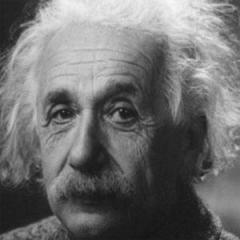
0 quotes

Related Quotes

“The timid may say, “What is the use? We shall be sent to prison.” To them I would reply: Even if only two percent of those assigned to perform military service should announce their refusal to fight, as well as urge means other than war of settling international disputes, governments would be powerless, they would not dare send such a large number of people to jail.”

“Men should continue to fight, but they should fight for things worthwhile, not for imaginary geographical lines, racial prejudices, and private greed draped in the colors of patriotism. Their arms should be weapons of the spirit, not shrapnel and tanks. Think of what a world we could build if the power unleashed in war were applied to constructive tasks! One tenth of the energy that the various belligerent spent in the World War, a fraction of the money they exploded in hand grenades and poison gas, would suffice to raise the standard of living in every country and avert the economic catastrophe of worldwide unemployment. Nothing that I can do or say will change the structure of the universe. But maybe, by raising my voice, I can help the greatest of all causes-goodwill among men and peace on earth”

“If you wish to learn from the theoretical physicist anything about the methods which he uses, I would give you the following piece of advice: Don't listen to his words, examine his achievements. For to the discoverer in that field, the constructions of his imagination appear so necessary and so natural that he is apt to treat them not as the creations of his thoughts but as given realities.”

“It is, in fact, nothing short of a miracle that the modern methods of instruction have not yet entirely strangled the holy curiosity of inquiry; for this delicate little plant, aside from stimulation, stands mainly in need of freedom; without this it goes to wreck and ruin without fail.”

“Strange is our situation here upon earth. Each of us comes for a short visit, not knowing why, yet sometimes seeming to a divine purpose. From the standpoint of daily life, however, there is one thing we do know: That we are here for the sake of other men —above all for those upon whose smile and well-being our own happiness depends, for the countless unknown souls with whose fate we are connected by a bond of sympathy. Many times a day, I realize how much my outer and inner life is built upon the labors of people, both living and dead, and how earnestly I must exert myself in order to give in return as much as I have received and am still receiving.”

“Je refuse de séjourner dans un pays où la liberté politique, la tolérance et l'égalité ne seront pas garanties par la loi. Je maintiendrai cette attitude aussi longtemps que nécessaire. Par liberté politique je comprends la liberté d'exprimer publiquement ou par écrit mon opinion politique, et par tolérance j'entends le respect de toute conviction individuelle.”

“A human being is a spatially and temporally limited piece of the whole of what we call the "universe". He experiences himself and his feelings as separated from the rest, an optical illusion of his consciousness. The quest for liberation from this bondage [or delusion] is the sole object of real religion. Not nurturing the illusion but only overcoming it gives us the attainable measure of inner peace.”

“How does it happen that a properly endowed natural scientist comes to concern himself with epistemology? Is there no more valuable work in his specialty? I hear many of my colleagues saying, and I sense it from many more, that they feel this way. I cannot share this sentiment. When I think about the ablest students whom I have encountered in my teaching, that is, those who distinguish themselves by their independence of judgment and not merely their quick-wittedness, I can affirm that they had a vigorous interest in epistemology. They happily began discussions about the goals and methods of science, and they showed unequivocally, through their tenacity in defending their views, that the subject seemed important to them. Indeed, one should not be surprised at this.”

“Science has provided the possibility of liberation for human beings from hard labor, but science itself is not a liberator. It creates means not goals. Man should use [Science] for reasonable goals. When the ideals of humanity are war and conquest, those tools become as dangerous as a razor in the hands of a child of three. We must not condemn man’s inventiveness and patient conquest of the forces of nature because they are being used wrongly and disobediently now. The fate of humanity is entirely dependent upon its moral development.”

“He who joyfully marches to music rank and file has already earned my contempt. He has been given a large brain by mistake, since for him the spinal cord would surely suffice. This disgrace to civilization should be done away with at once. Heroism at command, senseless brutality, deplorable love-of-country stance and all the loathsome nonsense that goes by the name of patriotism, how violently I hate all this, how despicable and ignoble war is; I would rather be torn to shreds than be part of so base an action! It is my conviction that killing under the cloak of war is nothing but an act of murder.”

“Honestly, I cannot understand what people mean when they talk about the freedom of the human will. I have a feeling, for instance, that I will something or other; but what relation this has with freedom I cannot understand at all. I feel that I will to light my pipe and I do it; but how can I connect this up with the idea of freedom? What is behind the act of willing to light the pipe? Another act of willing? Schopenhauer once said: Der Mensch kann was er will; er kann aber nicht wollen was er will (Man can do what he will but he cannot will what he wills).”

“It is a special blessing to belong among those who can and may devote their best energies to the contemplation and exploration of objective and timeless things. How happy and grateful I am for having been granted this blessing, which bestows upon one a large measure of independence from one's personal fate and from the attitude of one's contemporaries. Yet this independence must not inure us to the awareness of the duties that constantly bind us to the past, present and future of humankind at large. Our situation on this earth seems strange. Every one of us appears here, involuntarily and uninvited, for a short stay, without knowing the why and the wherefore. In our daily lives we feel only that man is here for the sake of others, for those whom we love and for many other beings whose fate is connected with our own. I am often troubled by the thought that my life is based to such a large extent on the work of my fellow human beings, and I am aware of my great indebtedness to them. I do not believe in free will. Schopenhauer's words: 'Man can do what he wants, but he cannot will what he wills,' accompany me in all situations throughout my life and reconcile me with the actions of others, even if they are rather painful to me. This awareness of the lack of free will keeps me from taking myself and my fellow men too seriously as acting and deciding individuals, and from losing my temper. I have never coveted affluence and luxury and even despise them a good deal. My passion for social justice has often brought me into conflict with people, as has my aversion to any obligation and dependence I did not regard as absolutely necessary. [Part 2] I have a high regard for the individual and an insuperable distaste for violence and fanaticism. All these motives have made me a passionate pacifist and antimilitarist. I am against any chauvinism, even in the guise of mere patriotism. Privileges based on position and property have always seemed to me unjust and pernicious, as does any exaggerated personality cult. I am an adherent of the ideal of democracy, although I know well the weaknesses of the democratic form of government. Social equality and economic protection of the individual have always seemed to me the important communal aims of the state. Although I am a typical loner in daily life, my consciousness of belonging to the invisible community of those who strive for truth, beauty, and justice keeps me from feeling isolated. The most beautiful and deepest experience a man can have is the sense of the mysterious. It is the underlying principle of religion as well as of all serious endeavour in art and science. He who never had this experience seems to me, if not dead, then at least blind. To sense that behind anything that can be experienced there is a something that our minds cannot grasp, whose beauty and sublimity reaches us only indirectly: this is religiousness. In this sense I am religious. To me it suffices to wonder at these secrets and to attempt humbly to grasp with my mind a mere image of the lofty structure of all there is.”