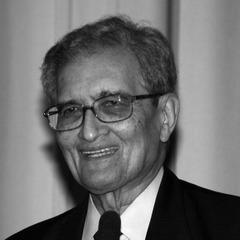
“I think that so many of our abilities to do things depend on interaction with each other.” ThinkingAbilityDependsInteraction Author:Amartya Sen
“I dont think that India is much celebrated for its democracy. Democracy has been a very neglected commodity at home and abroad.” ThinkingHas BeensHomeDemocracyIndiaCommodityNeglectedDemocracies Have Author:Amartya Sen
“I think the whole progress over the last two or three millennia has been entirely dependent on ideas and techniques and commodities and people moving from one part of the world to another. It seems difficult to take an anti-globalization view if one takes globalization properly in its full sense.” PeopleIfsThinkingWorldHas BeensTwoIdeasWholeSeemsLastsMovingThreeDifficultViewsProgressTechniqueDependentCommodityGlobalization Author:Amartya Sen
“Japan became an imperialist country in many ways, but that was much later, after it had already made big progress. I dont think Japans wealth was based on exploiting China. Japans wealth was based on its expansion in international trade.” ThinkingWayMadeCountryBigsWealthProgressTradeInternationalChinaJapanExpansionInternational Trade Author:Amartya Sen
“Its scandalous when one thinks about the people who live in a world in which they need not be hungry, in which they need not die without medical care, in which they need not be illiterate, they need not feel hopeless and miserable so much of the time, and yet they are.” PeopleThinkingWorldNeedsFeelsCareDiesMedicalHungryMiserableHopelessIlliterateMedical CareScandalous Author:Amartya Sen
“There are some people who say that theyre concerned only with poverty but not inequality. But I dont think that is a sustainable thought. A lot of poverty is, in fact, inequality because of the connection between income and capabilityhaving adequate resources to take part in the life of the community.” PeopleThinkingFactsCommunityPovertyResourcesConcernedConnectionsIncomeInequalityCapabilityAdequate Author:Amartya Sen
“Every time you have an opportunity of opening a school, its fee and funding is really relatively small in comparison with the big expenditure, which is basically quote unquote defense. I think if there were fees, progress could be very much faster. But for that we need not only the government in different countries to understand it but the society to put pressure on it, the parents to understand that their desire to have their children educated can actually be realized, and it could make a dramatic difference.” IfsThinkingNeedsChildrenDifferentCountryBigsGovernmentSchoolDesireOpportunityParentDifferencesProgressPressureDefenseOpeningEducatedFasterDramaticComparisonFundingFeesExpendituresDifferent Countries Author:Amartya Sen
“One has to bring the multidimensional impact that schooling makes in the lives of people. There's nothing like it, and I think the importance of it has to be shaken into people's understanding and determination.” PeopleThinkingUnderstandingDeterminationImportanceImpactSchooling Author:Amartya Sen
“I'm very skeptical of the amount of money that goes into military expenditure, not just in the poor countries [but] also in the rich. I think it's one of the most massive wastes in the world, but education is [at the] other end. It's the bearer of the greatest fruits that mankind has ever known.” ThinkingWorldEndsCountryPoorKnownRichMankindMilitaryAmountWasteFruitMassiveSkepticalExpendituresPoor Countries Author:Amartya Sen
“I think gender inequality is a problem that goes back a long, long time. In human society, as a whole, women have tended to have a kind of inferior position - very often combined with playing up women as great role [models].” ThinkingHumansKindLongWholeProblemRolesPositionLong TimeModelsGenderInequalityRole ModelsInferiorsHuman SocietyGender InequalityGreat Role ModelsPlaying Up Author:Amartya Sen
“In India, [in] the great documents like [the] Upanishads in eighth century B.C., you find some of the wisest [women] making great, learned speeches and then you worship them, but actually don't do very much about girls' education generally. So I think there has been a kind of dual presence of pain, respect, and saying you are great, etc., but not providing the basic facilities that make women able to lead the kind of life that they would like to and that men easily do.” ThinkingMenKindHas BeensAblePainGirlCenturySpeechWorshipIndiaEtcProvidingDocumentsFacilityWisest Author:Amartya Sen
“I think in those countries, including my own in India, where I think primary education has been badly neglected by successive governments, I blame the opposition as much. Why have they allowed the government to get away with it?” ThinkingHas BeensCountryGovernmentMy OwnIndiaBlameIncludingPrimariesOppositionGet AwayNeglectedPrimary Education Author:Amartya Sen
“The understanding that women are not inferior across the world, it's something that you can get from school, not only from the book but also from chatting with other kids. It's a big impact. One of the curious things is that even when - and this we found from studies - the schools are doing pretty badly in terms of their education, about mathematics and literature and language, going to school transformed people because I think the action of schooling, the activity, is very important.” PeopleThinkingWorldImportantBookBigsKidsActionSchoolFoundLiteratureLanguageUnderstandingTermStudyActivityMathematicsImpactCuriousTransformedInferiorsSchoolingChattingBig Impact Author:Amartya Sen
“I think the UN's role - especially since it's not an extremely rich fund, and that's to put it mildly - is mainly to act as a leading thinker of the world in terms of how to think about the future.” ThinkingWorldTermRolesRichFundThinker Author:Amartya Sen
“I think one big thing about the United States is that the American population, they may be excited about Iraq or one thing or another, but basically has had a great deal of interest in humanitarian causes both within the country and abroad. Even when they criticize the mechanism to which it flows.” ThinkingMayCountryStatesBigsCausesInterestUnitedDealsUnited StatesOne ThingFlowIraqPopulationExcitedHumanitarianCriticizeMechanismBig Things Author:Amartya Sen
“I think just as armament had a major impact of a negative kind in the world, education is something which has a major impact of a positive kind in the world. And I think the American population, with its humanity and with its concern about the future of the world, has a real reason to think about what it can do to help the world in expanding education.” ThinkingWorldKindRealReasonHelpingHumanityCan DoMajorsConcernNegativeImpactPopulationExpandingArmament Author:Amartya Sen
“The identity of just one thing, the "clash of civilization" view that you're a Muslim or a Hindu or a Buddhist or a Christian, I think that's such a limited way of seeing humanity, and schools have the opportunity to bring out the fact that we have hundreds of identities. We have our national identity. We have our cultural identity, linguistic identity, religious identity. Yes, cultural identity, professional identity, all kinds of ways.” ThinkingWayKindFactsSchoolChristianHumanityOpportunityReligiousViewsSeeingOne ThingIdentityCivilizationAll KindsBuddhistJust OneClashCultural IdentityNational IdentityClash Of CivilizationsReligious Identity Author:Amartya Sen
“I think education has a bigger impact on the lives of people than absolutely anything else.” PeopleThinkingBiggerImpact Author:Amartya Sen
“Education makes human beings more articulate. It transforms people. You can think differently about the world. It makes it possible for you to get jobs. It makes a dramatic difference. It generates a social equity that we need.” PeopleThinkingWorldNeedsHumansJobsSocialDifferencesHuman BeingsDramaticEquity Author:Amartya Sen
“I think East Asian countries, I think they're very fortunate to have Buddhism survive as a strong influence because right from the time when Buddha himself, 2,500 years ago, made the point about the importance of education, and the word "Buddha" also means enlighten[ed] or educated. So all the Buddhist countries, not only Japan and Korea and China and Hong Kong and Thailand but also even Burma and Sri Lanka, had a higher level of education.” ThinkingYearsMeanMadeCountryStrongLevelsInfluenceBuddhismHigherYears AgoImportanceChinaEastEducatedBuddhistFortunateJapanAsianKoreaEnlighteningHigher LevelHong KongThailandBurmaSri LankaImportance Of EducationAsian Countries Author:Amartya Sen
“South Korea from a country that had relatively little primary education became close to universal literacy in the course of 25, 30 years, in a way trying to replicate what Japan had done earlier. They were learning to some extent from the Japanese experience too. So I think, in a sense, the East Asians were following a path, which all other countries including South Asia could follow but chose not too.” ThinkingWayTryingYearsLittlesCountryDoneCoursesPathUniversalSouthIncludingFollowingEastPrimariesJapanOther CountriesAsiaLiteracyKoreaReplicateSouth KoreaSouth AsiaPrimary Education Author:Amartya Sen
“I don't think poverty provides that much of an obstacle to education as one thinks. I think the bigger obstacle to education is the fact that it's a very hard thing to do for a first-generation schoolgoer. Because not to have parents at home who can help you, motivate you, is a problem even when the parents are in the abstract very keen on children being educated.” ThinkingFirstsChildrenHardFactsHelpingProblemHomeParentPovertyGenerationsBiggerObstaclesEducatedThings To DoAbstractHard Things Author:Amartya Sen
“Belonging to humanity is a great thing for us, and I think the schools can do it. So I think we can look after the quality of education on the school even as we expand the availability of schooling.” ThinkingLooksSchoolHumanityCan DoQualityGreat ThingsBelongingSchoolingAvailability Author:Amartya Sen
“I was told Indian women don't think like that about equality. But I would like to argue that if they don't think like that they should be given a real opportunity to think like that.” IfsThinkingShouldRealOpportunityGivenWomenEqualityArguingIndianWomens Rights Author:Amartya Sen