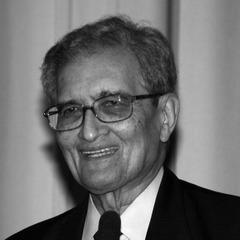
“When I was giving a lecture in India, the capabilities that I have to be concerned with there, namely the ability of people to go to a school, to be literate, to be able to have a basic health care everywhere, to be able to seek some kind of medical response to one's ailment; these become central issues in the Indian context which they're not in the UK, because you're well beyond that.” PeopleGivingWellsKindCareAbleSchoolAbilityIssuesConcernedIndiaResponseMedicalHealth CareIndianCapabilityLecturesAilments Author:Amartya Sen
“Famines occur under a colonial administration, like the British Raj in India or for that matter in Ireland, or under military dictators in one country after another, like Somalia and Ethiopia, or in one-party states like the Soviet Union and China.” CountryMatterStatesPartyMilitaryIndiaUnionsChinaBritishAdministrationSovietIrelandDictatorSoviet UnionFamineEthiopiaSomalia Author:Amartya Sen
“I dont think that India is much celebrated for its democracy. Democracy has been a very neglected commodity at home and abroad.” ThinkingHas BeensHomeDemocracyIndiaCommodityNeglectedDemocracies Have Author:Amartya Sen
“Theres a clear and strong connection between fertility reduction and womens literacy and empowerment, including womens gainful employment. If you look at the more than 300 districts of India, the strongest influences in explaining fertility variations are womens literacy and gainful economic employment.” IfsLooksStrongClearInfluenceEconomicEmpowermentConnectionsIndiaIncludingEmploymentStrongestLiteracyExplainingVariationReductionFertilityStrong Connection Author:Amartya Sen
“The anti-globalization movement is one of the biggest globalized events of the contemporary world, people coming from everywhere, Australia, Indonesia, Britain, India, Poland, Germany, South Africato demonstrate in Seattle or Quebec. What could be more global than that?” PeopleWorldEventsMovementIndiaSouthContemporaryGermanyBritainAustraliaSouth AfricaGlobalizationIndonesiaSeattlePolandQuebec Author:Amartya Sen
“In India, [in] the great documents like [the] Upanishads in eighth century B.C., you find some of the wisest [women] making great, learned speeches and then you worship them, but actually don't do very much about girls' education generally. So I think there has been a kind of dual presence of pain, respect, and saying you are great, etc., but not providing the basic facilities that make women able to lead the kind of life that they would like to and that men easily do.” ThinkingMenKindHas BeensAblePainGirlCenturySpeechWorshipIndiaEtcProvidingDocumentsFacilityWisest Author:Amartya Sen
“Even in areas like the most depressed region of India in terms of female education, namely Rajasthan, which has [one of] the lowest female literacy [rates] in India. Even there, 80 to 90 percent of the parents would like their girls to go to school. And indeed, about 80 percent would like them to be made compulsory.” MadeSchoolGirlParentTermPercentAreasFemaleIndiaRateRegionsLowestLiteracyCompulsoryFemale Education Author:Amartya Sen
“I think in those countries, including my own in India, where I think primary education has been badly neglected by successive governments, I blame the opposition as much. Why have they allowed the government to get away with it?” ThinkingHas BeensCountryGovernmentMy OwnIndiaBlameIncludingPrimariesOppositionGet AwayNeglectedPrimary Education Author:Amartya Sen
“The higher education has always appealed to the South Asian social leaders across all the countries in South Asia. But primary education has been neglected. The oddity, by the way, is if you look at the contrast in India, there are some areas like Kerala where there's a long history of educational development.” IfsWayLooksLongHas BeensCountrySocialLeaderDevelopmentHigherAreasIndiaSouthEducationalPrimariesContrastAsiaAsianNeglectedHigher EducationOdditiesSouth AsiaPrimary Education Author:Amartya Sen
“When the Nobel award came my way, it also gave me an opportunity to do something immediate and practical about my old obsessions, including literacy, basic health care and gender equity, aimed specifically at India and Bangladesh.” WayCareOpportunityIndiaIncludingGenderPracticalsObsessionMy WayHealth CareAwardsLiteracyEquityNobelBangladesh Author:Amartya Sen
“Famines are easy to prevent if there is a serious effort to do so, and a democratic government, facing elections and criticisms from opposition parties and independent newspapers, cannot help but make such an effort. Not surprisingly, while India continued to have famines under British rule right up to independence... they disappeared suddenly with the establishment of a multiparty democracy and... a free press and an active political opposition constitute the best early-warning system a country threaten by famines can have.” IfsCountryHelpingGovernmentPoliticalEasyPartyEffortDemocracySeriousCriticismIndiaIndependentElectionIndependencePressesDemocraticBritishActiveNewspapersOppositionWarningEstablishmentFamineFree PressDemocratic GovernmentOpposition PartiesBritish Rule Author:Amartya Sen