Quotessence
Home / Authors / Charles Darwin
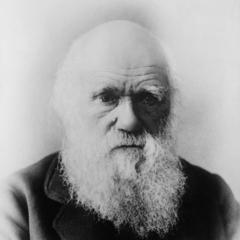
Charles Darwin

Charles Darwin Quotes

Naturalist

Filter quotes by topic

Famous Charles Darwin Quotes

“The love of a dog for his master is notorious; in the agony of death he has been known to caress his master, and everyone has heard of the dog suffering under vivisection, who licked the hand of the operator; this man, unless he had a heart of stone, must have felt remorse to the last hour of his life.”

“The explanation of types of structure in classes - as resulting from the will of the Deity, to create animals on certain plans - is no explanation. It has not the character of a physical law and is therefore utterly useless. It foretells nothing because we know nothing of the will of the Deity, how it acts and whether constant or inconstant like that of man.”

“Mr. J.S. Mill speaks, in his celebrated work, "Utilitarianism," of the social feelings as a "powerful natural sentiment," and as "the natural basis of sentiment for utilitarian morality," but on the previous page he says, "if, as is my own belief, the moral feelings are not innate, but acquired, they are not for that reason less natural." It is with hesitation that I venture to differ from so profound a thinker, but it can hardly be disputed that the social feelings are instinctive or innate in the lower animals; and why should they not be so in man?”

“At last gleams of light have come, and I am almost convinced (quite contrary to opinion I started with) that species are not (it is like confessing a murder) immutable. Heaven forfend me from Lamarck nonsense of a 'tendency to progression', 'adaptations from the slow willing of animals', &c! But the conclusions I am led to are not widely different from his; though the means of change are wholly so. I think I have found out (here's presumption!) the simple way by which species become exquisitely adapted to various ends.”

“After my return to England it appeared to me that by following the example of Lyell in Geology, and by collecting all facts which bore in any way on the variation of animals and plants under domestication and nature, some light might perhaps be thrown on the whole subject.”

“The love for all living creatures is the most noble attribute of man.”

“But then with me the horrid doubt always arises whether the convictions of man's mind, which has been developed from the mind of the lower animals, are of any value or at all trustworthy. Would any one trust in the convictions of a monkey's mind, if there are any convictions in such a mind?”

“The number of humble-bees in any district depends in a great degree on the number of field-mice, which destroy their combs and nests; and Mr. H. Newman, who has long attended to the habits of humble-bees, ... says "Near villages and small towns I have found the nests of humble-bees more numerous than elsewhere, which I attribute to the number of cats that destroy the mice." Hence it is quite credible that the presence of a feline animal in large numbers in a district might determine, through the intervention first of mice and then of bees, the frequency of certain flowers in that district!”

“The plow is one of the most ancient and most valuable of man's inventions; but long before he existed the land was in fact regularly plowed, and still continues to be thus plowed by earthworms. It may be doubted whether there are many other animals which have played so important a part in the history of the world, as have these lowly organized creatures.”

“Of all the differences between man and the lower animals, the moral sense or conscience is by far the most important. This sense, as Mackintosh remarks, "has a rightful supremacy over every other principle of human action"; it is summed up in that short but imperious word "ought," so full of high significance. It is the most noble of all the attributes of man, leading him without a moment's hesitation to risk his life for that of a fellow-creature; or after due deliberation, impelled simply by the deep feeling of right or duty, to sacrifice it in some great cause.”

“We have seen that the senses and intuitions, the various emotions and faculties, such as love, memory, attention and curiosity, imitation, reason, etc., of which man boasts, may be found in an incipient, or even sometimes in a well-developed condition, in the lower animals.”

“The lower animals, on the other hand, must have their bodily structure modified in order to survive under greatly changed conditions. They must be rendered stronger, or acquire more effective teeth or claws, in order to defend themselves from new enemies; or they must be reduced in size so as to escape detection and danger. When they migrate into a colder climate they must become clothed with thicker fur, or have their constitutions altered. If they fail to be thus modified, they will cease to exist.”

“The following proposition seems to me in a high degree probable—namely, that any animal whatever, endowed with well-marked social instincts, the parental and filial affections being here included, would inevitably acquire a moral sense or conscience, as soon as its intellectual powers had become as well, or nearly as well developed, as in man. For, firstly, the social instincts lead an animal to take pleasure in the society of its fellows, to feel a certain amount of sympathy with them, and to perform various services for them.”

“In the long history of humankind (and animal kind, too) those who learned to collaborate and improvise most effectively have prevailed.”

“In however complex a manner this feeling may have originated, as it is one of high importance to all those animals which aid and defend one another, it will have been increased through natural selection; for those communities, which included the greatest number of the most sympathetic members, would flourish best, and rear the greatest number of offspring.”

“With savages, the weak in body or mind are soon eliminated. We civilized men, on the other hand, do our utmost to check the process of elimination. We build asylums for the imbecile, the maimed and the sick. Thus the weak members of civilized societies propagate their kind. No one who has attended to the breeding of domestic animals will doubt that this must be highly injurious to the race of man. Hardly anyone is so ignorant as to allow his worst animals to breed.”