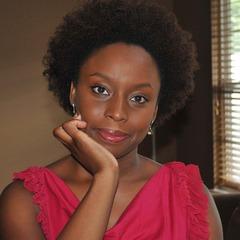
“I taught an introductory creative writing class at Princeton last year and, in addition to the classic ‘show don’t tell’, I often told my students that their fiction needed to have ’emotional truth’ […]: a quality different from honesty and more resilient than fact, a quality that existed not in the kind of fiction that explains but in the kind of fiction that shows. All the novels I love, the ones I remember, the ones I re-read, have this empathetic human quality. And because I write the kind of fiction I like to read, when I started Half of a Yellow Sun […], I hoped that emotional truth would be its major recognizable trait. […] Successful fiction does not need to be validated by ‘real life’; I cringe whenever a writer is asked how much of a novel is ‘real’. Yet, […] to write realistic fiction about war, especially one central to the history of one’s own country, is to be constantly aware of a responsibility to something larger than art. While writing Half of a Yellow Sun, I enjoyed playing with minor things [such as inventing a train station in a town that has none]. Yet I did not play with the central events of that time. I could not let a character be changed by anything that had not actually happened. If fiction is indeed the soul of history, then I was equally committed to the fiction and the history, equally keen to be true to the spirit of the time as well as to artistic vision of it. The writing itself was a bruising experience. […] But there were also moments of extravagant joy when I recognized, in a character or moment or scene, that quality of emotional truth.” In the Shadow of Biafra (essay included in the 2007 Harper Perennial edition of Half of a Yellow Sun).” WritingFictionHistoryHistorical FictionArtistic VisionEmotional TruthTrue FactsVerifiability Author:Chimamanda Ngozi Adichie
“I write from real life. I am an unrepentant eavesdropper and a collector of stories. I record bits of overheard dialogue.” WritingRealStoriesBitsRecordsReal LifeDialogueCollectors Author:Chimamanda Ngozi Adichie
“I didn't want to be apologetic about my love story, and I think to be willing to write about love you have to be willing to sound foolish. I wanted to write about foolish and goofy love and different relationships. I wanted to write about interracial relationships in a way that does not pretend as if race does not exist.” IfsThinkingWayWantWritingDoeDifferentStoriesWantedSoundRaceLove YouWillingFoolishLove StoryGoofyApologeticDifferent Relationships Author:Chimamanda Ngozi Adichie
“I can write with authority only about what I know well, which means that I end up using surface details of my own life in my fiction.” KnowsWritingWellsMeanI CanEndsMy OwnFictionAuthorityDetailsSurfaceMy Own Life Author:Chimamanda Ngozi Adichie
“I think human beings exist in a social world. I write realistic fiction, and so it isn't that surprising that the social realities of their existence would be part of the story.” ThinkingWorldWritingHumansStoriesRealityWould BeSocialHuman BeingsExistenceFictionRealisticSurprisingRealistic Fiction Author:Chimamanda Ngozi Adichie
“I don't believe that art and politics or social issues must be separated. In writing about marriage, for example, money can be a big factor, and money is linked to earning, and earning is influenced by politics.” WritingBelieveArtBigsSocialIssuesExampleDon't BelieveFactorsEarningLinkedSocial Issues Author:Chimamanda Ngozi Adichie
“My grandfather died in the war, my family went through the war, and it affected my parents in really profound ways. I've always wanted to write about that period - in some ways to digest it for myself, something that defined me but that I didn't go through.” WayWritingWarWantedParentPeriodsMy FamilyDiedProfoundDefinedAffectedGrandfatherMy GrandfatherFather DiedGrandfather Died Author:Chimamanda Ngozi Adichie
“If the government doesn't fund education, which they often don't, students are going to stay home and not go to school. It affects them directly. But I'm really not interested in writing explicitly about that. I'm really interested in human beings, and in love, and in family. Somehow, politics comes in.” IfsWritingHumansHomeGovernmentSchoolHuman BeingsStudentsFundNot Interested Author:Chimamanda Ngozi Adichie
“When the writing is going well, I'm obsessive. I don't shower, I don't take phone calls, I hardly respond to text messages, I don't do email. I take breaks only to read, and usually I read poetry. When it's not going well, I just lie in bed and eat chocolate.” WritingLyingBreakChocolateObsessiveText Message Author:Chimamanda Ngozi Adichie
“Creative writing programmes are not very necessary. They just exist so that people like us can make a living.” PeopleWritingCreativeCreative WritingProgrammes Author:Chimamanda Ngozi Adichie
“Richard exhaled. It was like somebody sprinkling pepper on his wound: Thousands of Biafrans were dead, and this man wanted to know if there was anything new about one dead white man. Richard would write about this, the rule of Western journalism: One hundred dead black people equal to one dead white person.” PeopleIfsKnowsMenWritingPersonsWantedBlackWhiteEqualRacismHundredWesternWoundsJournalismBlack PeopleWhite ManPeppers Author:Chimamanda Ngozi Adichie
“You can't write a script in your mind and then force yourself to follow it. You have to let yourself be.” WritingMindForceInspiringScriptsYellow Sun Book:Half of a Yellow Sun Source: Half of a Yellow Sun
“Americans think African writers will write about the exotic, about wildlife, poverty, maybe AIDS. They come to Africa and African books with certain expectations.” ThinkingWritingBookCertainPovertyExpectationsAidsWildlifeExotic Author:Chimamanda Ngozi Adichie
“I think my first general rule is that most of my experiences are not that interesting. It's usually other people's experiences. It's not that entirely conscious. Somebody tells me a story or, you know, repeats an anecdote that somebody else told them and I just feel like I have to write it down so I don't forget - that means for me, something made it fiction-worthy. Interesting things never happen to me, so maybe two or three times when they do, I have to use them, so I write them down.” PeopleThinkingKnowsFeelsWritingFirstsMeanMadeTwoStoriesUseHappensThreeForgetInterestingFictionConsciousWorthyMade ItRepeatsThree TimesInteresting ThingsAnecdotes Author:Chimamanda Ngozi Adichie
“I had people read it early on and, you know, well-meaning people said to me, you should take out the blogs. I didn't get much positive feedback. Only because most of these people were protective of me - it was sort of like a "tone it down, make it easier to swallow" kind of thing. And I just thought if I do that then it's not the book I want to write.” PeopleIfsKnowsWantShouldWritingWellsKindSaidBookEasierToneFeedbackBlogsProtectivePositive Feedback Author:Chimamanda Ngozi Adichie