Quotessence
Home / Authors / Immanuel Kant
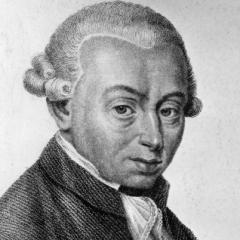
Immanuel Kant

Immanuel Kant Quotes

Philosopher

Filter quotes by topic

Famous Immanuel Kant Quotes

“An age cannot bind itself and ordain to put the succeeding one into such a condition that it cannot extend its (at best very occasional) knowledge , purify itself of errors, and progress in general enlightenment. That would be a crime against human nature, the proper destination of which lies precisely in this progress and the descendants would be fully justified in rejecting those decrees as having been made in an unwarranted and malicious manner. The touchstone of everything that can be concluded as a law for a people lies in the question whether the people could have imposed such a law on itself.”

“No-one can compel me to be happy in accordance with his conception of the welfare of others, for each may seek his happiness in whatever way he sees fit, so long as he does not infringe upon the freedom of others to pursue a similar end which can be reconciled with the freedom of everyone else within a workable general law ? i.e. he must accord to others the same right as he enjoys himself.”

“Since the narrower or wider community of the peoples of the earth has developed so far that a violation of rights in one place is felt throughout the world, the idea of a cosmopolitan right is not fantastical, high-flown or exaggerated notion. It is a complement to the unwritten code of the civil and international law, necessary for the public rights of mankind in general and thus for the realization of perpetual peace.”

“Enthusiasm is always connected with the senses, whatever be the object that excites it. The true strength of virtue is serenity of mind, combined with a deliberate and steadfast determination to execute her laws. That is the healthful condition of the moral life; on the other hand, enthusiasm, even when excited by representations of goodness, is a brilliant but feverish glow which leaves only exhaustion and languor behind.”

“Two things fill the mind with ever new and increasing admiration and awe, the more often and steadily we reflect upon them: the starry heavens above me and the moral law within me. I do not seek or conjecture either of them as if they were veiled obscurities or extravagances beyond the horizon of my vision; I see them before me and connect them immediately with the consciousness of my existence.”

“Act only according to that maxim whereby you can at the same time will that it should become a universal law.”

“. . . as to moral feeling, this supposed special sense, the appeal to it is indeed superficial when those who cannot think believe that feeling will help them out, even in what concerns general laws: and besides, feelings which naturally differ infinitely in degree cannot furnish a uniform standard of good and evil, nor has any one a right to form judgments for others by his own feelings. . . .”

“Deaths, births, and marriages, considering how much they are separately dependent on the freedom of the human will, should seem to be subject to no law according to which any calculation could be made beforehand of their amount; and yet the yearly registers of these events in great countries prove that they go on with as much conformity to the laws of nature as the oscillations of the weather.”