Quotessence
Home / Authors / John Dewey
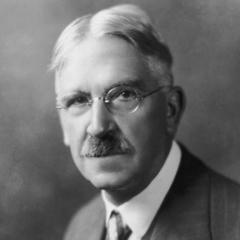
John Dewey

John Dewey Quotes

Philosopher

Filter quotes by topic

Famous John Dewey Quotes

“With respect to the development of powers devoted to coping with specific scientific and economic problems we may say that the child should be growing in manhood. With respect to sympathetic curiosity, unbiased responsiveness, and openness of mind, we may say that the adult should be growing in childlikeness.”

“Each generation is inclined to educate its young so as to get along in the present world instead of with a view to the proper end of education: the promotion of the best possible realization of humanity as humanity. Parents educate their children so that they may get on; princes educate their subjects as instruments of their own purpose.”

“It may be seriously questioned whether the philosophies... which isolate mind and set it over against the world did not have their origin in the fact that the reflective or theoretical class of men elaborated a large stock of ideas which social conditions did not allow them to act upon and test. Consequently men were thrown back into their own thoughts as ends in themselves.”

“The development of science has produced an industrial revolution which has brought different peoples in such close contact with one another through colonization and commerce that no matter how some nations may still look down upon others, no country can harbor the illusion that its career is decided wholly within itself.”

“A large part of the art of instruction lies in making the difficulty of new problems large enough to challenge thought, and small enough so that, in addition to the confusion naturally attending the novel elements, there shall be luminous familiar spots from which helpful suggestions may spring.”

“While the living thing may easily be crushed by superior force, it none the less tries to turn the energies which act upon it into means of its own further existence. If it cannot do so, it does not just split into smaller pieces (at least in the higher forms of life), but loses its identity as a living thing.”

“The importance of language in gaining knowledge is doubtless the chief cause of the common notion that knowledge may be passed directly from one to another. It almost seems as if all we have to do to convey an idea into the mind of another is to convey a sound into his ear. Thus imparting knowledge gets assimilated to a purely physical process.”

“In general it may be said that the things which we take for granted without inquiry or reflection are just the things which determine our conscious thinking and decide our conclusions. And these habitudes which lie below the level of reflection are just those which have been formed in the constant give and take of relationship with others.”

“Individuals are certainly interested, at times, in having their own way, and their own way may go contrary to the ways of others. But they are also interested, and chiefly interested upon the whole, in entering into the activities of others and taking part in conjoint and cooperative doings. Otherwise, no such thing as a community would be possible.”

“The theory of the method of knowing which is advanced in these pages may be termed pragmatic. ... Only that which has been organized into our disposition so as to enable us to adapt the environment to our needs and adapt our aims and desires to the situation in which we live is really knowledge.”

“Democracy is a way of life controlled by a working faith in the possibilities of human nature. . . . This faith may be enacted in statutes, but it is only on paper unless it is put in force in the attitudes which human beings display to one another in all the incidents and relations of daily life.”

“In the present state of the world, it is evident that the control we have gained of physical energies, heat, light, electricity, etc., without having first secured control of our use of ourselves is a perilous affair. Without the control of our use of ourselves, our use of other things is blind; it may lead to anything.”

“It science involves an intelligent and persistent endeavor to revise current beliefs so as to weed out what is erroneous, to add to their accuracy, and, above all, to give them such shape that the dependencies of the various facts upon one another may be as obvious as possible.”

“No thought, no idea, can possibly be conveyed as an idea from one person to another. When it is told it is to the one to whom it is told another fact, not an idea. The communication may stimulate the other person to realize the question for himself and to think out a like idea, or it may smother his intellectual interest and suppress his dawning effort at thought. But what he directly gets cannot be an idea. Only by wrestling with the conditions of the problem at first hand, seeking and finding his own way out, does he think.”