Quotessence
Home / Authors / John F. Kennedy
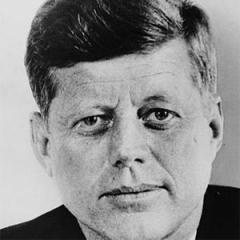
John F. Kennedy

John F. Kennedy Quotes

35th U.S. President

Filter quotes by topic

Famous John F. Kennedy Quotes

“Our practical choice is not between a tax-cut deficit and a budgetary surplus. It is between two kinds of deficits: a chronic deficit of inertia, as the unwanted result of inadequate revenues and a restricted economy; or a temporary deficit of transition, resulting from a tax cut designed to boost the economy, increase tax revenues, and achieve -- and I believe this can be done -- a budget surplus. The first type of deficit is a sign of waste and weakness; the second reflects an investment in the future.”

“For in a government of laws and not of men, no man, however prominent or powerful, and no mob however unruly or boisterous, is entitled to defy a court of law. If this country should ever reach the point where any man or group of men by force or threat of force could long defy the commands of our court and our Constitution, then no law would stand free from doubt, no judge would be sure of his writ, and no citizen would be safe from his neighbors.”

“Third, and finally, the educated citizen has an obligation to uphold the law. This is the obligation of every citizen in a free and peaceful society--but the educated citizen has a special responsibility by the virtue of his greater understanding. For whether he has ever studied history or current events, ethics or civics, the rules of a profession or the tools of a trade, he knows that only a respect for the law makes it possible for free men to dwell together in peace and progress.”

“First, what does truth require? It requires us to face the facts as they are, not to involve ourselves in self-deception; to refuse to think merely in slogans. If we are to work for the future of the city, let us deal with the realities as they actually are, not as they might have been, and not as we wish they were.”

“There is danger that totalitarian governments, not subject to vigorous popular debate, will underestimate the will and unity of democratic societies where vital interests are concerned.”

“Members of the Congress, the Constitution makes us not rivals for power but partners for progress. We are all trustees for the American people, custodians of the American heritage. It is my task to report the State of the Union--to improve it is the task of us all.”

“I think when we talk about corporal punishment, and we have to think about our own children, and we are rather reluctant, it seems to me, to have other people administering punishment to our own children, because we are reluctant, it puts a special obligation on us to maintain order and to send children out from our homes who accept the idea of discipline. So I would not be for corporal punishment in the school, but I would be for very strong discipline at home so we don't place an unfair burden on our teachers.”

“President Roosevelt and President Truman and President Eisenhower had the same experience, they all made the effort to get along with the Russians. But every time, finally it failed. And the reason it failed was because the Communists are determined to destroy us, and regardless of what hand of friendship we may hold out or what arguments we may put up, the only thing that will make that decisive difference is the strength of the United States.”

“Our Constitution wisely assigns both joint and separate roles to each branch of the government; and a President and a Congress who hold each other in mutual respect will neither permit nor attempt any trespass.”

“And lastly, Chairman Khrushchev has compared the United States to a worn-out runner living on its past performance, and stated that the Soviet Union would out-produce the United States by 1970. Without wishing to trade hyperbole with the Chairman, I do suggest that he reminds me of the tiger hunter who has picked a place on the wall to hang the tiger's skin long before he his caught the tiger. This tiger has other ideas.”

“After visiting these places, you can easily understand how that within a few years Hitler will emerge from the hatred that surrounds him now as one of the most significant figures who ever lived. He had boundless ambition for his country which rendered him a menace to the peace of the world, but he had a mystery about him in the way that he lived and in the manner of his death that will live and grow after him. He had in him the stuff of which legends are made.”

“The deadly arms race, and the huge resources it absorbs, have too long overshadowed all else we must do. We must prevent that arms race from spreading to new nations, to new nuclear powers and to the reaches of outer space.”

“The education of our people should be a lifelong process by which we continue to feed new vigor into the lifestream of the Nation through intelligent, reasoned decisions. Let us not think of education only in terms of its costs, but rather in terms of the infinite potential of the human mind that can be realized through education. Let us think of education as the means of developing our greatest abilities, because in each of us there is a private hope and dream which, fulfilled, can be translated into benefit for everyone and greater strength for our Nation.”

“The very word "secrecy" is repugnant in a free and open society; and we are as a people inherently and historically opposed to secret societies, to secret oaths and to secret proceedings. We decided long ago that the dangers of excessive and unwarranted concealment of pertinent facts far outweighed the dangers which are cited to justify it. Even today, there is little value in opposing the threat of a closed society by imitating its arbitrary restrictions. Even today, there is little value in insuring the survival of our nation if our traditions do not survive with it.”

“It should be clear by now that a nation can be no stronger abroad than she is at home. Only an America which practices what it preaches about equal rights and social justice will be respected by those whose choice affects our future. Only an America which has fully educated its citizens is fully capable of tackling the complex problems and perceiving the hidden dangers of the world in which we live. And only an America which is growing and prospering economically can sustain the worldwide defenses of freedom, while demonstrating to all concerned the opportunities of our system and society.”

“As a great democratic society, we have a special responsibility to the arts. For art is the great democrat, calling forth creative genius from every sector of society, disregarding race or religion or wealth or color. What freedom alone can bring is the liberation of the human mind and a spirit which finds its greatest flowering in the free society. I see of little more importance to the future of our country and our civilization than the full recognition of the place of the artist.”

“No man who enters upon the office to which I have succeeded can fail to recognize how every president of the United States has placed special reliance upon his faith in God. Every president has taken comfort and courage when toldthat the Lord 'will be with thee. He will not fail thee nor forsake thee. Fear not-neither be thou dismayed.' Each of our presidents in his own way has placed a special trust in God. Those who were strongest intellectually were also strongest spiritually.”

“If a beach-head of cooperation may push back the jungle of suspicion, let both sides join in creating a new endeavor, not a new balance of power, but a new world of law, where the strong are just and the weak secure and the peace preserved. All this will not be finished in the first one hundred days. Nor will it be finished in the first one thousand days, nor in the life of this Administration, nor even perhaps in our lifetime on this planet. But let us begin.”

“Collective bargaining has always been the bedrock of the American labor movement. I hope that you will continue to anchor your movement to this foundation. Free collective bargaining is good for the entire Nation. In my view, it is the only alternative to State regulation of wages and prices - a path which leads far down the grim road of totalitarianism. Those who would destroy or further limit the rights of organized labor - those who would cripple collective bargaining or prevent organization of the unorganized - do a disservice to the cause of democracy.”