Quotessence
Home / Authors / Lord Byron Books
Lord Byron

Lord Byron Books

Baron Byron

DON JUAN

A source page for quotes linked to Lord Byron.
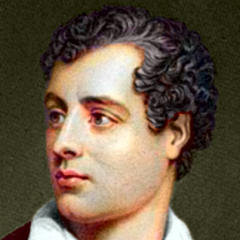
0 quotes

Manfred

A source page for quotes linked to Lord Byron.

0 quotes

Lara

A source page for quotes linked to Lord Byron.

0 quotes

Related Quotes

“He thought about himself, and the whole earth Of man the wonderful, and of the stars, And how the deuce they ever could have birth; And then he thought of earthquakes, and of wars, How many miles the moon might have in girth, Of air-balloons, and of the many bars To perfect knowledge of the boundless skies;— And then he thought of Donna Julia’s eyes. In thoughts like these true wisdom may discern Longings sublime, and aspirations high, Which some are born with, but the most part learn To plague themselves withal, they know not why: ’Twas strange that one so young should thus concern His brain about the action of the sky; If you think ’twas philosophy that this did, I can’t help thinking puberty assisted.”

“I should like, I think, to die of consumption; it is so romantic; and the symptoms are so agreeable! What a pity it is that it is so slow in its approaches, that we must be so long about dying of it; and then, too, there is so much coughing and groaning, so little dignity in the thing,--in short, I never could perceive any thing to admire in consumption but its name and the name is its best part.”

“The day drags through though storms keep out the sun; And thus the heart will break, yet brokenly live on: Even as a broken mirror, which the glass In every fragment multiplies; and makes A thousand images of one that was, The same, and still the more, the more it breaks; And thus the heart will do which not forsakes, Living in shattered guise, and still, and cold, And bloodless, with its sleepless sorrow aches, Yet withers on till all without is old, Showing no visible sign, for such things are untold.”

“From my youth upwards My Spirit walked not with the souls of men, Nor looked upon the earth with human eyes; The thirst of their ambition was not mine, The aim of their existence was not mine; My joy was in the wilderness—to breathe the difficult air of the iced mountain's top, Where the birds dare not build—nor insect's wing. These were my pastimes, and to be alone; For if the beings, of whom I was one—Hating to be so—crossed me in my path, I felt myself degraded back to them, And was all clay again. And then I dived, In my lone wanderings, to the caves of Death, Searching its cause in its effect; and drew from withered bones, and skulls, and heaped up dust conclusions most forbidden.”

“Too high for common selfishness , he could At times resign his own for others' good, But not in pity - not because he ought, But in some strange perversity of thought, That swayed him onward with a secred pride To do what few or none could do beside; And this same impulse would, in tempting time, Mislead his spirit equally to crime; So much he soared beyond, or sank beneath, The men with whom he felt condemned to breathe And longed by good or ill to seperate Himself from all who shared his mortal fate.”

“Too high for common selfishness, he could At times resign his own for others’ good, But not in pity, not because he ought, But in some strange perversity of thought, That swayed him onward with a secret pride To do what few or none would do beside; And this same impulse would, in tempting time, Mislead his spirit equally in crime; So much he soared beyond, or sunk beneath, The men with whom he felt condemned to breathe, And longed by good or ill to separate Himself from all who shared his mortal state.”

“We'll Go No More A-roving So, we'll go no more a-roving So late into the night, Though the heart still be as loving, And the moon still be as bright. For the sword outwears its sheath, And the soul wears out the breast, And the heart must pause to breathe, And love itself have rest. Though the night was made for loving, And the day returns too soon, Yet we'll go no more a-roving By the light of the moon.”

“I hate inconstancy—I loathe, detest, Abhor, condemn, abjure the mortal made Of such quicksilver clay that in his breast No permanent foundation can be laid; Love, constant love, has been my constant guest, And yet last night, being at a masquerade, I saw the prettiest creature, fresh from Milan, Which gave me some sensations like a villain. But soon Philosophy came to my aid, And whisper’d, ‘Think of every sacred tie!’ ‘I will, my dear Philosophy!’ I said, ‘But then her teeth, and then, oh, Heaven! her eye! I’ll just inquire if she be wife or maid, Or neither—out of curiosity.’ ‘Stop!’ cried Philosophy, with air so Grecian (Though she was masqued then as a fair Venetian); ‘Stop!’ so I stopp’d.—But to return: that which Men call inconstancy is nothing more Than admiration due where nature’s rich Profusion with young beauty covers o’er Some favour’d object; and as in the niche A lovely statue we almost adore, This sort of adoration of the real Is but a heightening of the ‘beau ideal.’ ’Tis the perception of the beautiful, A fine extension of the faculties, Platonic, universal, wonderful, Drawn from the stars, and filter’d through the skies, Without which life would be extremely dull; In short, it is the use of our own eyes, With one or two small senses added, just To hint that flesh is form’d of fiery dust. Yet ’tis a painful feeling, and unwilling, For surely if we always could perceive In the same object graces quite as killing As when she rose upon us like an Eve, ’Twould save us many a heartache, many a shilling (For we must get them any how or grieve), Whereas if one sole lady pleased for ever, How pleasant for the heart as well as liver! The heart is like the sky, a part of heaven, But changes night and day, too, like the sky; Now o’er it clouds and thunder must be driven, And darkness and destruction as on high: But when it hath been scorch’d, and pierced, and riven, Its storms expire in water-drops; the eye Pours forth at last the heart’s blood turn’d to tears, Which make the English climate of our years.”