Quotessence
Home / Authors / Marcus Tullius Cicero Books
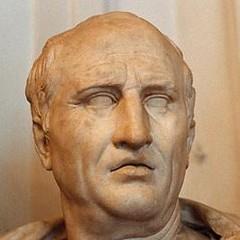
Marcus Tullius Cicero

Marcus Tullius Cicero Books

Philosopher

Philippics

A source page for quotes linked to Marcus Tullius Cicero.
0 quotes

Select orations

A source page for quotes linked to Marcus Tullius Cicero.

0 quotes

Selected Letters

A source page for quotes linked to Marcus Tullius Cicero.

0 quotes

Related Quotes

“Now in regard to trades and other means of livelihood, which ones are to be considered becoming to a gentleman and which ones are vulgar, we have been taught, in general, as follows. First, those means of livelihood are rejected as undesirable which incur people's ill-will, as those of tax-gatherers and usurers. Unbecoming to a gentleman, too, and vulgar are the means of livelihood of all hired workmen whom we pay for mere manual labour, not for artistic skill; for in their case the very wage they receive is a pledge of their slavery. Vulgar we must consider those also who buy from wholesale merchants to retail immediately; for they would get no profits without a great deal of downright lying; and verily, there is no action that is meaner than misrepresentation. And all mechanics are engaged in vulgar trades; for no workshop can have anything liberal about it. Least respectable of all are those trades which cater for sensual pleasures.”

“Osons non seulement couper les branches de nos malheurs, mais arracher tous les filaments de leurs racines. Peut-être pourtant en restera-t-il quelque chose, tellement sont profondes les souches de la déraison ; mais il ne restera que le nécessaire. Ainsi tiens pour certains que, si l'âme ne guérit pas (ce qui est impossible sans la philosophie), il n'y aura pas de fins à nos misères. Aussi, puisque nous avons commencé, confions-nous à elle pour être soignés ; nous guérirons si nous le voulons.”

“There is a story that Simonides was dining at the house of a wealthy nobleman named Scopas at Crannon in Thessaly, and chanted a lyric poem which he had composed in honor of his host, in which he followed the custom of the poets by including for decorative purposes a long passage referring to Castor and Pollux; whereupon Scopas with excessive meanness told him he would pay him half the fee agreed on for the poem, and if he liked he might apply for the balance to his sons of Tyndaraus, as they had gone halves in the panegyric. The story runs that a little later a message was brought to Simonides to go outside, as two young men were standing at the door who earnestly requested him to come out; so he rose from his seat and went out, and could not see anybody; but in the interval of his absence the roof of the hall where Scopas was giving the banquet fell in, crushing Scopas himself and his relations underneath the ruins and killing them; and when their friends wanted to bury them but were altogether unable to know them apart as they had been completely crushed, the story goes that Simonides was enabled by his recollection of the place in which each of them had been reclining at table to identify them for separate interment; and that this circumstance suggested to him the discovery of the truth that the best aid to clearness of memory consists in orderly arrangement. He inferred that persons desiring to train this faculty must select localities and form mental images of the facts they wish to remember and store those images in the localities, with the result that the arrangement of the localities will preserve the order of the facts, and the images of the facts will designate the facts themselves, and we shall employ the localities and images respectively as a wax writing tablet and the letters written on it.”

“Il me semble que cette méditation anticipée des malheurs humains produit presque le même effet que la guérison obtenue avec le temps, sinon que, dans le premier cas, c'est le raisonnement qui guérit, et dans le second, la nature ; mais on comprend l'essentiel, à savoir que le mal tenu pour le plus grand de tous n'est jamais si grand qu'il puisse détruire la vie heureuse.”

“So let this be the first and sacred law of friendship: seek only good from friends, do only good for the sake of friends- and don't wait to be asked! Be always attentive! Banish hesitation! Be ready to give advice freely! Take seriously the good advice of friends. Be ready to offer it openly, even forcefully, if the occasion demands- and also be ready to follow when it's been offered.”

“Thou knowest how numerous this tribe is, how united and how powerful in the assemblies. I will plead in a low voice so that only the judges may hear, for instigators are not lacking to stir up the crowd against me, and against all the best citizens. To scorn, in the interest of the Republic, this multitude of Jews so often turbulent in the assemblies shows a singular strength of mind. The money is in the Treasury; they do not accuse us of theft; they seek to stir up hatreds.”

“For every man's nature is concealed with many folds of disguise, and covered as it were with various veils. His brows, his eyes, and very often his countenance, are deceitful, and his speech is most commonly a lie.”

“The precept, "Know yourself," was not solely intended to obviate the pride of mankind; but likewise that we might understand our own worth.”