Quotessence
Home / Authors / Ralph Waldo Emerson Books
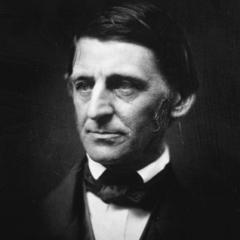
Ralph Waldo Emerson

Ralph Waldo Emerson Books

Essayist

Poems

A source page for quotes linked to Ralph Waldo Emerson.
0 quotes

The Over-Soul

A source page for quotes linked to Ralph Waldo Emerson.

0 quotes

The Poet

A source page for quotes linked to Ralph Waldo Emerson.

0 quotes

Emerson: Poems

A source page for quotes linked to Ralph Waldo Emerson.

0 quotes

Related Quotes

“Valor consists in the power of self-recovery, so that a man cannot have his flank turned, cannot be out-generalled, but put him where you will, he stands. This can only be by his preferring truth to his past apprehension of truth; and his alert acceptance of it, from whatever quarter; the intrepid conviction that his laws, his relations to society, his Christianity, his world may at any time be superseded and decease.”

“When we are young, we spend much time and pains in filling our note-books with all definitions of Religion, Love, Poetry, Politics, Art, in the hope that, in the course of a few years, we shall have condensed into our encyclopaedia the net value of all the theories at which the world has yet arrived. But year after year our tables get no completeness, and at last we discover that our curve is a parabola, whose arcs will never meet.”

“Napoleon said of Massena, that he was not himself until the battle began to go against him; then, when the dead began to fall in ranks around him, awoke his powers of combination, and he put on terror and victory as a robe. So it is in rugged crises, in unweariable endurance, and in aims which put sympathy out of question, that the angel is shown.”

“Crime and punishment grow out of one stem. Punishment is a fruit that unsuspected ripens within the flower of the pleasure which concealed it. Cause and effect, means and ends, seed and fruit, cannot be severed; for the effect already blooms in the cause, the end preexists in the means, the fruit in the seed.”

“Everybody we know surrounds himself with a fine house, fine books, conservatory, gardens, equipage, and all manner of toys, as screens to interpose between himself and his guest. Does it not seem as if man was of a very sly, elusive nature, and dreaded nothing so much as a full rencontre front to front with his fellow?”

“This outlook, one that said that American history must be the history of nature speaking through men, not of men shaping nature, became the single most powerful force in American intellectual life in the nineteenth century and shaped some of America's greatest works of literature, such as Moby Dick, Leaves of Grass and Walden, as well as generating an American school of philosophy , to be furthered by William James and John Dewey.”

“It facilitates labor and thought so much that there is always the temptation in large schools to omit the endless task of meeting the wants of each single mind, and to govern by steam. But it is at frightful cost. Our modes of Education aim to expedite, to save labor; to do for masses what cannot be done for masses, what must be done reverently, one by one: say rather, the whole world is needed for the tuition of each pupil.”

“They should own who can administer, not they who hoard and conceal; not they who, the greater proprietors they are, are only the greater beggars, but they whose work carves out work for more, opens a path for all. For he is the rich man in whom the people are rich, and he is the poor man in whom the people are poor; and how to give all access to the masterpieces of art and nature is the problem of civilization.”

“Another point of economy is to look for seed of the same kind as you sow, and not to hope to buy one kind with an other kind. Friendship buys friendship; justice, justice; military merit, military success...Yet there is commonly a confusion of expectations on these points. Hotspur lives for the moment, praises himself for it, and despises Furlong, that he does not. Hotspur of course is poor, and Furlong is a good provider. The odd circumstance is that Hotspur thinks it a superiority in himself, this improvidence, which ought to be rewarded with Furlong's lands.”

“That law of nature whereby everything climbs to higher platforms, and bodily vigor becomes mental and moral vigor. The bread he eats is first strength and animal spirits; it becomes, in higher laboratories, imagery and thought; and in still higher results, courage and endurance. This is the right compound interest; this is capital doubled, quadrupled, centupled; man raised to his highest power. The true thrift is always to spend on the higher plane; to invest and invest, with keener avarice, that he may spend in spiritual creation and not in augmenting animal existence.”

“The virtues are economists, but some of the vices are also...Pride is handsome, economical; pride eradicates so many vices, letting none subsist but itself, that it seems as if it were a great gain to exchange vanity for pride. Pride can go without domestics, without fine clothes, can live in a house with two rooms, can eat potato, purslain, beans, lyed corn, can work on the soil, can travel afoot, can talk with poor men, or sit silent well contented in fine saloons. But vanity costs money, labor, horses, men, women, health and peace, and is still nothing at last; a long way leading nowhere. Only one drawback; proud people are intolerably selfish, and the vain are gentle and giving.”

“If you are noble, I will love you; if you are not, I will not hurt you and myself by hypocritical attentions. If you are true, but not in the same truth with me, cleave to your companions; I will seek my own. I do this not selfishly, but humbly and truly. It is alike your interest, and mine, and all men's, however long we have dwelt in lies, to live in truth.”

“Man is timid and apologetic; he is no longer upright; he dares not say "I think," "I am," but quotes some saint or sage. He is ashamed before the blade of grass or the blowing rose. These roses under my window make no reference to former roses or to better ones; they are for what they are; they exist with God to-day. There is no time to them. There is simply the rose; it is perfect in every moment of its existence. Before a leaf-bud has burst, its whole life acts; in the full-blown flower there is no more; in the leafless root there is no less. Its nature is satisfied, and it satisfies nature, in all moments alike. But man postpones or remembers; he does not live in the present, but with reverted eye laments the past, or, heedless of the riches that surround him, stands on tiptoe to foresee the future. He cannot be happy and strong until he too lives with nature in the present, above time.”

“If the finest genius studies at one of our colleges, and is not installed in an office within one year afterwards in the cities or suburbs of Boston or New York, it seems to his friends and to himself that he is right in being disheartened, and in complaining the rest of his life. A sturdy lad from New Hampshire or Vermont, who in turn tries all the professions, who teams it, farms it, peddles, keeps a school, preaches, edits a newspaper, goes to Congress, buys a township, and so forth, in successive years, and always, like a cat, falls on his feet, is worth a hundred of these city dolls. He walks abreast with his days, and feels no shame in not 'studying a profession,' for he does not postpone his life, but lives already.”

“Those who are esteemed umpires of taste, are often persons who have acquired some knowledge of admired pictures or sculptures, and have an inclination for whatever is elegant; but if you inquire whether they are beautiful souls, and whether their own acts are like fair pictures, you learn that they are selfish and sensual. Their cultivation is local, as if you should rub a log of dry wood in one spot to produce fire, all the rest remaining cold. Their knowledge of the fine arts is some study of rules and particulars, or some limited judgment of color or form which is exercised for amusement or for show. It is a proof of the shallowness of the doctrine of beauty, as it lies in the minds of our amateurs, that men seem to have lost the perception of the instant dependence of form upon soul.”

“One man thinks justice consists in paying debts, and has no measure in his abhorrence of another who is very remiss in this duty and makes the creditor wait tediously. But that second man has his own way of looking at things; asks himself Which debt must I pay first, the debt to the rich, or the debt to the poor? the debt of money or the debt of thought to mankind, of genius to nature? For you, O broker, there is not other principle but arithmetic. For me, commerce is of trivial import; love, faith, truth of character, the aspiration of man, these are sacred;”

“Nothing is quite beautiful alone; nothing but is beautiful in the whole. A single object is only so far beautiful as it suggests this universal grace. The poet, the painter, the sculptor, the musician, the architect, seek each to concentrate this radiance of the world on one point, and each in his several work to satisfy the love of beauty which stimulates him to produce. Thus is Art, a nature passed through the alembic of man. Thus in art, does nature work through the will of a man filled with the beauty of her first works.”