Quotessence
Home / Authors / Sogyal Rinpoche
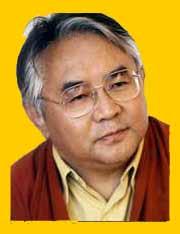
Sogyal Rinpoche

Sogyal Rinpoche Quotes

Lama

Filter quotes by topic

Famous Sogyal Rinpoche Quotes

“When you have learned, through discipline, to simplify your life, and so practiced the mindfulness of meditation, and through it loosened the hold of aggression, clinging, and negativity on your whole being, the wisdom of insight can slowly dawn. And in the all-revealing clarity of its sunlight, this insight can show you, distinctly and directly, both the subtlest workings of your own mind and the nature of reality.”

“What most of us need, almost more than anything, is the courage and humility really to ask for help, from the depths of our hearts: to ask for the compassion of the enlightened beings, to ask for purification and healing, to ask for the power to understand the meaning of our suffering and transform it; at a relative level to ask for the growth in our lives of clarity, peace, and discernment, and to ask for the realization of the absolute nature of mind that comes from merging with the deathless wisdom mind of the master.”

“Modern civilization is largely devoted to the pursuit of the cult of delusion. There is no general information about the nature of mind. It is hardly ever written about by writers or intellectuals; modern philosophers do not speak of it directly; the majority of scientists deny it could possibly be there at all. It plays no part in popular culture: no one sings about it, no one talks about it in plays, and it's not on TV. We are actually educated into believing that nothing is real beyond what we can perceive with our ordinary senses.”

“In meditation take care not to impose anything on the mind, or to tax it. When you meditate there should be no effort to control, and no attempt to be peaceful. Don't be overly solemn or feel that you are taking part in some special ritual; let go even of the idea that you are meditating. Let your body remain as it is, your breath as you find it, and remain in your natural condition of unchanging pure awareness.”

“Devote the mind to confusion and we know only too well, if we´re honest, that it will become a dark master of confusion, adept in its addictions, subtle and perversely supple in its slaveries. Devote it in meditation to the task of freeing itself from illusion, and we will find that, with time, patience, discipline, and the right training, our mind will begin to unknot itself and know its essential bliss and clarity.”

“We often wonder: "How will I be when I die?" The answer to that is that whatever state of mind we are in now, whatever kind of person we are now, that's what we will be like at the moment of death, if we do not change. This is why it is so absolutely important to use this lifetime to purify our mindstream, and so our basic being and character, while we can.”

“I remember how people would often come to see my master Jamyang Khyentse simply to ask for his guidance for the moment of death. He was so loved and revered throughout Tibet, especially in the eastern province of Kham, that some would travel for months on end to meet him and get his blessing just once before they died. All my masters would give this as their advice, for this is the essence of what is needed as you come to die: "Be free of attachment and aversion. Keep your mind pure. And unite your mind with Buddha."”

“If all we know of mind is the aspect of mind that dissolves when we die, we will be left with no idea of what continues, no knowledge of the new dimension of the deeper reality of the nature of mind. So it is vital for us all to familiarize ourselves with the nature of mind while we are still alive. Only then will we be prepared for the time when it reveals itself spontaneously and powerfully at the moment of death; be able to recognize it "as naturally," the teachings say, "as a child running into its mother's lap"; and by remaining in that state, finally be liberated.”

“At the moment of death, there are two things that count: whatever we have done in our lives, and what state of mind we are in at that very moment. Even if we have accumulated a lot of negative karma, if we are able to make a real change of heart at the moment of death, it can decisively influence our future, and transform our karma, for the moment of death is an exceptionally powerful opportunity to purify karma.”

“Devotion {to the spiritual master} becomes the purest, quickest, and simplest way to realize the nature of our mind and all things. As we progress in it, the process reveals itself as wonderfully interdependent: We, from our side, try continually to generate devotion; the devotion we arouse itself generates glimpses of the nature of mind, and these glimpses only enhance and deepen our devotion to the master who is inspiring us. So in the end devotion springs out of wisdom: devotion and the living experience of the nature of mind becomes inseparable, and inspire one another.”

“. . . when the nature of mind is introduced by a master, it is just too simple for us to believe. Our ordinary mind tells us this cannot be, there must be something more to it than this. It must surely be more "glorious", with light blazing in space around us, angels with flowing golden hair swooping down to meet us, and a deep Wizard of Oz voice announcing, "Now you have been introduced to the nature of your mind." There is no such drama.”

“{While meditating} I sit quietly and rest in the nature of mind; I don't question or doubt whether I am in the "correct" state or not. There is no effort, only rich understanding, wakefulness, and unshakable certainty. When I am in the nature of mind, the ordinary mind is no longer there. There is no need to sustain or confirm a sense of being: I simply am.”

“At the beginning of meditation training thoughts will arrive one on top of another, uninterrupted, like a steep mountain waterfall. Gradually, as you perfect meditation, thoughts become like the water in a deep, narrow gorge, then a great river slowly winding its way down to the sea; finally the mind becomes like a still and placid ocean, ruffled by only the occasional ripple or wave.”