Quotessence
Home / Authors / Swami Vivekananda
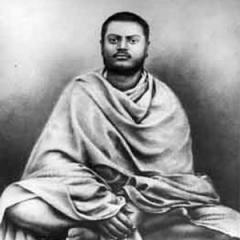
Swami Vivekananda

Swami Vivekananda Quotes

Author

Filter quotes by topic

Famous Swami Vivekananda Quotes

“Renunciation - non-resistance - non-destructiveness - are the ideals to be attained through less and less worldliness, less and less resistance, less and less destructiveness. Keep the ideal in view and work towards it. None can live in the world without resistance, without destruction, without desire. The world has not come to that state yet when the ideal can be realised in society.”

“There can be no love so long as there is lust- even a speck of it, as it were, in the heart. None but men of great renunciation, none but mighty giants among men, have a right to that Love Divine. If that highest ideal of love is held out to the masses, it will indirectly tend to stimulate its worldly which dominates the heart of man- for, meditating on love to God by thinking of oneself as His wife or beloved, one would very likely be thinking most of the time of one's own wife- the result is too obvious to point out.”

“In the world take always the position of the giver. Give everything and look for no return. Give love, give help, give service, give any little thing you can, but keep out barter. Make no conditions and none will be imposed on you. Let us give out of our own bounty, just as God gives to us.”

“Feel, my children, feel; feel for the poor, the ignorant, the downtrodden; feel till the heart stops and the brain reels and you think you will go mad; then pour the soul out at the feet of the Lord, and then will come power, help and indomitable energy.”

“The more we grow in love and virtue and holiness, the more we see love and virtue and holiness outside. All condemnation of others really condemns ourselves. Adjust the microcosm (which is in your power to do) and the macrocosm will adjust itself for you. It is like the hydrostatic paradox, one drop of water can balance the universe.”

“The goal of mankind is knowledge ... Now this knowledge is inherent in man. No knowledge comes from outside: it is all inside. What we say a man 'knows', should, in strict psychological language, be what he 'discovers' or 'unveils'; what man 'learns' is really what he discovers by taking the cover off his own soul, which is a mine of infinite knowledge.”

“At the head of all these laws, in and through every particle of matter and force, stands One through whose command the wind blows, the fire burns, the clouds rain, and death stalks upon the earth. And what is His nature? He is everywhere the pure and formless One, the Almighty and the All Merciful. Thou art our Father. Thou art our beloved Friend.”

“He is everywhere, the pure and formless One, the Almighty and the All-merciful. "Thou art our father, Thou art our mother, Thou art our beloved friend, Thou art the source of all strength; give us strength. Thou art He that beareth the burdens of the universe; help me bear the little burden of this life." Thus sang the Rishis of the Vedas. And how to worship Him? Through love. "He is to be worshipped as the one beloved, dearer than everything in this and the next life."”

“Only love for the Supreme Lord is true Bhakti. Love for any other being, however great, is not Bhakti. The "Supreme Lord" here means Ishvara, the concept of which transcends what you in the West mean by the personal God. "He from whom this universe proceeds, in whom it rests, and to whom it returns, He is Ishvara, the Eternal, the Pure, the All-Merciful, the Almighty, the Ever-Free, the All-Knowing, the Teacher of all teachers, the Lord who of His own nature is inexpressible Love."”