Quotessence
Home / Authors / Thornton Wilder Books
Thornton Wilder

Thornton Wilder Books

Playwright

Our Town

A source page for quotes linked to Thornton Wilder.
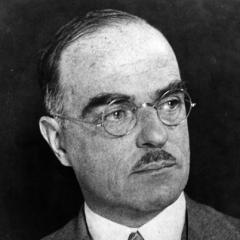
0 quotes

Related Quotes

“This assumption that she need look for no more devotion now that her beauty had passed proceeded from the fact that she had never realized any love save love as passion. Such love, though it expends itself in generosity and thoughtfulness, though it give birth to visions and to great poetry, remains among the sharpest expressions of self-interest. Not until it has passed through a long servitude, through its own self-hatred, through mockery, through great doubts, can it take its place among the loyalties. Many who have spent a lifetime in it can tell us less of love than the child that lost a dog yesterday.”

“There was something in Lima that was wrappd up in yards of violet satin from which protruded a great dropsical head and two fat pearly hands; and that was its archbishop. Between the rolls of flesh that surrounded them looked out two black eyes speaking discomfort, kindliness, and wit. A curious and eager soul was imprisoned in all this lard, but by dint of never refusing himself a pheasant or a goose or his daily procession of Roman wines, he was his own bitter jailer. He loved his cathedral; he loved his duties; he was very devout. Some days he regarded his bulk ruefully; but the distress of remorse was less poignant than the distress of fasting, and he was presently found deliberating over the secret messages that a certain roast sends to the certain salad that will follow it. And to punish himself he led an exemplary life in every other respect. He had read all the literature of antiquity and forgotten all about it except a general aroma of charm and disillusion. He had been learned in the Fathers and the Councils and forgotten all about them save a floating impression of dissensions that had no application to Peru. He had read all the libertine masterpieces of Italy and France and reread them annually;”

“She resembled the swallow in the fable who once every thousand years transferred a grain of wheat, in the hope of rearing a mountain to reach the moon. Such persons are raised up in every age; they obstinately insist on transporting their grains of wheat and they derive a certain exhilaration from the sneers of the bystanders. “How queerly they dress!” we cry. “How queerly they dress!”

“Cesar is not a philosophical man. His life has been one long flight from reflection. At least he is clever enough not to expose the poverty of his general ideas; he never permits the conversation to move toward philosophical principles. Men of his type so dread all deliberation that they glory in the practice of the instantaneous decision. They think they are saving themselves from irresolution; in reality they are sparing themselves the contemplation of all the consequences of their acts. Moreover, in this way they can rejoice in the illusion of never having made a mistake; for act follows so swiftly on act that it is impossible to reconstruct the past and say that an alternative decision would have been better. They can pretend that every act was forced on them under emergency and that every decision was mothered by necessity”

“It required all his delicate Epicurean education to prevent his doing something about it; he had to repeat over to himself his favorite notions: that the injustice and unhappiness in the world is a constant; that the theory of progress is a delusion; that the poor, never having known happiness, are insensible to misfortune. Like all the rich he could not bring himself to believe that the poor (look at their houses, look at their clothes) could really suffer. Like all the cultivated he believed that only the widely read could be said to know that they were unhappy.”

“Most of all, however, these observances attack and undermine the very spirit of life within the minds of men. They afford to our Romans, from the street sweepers to the consuls, a vague sense of confidence where no confidence is and at the same time a pervasive fear, a fear which neither arouses to action nor calls forth ingenuity, but which paralyzes. They remove from men's shoulders the unremitting obligation to create, moment by moment, their own Rome. They come to us sanctioned by the usage of our ancestors and breathing the security of our childhood; they flatter passivity and console inadequacy”

“The great law of art is uniformity of tone; since it cannot record all experience, its fidelity to its chosen fragment of experience implies its consciousness of all experience as a similar though more variegated uniformity of tone. (To intrude into a work an unrelated tone is to imply that one is incorporating the ‘all,’ a presumption that speaks volumes on the author’s inability to grasp experience’s multiplicity.) Here lies the greatness of Jane Austen: her perfection in the small implies her comprehension of the large.”

“Yes, now you know. Now you know! That's what it was to be alive. To move about in a cloud of ignorance; to go up and down trampling on the feelings of those...of those about you. To spend and waste time as though you had a million years. To be always at the mercy of one self-centered passion, or another. Now you know — that's the happy existence you wanted to go back to. Ignorance and blindness.”