Quotessence
Home / Authors / Wallace Stegner Books
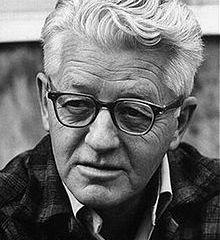
Wallace Stegner

Wallace Stegner Books

Historian

Angle of Repose

A source page for quotes linked to Wallace Stegner.
0 quotes

Wolf Willow

A source page for quotes linked to Wallace Stegner.

0 quotes

Related Quotes

“I am deep in my willed habits. From the outside, I suppose I look like an unoccupied house with one unconvincing night-light left on. Any burglar could look through my curtains and conclude I am empty. But he would be mistaken. Under that one light unstirred by movement or shadows there is a man at work, and as long as I am at work I am not a candidate for Menlo Park, or that terminal facility they cynically call a convalescent hospital, or a pine box. My habits and the unchanging season sustain me. Evil is what questions and disrupts.”

“I wouldn't live in a colony like that, myself, for a thousand dollars an hour. I wouldn't want it next door. I'm not too happy it's within ten miles. Why? Because their soft-headedness irritates me. Because their beautiful thinking ignores both history and human nature. Because they'd spoil my thing with their thing. Because I don't think any of them is wise enough to play God and create a human society. Look. I like privacy, I don't like crowds, I don't like noise, I don't like anarchy, I don't even like discussion all that much. I prefer study, which is very different from meditation-not better, different. I don't like children who are part of the wild life. So are polecats and rats and other sorts of hostile and untrained vermin. I want to make a distinction between civilization and the wild life. I want a society that will protect the wild life without confusing itself with it.”

“It is not an unusual life curve for Westerners - to live i n and be shaped by the bigness, sparseness, space clarity & hopefulness of the West, to go away for study and enlargement and the perspective that distance and dissatisfaction can give, and then to return to what pleases the sight and enlists the loyalty and demands the commitment.”

“The moderns, carrying little baggage of the kind that Shelly called "merely cultural," not even living in the traditional air, but breathing into their space helmets a scientific mixture of synthetic gases (and polluted at that) are the true pioneers. Their circuitry seems to include no atavistic domestic sentiment, they have suffered empathectomy, their computers hum no ghostly feedback of Home, Sweet Home. How marvelously free they are! How unutterably deprived!”

“Marian’s eyes absolutely blaze. To meet them is to have a shock of contact as if they were electrically charged. “Now you see? You wondered what was in whale’s milk. Don’t you know now? The same thing that’s in a mushroom spore so small you need a microscope to see it, or in gophers, or poison oak, or anything else we try to pave under or grub out, or poison. There isn’t good life and bad life, there’s only life. Think of the force down there, just telling things to get born!”

“Before I can say I am, I was. Heraclitus and I, prophets of flux, know that the flux is composed of parts that imitate and repeat each other. Am or was, I am cumulative, too. I am everything I ever was, whatever you and Leah may think. I am much of what my parents and especially my grandparents were -- inherited stature, coloring, brains, bones (that part unfortunate), plus transmitted prejudices, culture, scruples, likings, moralities, and moral errors that I defend as if they were personal and not familial.”

“I would like to hear your life as you heard it, coming at you, instead of hearing it as I do, a sober sound of expectations reduced, desires blunted, hopes deferred or abandoned, chances lost, defeats accepted, griefs borne. I don't find your life uninteresting, as Rodman does. I would like to hear it as it sounded while it was passing. Having no future of my own, why shouldn't I look forward to yours.”

“I can't see that Danish episode as an adventure, or a crisis survived, or a serious quest for anything definable. It was just another happening like today's luncheon, something I got into and got out of. And it reminds me too much of how little life changes: how, without dramatic events or high resolves, without tragedy, without even pathos, a reasonably endowed, reasonably well-intentioned man can walk through the world's great kitchen from end to end and arrive at the back door hungry.”

“…the understanding of any person is an exercise in genealogy. A man is not a static organism to be taken apart and analyzed and classified. A man is movement, motion, a continuum. There is no beginning to him. He runs through his ancestors, and the only beginning is the primal beginning of the single cell in the slime. The proper study of mankind is man, but man is an endless curve on the eternal graph paper, and who can see the whole curve?”

“There must be some other possibility than death or lifelong penance ... some meeting, some intersection of lines; and some cowardly, hopeful geometer in my brain tells me it is the angle at which two lines prop each other up, the leaning-together from the vertical which produces the false arch. For lack of a keystone, the false arch may be as much as one can expect in this life. Only the very lucky discover the keystone.”

“Ideas, of course, have a place in fiction, and any writer of fiction needs a mind. But ideas are not the best subject matter for fiction. They do not dramatize well. They are, rather, a by-product, something the reader himself is led to formulate after watching the story unfold. The ideas, the generalizations, ought to be implicit in the selection and arrangement of the people and places and actions. They ought to haunt a piece of fiction as a ghost flits past an attic window after dark.”

“We have been cut off, the past has been ended and the family has broken up and the present is adrift in its wheelchair. ... That is no gap between the generations, that is a gulf. The elements have changed, there are whole new orders of magnitude and kind. [...] My grandparents had to live their way out of one world and into another, or into several others, making new out of old the way corals live their reef upward. I am on my grandparents' side. I believe in Time, as they did, and in the life chronological rather than in the life existential. We live in time and through it, we build our huts in its ruins, or used to, and we cannot afford all these abandonings.”

“[The modern age] knows nothing about isolation and nothing about silence. In our quietest and loneliest hour the automatic ice-maker in the refrigerator will cluck and drop an ice cube, the automatic dishwasher will sigh through its changes, a plane will drone over, the nearest freeway will vibrate the air. Red and white lights will pass in the sky, lights will shine along highways and glance off windows. There is always a radio that can be turned to some all-night station, or a television set to turn artificial moonlight into the flickering images of the late show. We can put on a turntable whatever consolation we most respond to, Mozart or Copland or the Grateful Dead.”

“What do you mean, 'Angle of Repose?' she asked me when I dreamed we were talking about Grandmother's life, and I said it was the angle at which a man or woman finally lies down. I suppose it is; and yet ... I thought when I began, and still think, that there was another angle in all those years when she was growing old and older and very old, and Grandfather was matching her year for year, a separate line that did not intersect with hers. They were vertical people, they lived by pride, and it is only by the ocular illusion of perspective that they can be said to have met. But he had not been dead two months when she lay down and died too, and that may indicate that at that absolute vanishing point they did intersect. They had intersected for years, for more than he especially would ever admit.”

“I am terribly glad to be alive; and when I have wit enough to think about it, terribly proud to be a man and an American, with all the rights and privileges that those words connote; and most of all I am humble before the responsibilities that are also mine. For no right comes without a responsibility, and being born luckier than most of the world's millions, I am also born more obligated.”

“To try to save for everyone, for the hostile and independent as well as the committed, some of the health that flows down across the green ridges from the skyline, and some of the beauty and spirit that are still available to any resident of the valley who has a moment and the wit to lift up his eyes unto the hills.”

“Homesickness is a great teacher. It taught me, during an endless rainy fall, that I came from the arid lands, and like where I came from. I was used to dry clarity and sharpness in the air. I was used to horizons that either lifted into jagged ranges or rimmed the geometrical circle of the flat world. I was used to seeing a long way. I was used to earth colors--tan, rusty red, toned white--and the endless green of Iowa offended me. I was used to a sun that came up over mountains and went down behind other mountains. I missed the color and smell of sagebrush, and the sight of bare ground.”