Quotessence
Home / Quotes / Quote by Karl Popper

Quote by Karl Popper

“Is the world ruled by strict laws or not? This question I regard as metaphysical. The laws we find are always hypotheses; which means that they may always be superseded, and that they may possibly be deduced from probability estimates. Yet denying causality would be the same as attempting to persuade the theorist to give up his search; and that such an attempt cannot be backed by anything like a proof.”

Quote by Karl Popper

Work

The Logic of Scientific Discovery

This book delves into the nature of scientific knowledge, examining the methods and criteria that distinguish scientific theories from other forms of knowledge. It discusses the role of empirical evidence, the structure of scientific theories, and the process of scientific discovery. more

Author
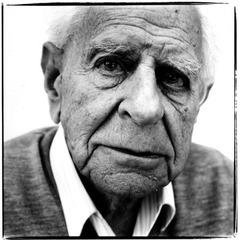
Karl Popper
Karl Popper

Karl Popper (July 28, 1902 – September 17, 1994) was an influential philosopher known for his work on critical rationalism and falsificationism. He is renowned for his contributions to the philosophy of science, political philosophy, and epistemology, with his ideas having a profound impact on these fields. more

You May Also Like

“It is not intuitive ease I am after, but rather a point of view which is sufficiently definite to clear up some difficulties, and to be criticized in rational terms. (Bohr's complementarity cannot be so criticized, I fear; it can only be accepted or denounced - perhaps as being ad hoc, or as being irrational, or as being hopelessly vague.)”

“The routine of custom tends to deaden even scientific inquiry; it stands in the way of discovery and of the active scientific worker. For discovery and inquiry are synonymous as an occupation. Science is a pursuit, not a coming into possession of the immutable; new theories as points of view are more prized than discoveries that quantitatively increase the store on hand.”

“It is not truly realistic or scientific to take short views, to sacrifice the future to immediate pressure, to ignore facts and forces that are disagreeable and to magnify the enduring quality of whatever falls in with immediate desire. It is false that the evils of the situation arise from absence of ideals; they spring from wrong ideals.”

“Intelligent thinking means an increment of freedom in action-an emancipation from chance and fatality. 'Thought' represents the suggestion of a way of response that is different from that which would have been followed if intelligent observation had not effected an inference as to the future.”

“It is quite clear to me that the religious paradise of youth, which [I] lost, was a first attempt to free myself from the chains of the 'merely personal,' from an existence which is dominated by wishes, hopes, and primitive feelings.”

“Part of the power of Emerson's individualism is his insistence, at crucial moments, that individualism does not mean isolation or self-sufficiency. This is not a paradox, for it is only the strong individual who can frankly concede the sometimes surprising extent of his own dependence.”