Quotessence
Home / Quotes / Quote by Ronald Reagan

Quote by Ronald Reagan

“Abraham Lincoln freed the black man. In many ways, Dr. King freed the white man. How did he accomplish this tremendous feat? Where others - white and black - preached hatred, he taught the principles of love and nonviolence.”

Quote by Ronald Reagan

Work

Speaking my mind: selected speeches

This book compiles a selection of speeches delivered by the author, offering insight into their communication skills and viewpoints on a range of subjects. more

Author
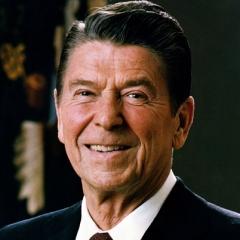
Ronald Reagan
Ronald Reagan

The 40th President of the United States, born on February 6, 1911, and passed away on June 5, 2004. Reagan's presidency was marked by economic prosperity and military strength, and he was known for his conservative political philosophy. more

You May Also Like

“Directly down the lawn and accross the Ellipse from the White House are those ordered, classic lines of the Jefferson Memorial and the eyes of the 19-foot statue that gaze directly into the White House, a reminder to any of us who might occupy that mansion of the quality of mind and generosity of heart that once abided there and has been so rarely seen there again.”

“The pursuit of science, the study of the great works, the value of free inquiry, in short, the very idea of living the life of the mind - yes, these formative and abiding principles of higher education in America had their first and firmest advocate, and their greatest embodiment, in a tall, fair-headed, friendly man who watched this university take form from the mountainside where he lived, the university whose founding he called a crowning achievement to along and well-spent life.”

“A zeal for different opinions concerning religion, concerning government, and many other points, as well of speculation as of practice; an attachment to different leaders ambitiously contending for pre-eminence and power; or to persons of other descriptions whose fortunes have been interesting to the human passions, have, in turn, divided mankind into parties, inflamed them with mutual animosity, and rendered them much more disposed to vex and oppress each other than to co-operate for their common good.”

“Conscience is the most sacred of all property; other property depending in part on positive law, the exercise of that being a natural and unalienable right. To guard a man's house as his castle, to pay public and enforce private debts with the most exact faith, can give no title to invade a man's conscience, which is more sacred than his castle, or to withhold from it that debt of protection for which the public faith is pledged by the very nature and original conditions of the social pact.”

“Hence it is that such democracies have ever been spectacles of turbulence and contention; have ever been found incompatible with personal security or the rights of property; and have in general been as short in their lives as they have been violent in their deaths. Theoretic politicians, who have patronized this species of government, have erroneously supposed that by reducing mankind to a perfect equality in their political rights, they would, at the same time, be perfectly equalized and assimilated in their possessions, their opinions, and their passions.”

“In framing a system, which we wish to last for ages, we should not lose sight of the changes which ages will produce.”