Quotessence
Home / Quotes / Quote by Galen

Quote by Galen

“He who has two cakes of bread, let him dispose of one of them for some flowers of the narcissus; for bread is the food of the body, and the narcissus is the food of the soul.”

Quote by Galen

Author
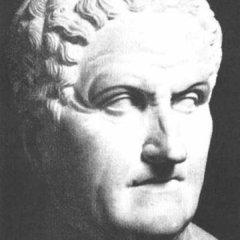
Galen
Galen

Galen (130-200 AD), a renowned physician of ancient Greece, is hailed as the father of Western medicine. Born in Pergamum, he studied medicine in Alexandria and became a follower of the famous physician Hippocrates. Galen's medical theories and practices had a profound impact on later generations, introducing the concept of blood circulation and providing detailed records of the human anatomy and physiological functions. more

You May Also Like

“Zen is to religion what a Japanese "rock garden" is to a garden. Zen knows no god, no afterlife, no good and no evil, as the rock-garden knows no flowers, herbs or shrubs. It has no doctrine or holy writ: its teaching is transmitted mainly in the form of parables as ambiguous as the pebbles in the rock-garden which symbolise now a mountain, now a fleeting tiger. When a disciple asks "What is Zen?", the master's traditional answer is "Three pounds of flax" or "A decaying noodle" or "A toilet stick" or a whack on the pupil's head.”

“Einstein's space is no closer to reality than Van Gogh's sky . The glory of science is not in a truth more absolute than the truth of Bach or Tolstoy, but in the act of creation itself. The scientist's discoveries impose his own order on chaos, as the composer or painter imposes his; an order that always refers to limited aspects of reality, and is based on the observer's frame of reference, which differs from period to period as a Rembrant nude differs from a nude by Manet.”

“Indeed, the ideal for a well-functioning democratic state is like the ideal for a gentleman's well-cut suit it is not noticed. For the common people of Britain, Gestapo and concentration camps have approximately the same degree of reality as the monster of Loch Ness. Atrocity propaganda is helpless against this healthy lack of imagination.”

“If time is treated in modern physics as a dimension on a par with the dimensions of space, why should we a priori exclude the possibility that we are pulled as well as pushed along its axis? The future has, after all, as much or as little reality as the past, and there is nothing logically inconceivable in introducing, as a working hypothesis, an element of finality, supplementary to the element of causality, into our equations. It betrays a great lack of imagination to believe that the concept of "purpose" must necessarily be associated with some anthropomorphic deity.”