Quotessence
Home / Quotes / Quote by Mary Cassatt

Quote by Mary Cassatt

Work

Women impressionists

This book delves into the lives and works of women artists who contributed to the Impressionist movement, highlighting their unique perspectives and artistic contributions. more
Author

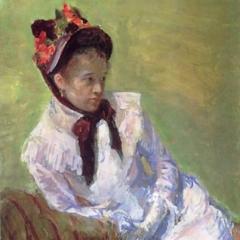
Mary Cassatt
Mary Cassatt

Mary Cassatt was an American painter known for her paintings that depicted the relationship between mothers and children. Born on May 22, 1844, and died on June 14, 1926, Cassatt spent most of her artistic career in France, where she was closely associated with the Impressionist movement, although her style was distinct and emphasized detail and emotional expression. more

You May Also Like

“You're not obligated to win. You're obligated to keep trying to do the best you can every day.”

“I am not blind to the shortcomings of our own people. I am not unaware that leaders betray, and sell out, and play false. But this knowledge does not outweigh the fact that my class, the working class, is exploited, driven, fought back with the weapon of starvation, with guns and with venal courts whenever they strike for conditions more human, more civilized for their children, and for their children's children.”

“To each eye, perhaps, the outlines of a great civilization present a different picture. In the wide ocean upon which we venture, the possible ways and directions are many; and the same studies which have served for my work might easily, in other hands, not only receive a wholly different treatment and application, but lead to essentially different conclusions.”

“Faithfulness to the truth of history involves far more than a research, however patient and scrupulous, into special facts. Such facts may be detailed with the most minute exactness, and yet the narrative, taken as a whole, may be unmeaning or untrue. The narrator must seek to imbue himself with the life and spirit of the time. He must study events in their bearings near and remote; in the character, habits, and manners of those who took part in them. He must himself be, as it were, a sharer or a spectator of the action he describes.”