Quotessence
Home / Quotes / Quote by Fulton J. Sheen

Quote by Fulton J. Sheen

Author

Fulton J. Sheen
Fulton J. Sheen

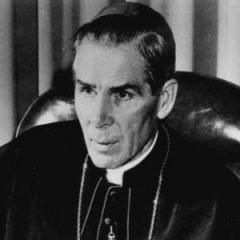
Fulton J. Sheen, an American television evangelist, was born on May 8, 1895, and passed away on December 9, 1979. Known for his unique charm and wisdom, he spread Christian faith to a global audience through his television programs, becoming one of the most influential religious leaders of the 20th century. more

You May Also Like

“The basic struggle today is not between individualism and collectivism, free enterprise and socialism, democracy and dictatorship. These are only the superficial manifestations of a deeper struggle which is moral and spiritual and involves above all else whether man shall exist for the state, or the state for man, and whether freedom is of the spirit or a concession of a materialized society.”

“If a man surrenders all power of self-determination in regard to the profits, management or ownership of the place where he works, he not only loses that special prerogative which marks him off from a cow in a pasture, but what is worse, he loses all capacity for determining any work. This is the beginning of a slavery which sometimes goes by the name of security.”

“The Western world generally has lost the concept of man as a creature made to the image and likeness of God, and reduced him either to a component part of the universe, to an economic animal or to a "physiological bag filled with psychological libido." Once man became materialized and atomized in Western thinking, it was only natural for a totalitarianism to arise to gather up the fragments into a new totality and substitute the collective man for the individual man who was isolated from all social responsibilities.”

“There are three ways in which a man becomes a slave. He may be born into slavery, or forced into it, or he can deliberately accept his servitude. All three forms flourish in the modern world. Men are born and forced into slavery in Russia and her satellites states. Men in the free world invite slavery when they ask the government to provide complete security, when they surrender their freedom to the "Welfare State."”

“The slave states of Western world are an outgrowth of monopolistic capitalism - an economic system which is opposed to the wide distribution of private property in many hands. Instead, monopolistic capitalism concentrates productive wealth among a few men, allowing the rest to become a vast proletariat.”

“Some representatives of monopolistic capitalism, sensing this evil in their system, have tried to silence criticism by pointing to the diffused ownership in the great corporations. They advertise, "No one owns more than 4 percent of the stock of this great company." Or they print lists of stockholders, showing that these include farmers, schoolteachers, baseball players, taxi drivers, and even babies.”

“Possession properly has two faces, two aspects: we all have a right to private property, but this is accompanied by our responsibility for its righteous use. These two things (which should be inseparable) are frequently divided today. Everyone admits that the farmer who own a horse is obligated to feed and care for it, but in the case of stocks and bonds, we often forget that the same principle should prevail.”

“Monopolistic capitalism is to blame for this; it sunders the right to own property from responsibility that owning property involves. Those who own only a few stocks have no practical control of any industry. They vote by postcard proxy, but they have rarely even seen "their" company. The two elements which ought to be inextricably joined in any true conception of private property - ownership and responsibility - are separated. Those who own do not manage; those who manage; those who manage and work do not control or own.”