Quotessence
Home / Quotes / Quote by Paul Krugman

Quote by Paul Krugman

“These days, however, the main problem comes from the right - from conservatives who, unlike most economists, really do think that the free market is always right - to such an extent that they refuse to believe even the most overwhelming scientific evidence if it seems to suggest a justification for government action.”

Quote by Paul Krugman

Author
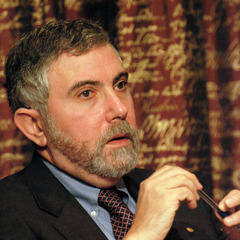
Paul Krugman
Paul Krugman

Paul Krugman is a renowned economist known for his contributions to macroeconomic policy and international trade. He won the Nobel Prize in Economics in 1991 and is considered one of the leading figures in the New Keynesian economics school. more

You May Also Like

“Unfortunately for ethical egoism, the claim that we will all be better off if every one of us does what is in his or her own interest is incorrect. This is shown by what are known as "prisoner's dilemma" situations, which are playing an increasingly important role in discussions of ethical theory... At least on the collective level, therefore, egoism is self-defeating - a conclusion well brought out by Parfit in his aforementioned Reasons and Persons.”

“Markets are interested in profits and profits only; service, quality, and general affluence are different functions altogether. The universal, democratic prosperity that Americans now look back to with such nostalgia was achieved only by a colossal reigning in of markets, by the gargantuan effort of mass, popular organizations like labor unions and of the people themselves, working through a series of democratically elected governments not daunted by the myths of the market.”

“On the conservative side, today's libertarianism is far more dogmatic and devoid of qualification than the liberalism of Adam Smith or J.S. Mill. Like Marxism, libertarianism is a utopian worldview based on an economic-determinist vision of history. Unlike Marxism, libertarianism is highly specific in its predictions about the transition to the utopian world order, rendering it vulnerable to fact.”

“For over a century, popular struggles in the democracies have used the nation-state to temper raw capitalism. The power of voters has offset the power of capital. But as national barriers have come down in the name of freer commerce, so has the capacity of governments to manage capitalism in a broad public interest. So the real issue is not "trade" but democratic governance.”

“One of the most extraordinary examples in recent decades [of unitary visions of constitutional enterprise] is found in a book called "Takings"... Epstein makes an extremely clever but stunningly reductionist argument that the whole Constitution is really designed to protect private property... Can a constitution reflecting as diverse an array of visions and aspirations as ours really be reducible to such as sadly single-minded vision as that?”