Quotessence
Home / Quotes / Quote by Stephen Jay Gould

Quote by Stephen Jay Gould

“The human brain became large by natural selection (who knows why, but presumably for good cause). Yet surely most "things" now done by our brains, and essential both to our cultures and to our very survival, are epiphenomena of the computing power of this machine, not genetically grounded Darwinian entities created specifically by natural selection for their current function.”

Quote by Stephen Jay Gould

Author
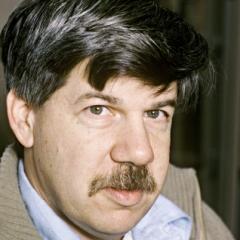
Stephen Jay Gould
Stephen Jay Gould

Stephen Jay Gould was a renowned paleontologist, evolutionary theorist, science writer, and academic. He is known for his work in ornithology, paleontology, evolutionary theory, and speciation. Gould's writings and papers have had a profound impact on the scientific community, and he was a long-time contributor to the journal 'Nature'. more

You May Also Like

“True majorities, in a TV-dominated and anti-intellectual age, may need sound bites and flashing lights and I am not against supplying such lures if they draw children into even a transient concern with science. But every classroom has one [Oliver] Sacks , one [Eric] Korn, or one [Jonathan] Miller , usually a lonely child with a passionate curiosity about nature, and a zeal that overcomes pressures for conformity. Do not the one in fifty deserve their institutions as well magic places, like cabinet museums, that can spark the rare flames of genius?”

“Very little comes easily to our poor, benighted species (the first creature, after all, to experiment with the novel evolutionary inventions of self-conscious philosophy and art). Even the most "obvious," "accurate," and "natural" style of thinking or drawing must be regulated by history and won by struggle. Solutions must therefore arise within a social context and record the complex interactions of mind and environment that define the possibility of human improvement.”

“If we choose a weak and foolish speculation as a primary textbook illustration (falsely assuming that the tale possesses a weight of history and a sanction of evidence), then we are in for trouble - as critics properly nail the particular weakness, and then assume that the whole theory must be in danger if supporters choose such a fatuous case as a primary illustration.”

“In his anti-Darwinian book... (and eponymously named The Neck of the Giraffe ), Francis Hitching tells the story... "The need to survive by reaching ever higher for food is, like so many Darwinian explanations of its kind, little more than a post hoc speculation." Hitching is quite correct, but he rebuts a fairy story that Darwin was far too smart to tell - even though the tale later entered our high school texts as a "classic case" nonetheless.”

“No one supposed that dinoflagellates might actively kill fish as an evolved response for their own specific advantage, including a potential nutritional benefit for the algal cells. And yet the dinoflagellates do seem to be killing and eating fishes in a manner suggesting active evolution for this most peculiar reversal.”

“Agnosticism is a perfectly respectable and tenable philosophical position; it is not dogmatic and makes no pronouncements about the ultimate truths of the universe. It remains open to evidence and persuasion; lacking faith, it nevertheless does not deride faith. Atheism, on the other hand, is as unyielding and dogmatic about religious belief as true believers are about heathens. It tries to use reason to demolish a structure that is not built upon reason.”