Quotessence
Home / Quotes / Quote by Carl Sagan

Quote by Carl Sagan

“'In his celebrated book, 'On Liberty', the English philosopher John Stuart Mill argued that silencing an opinion is "a peculiar evil." If the opinion is right, we are robbed of the "opportunity of exchanging error for truth"; and if it's wrong, we are deprived of a deeper understanding of the truth in its "collision with error." If we know only our own side of the argument, we hardly know even that: it becomes stale, soon learned by rote, untested, a pallid and lifeless truth.'”

Quote by Carl Sagan

Work

The Demon-Haunted World: Science as a Candle in the Dark

In this seminal work, the author delves into the principles of scientific inquiry, critical analysis, and evidence-based reasoning. The book serves as a guide to discerning fact from fiction, advocating for the importance of skepticism and rationality in understanding the natural world. more

Author
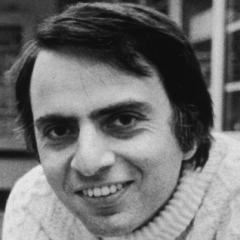
Carl Sagan
Carl Sagan

Carl Sagan was an American astronomer, cosmologist, author, and science communicator, born on November 9, 1934, in Brooklyn, New York. He is renowned for his profound research into the cosmos and his dedication to popularizing science. Sagan proposed numerous theories about the origin of the universe and life, and he made complex scientific knowledge accessible to the public with his unique perspective and clear, engaging writing style. more

You May Also Like

“If we live our lives as a gift it is possible to reach a blissful state of eternal happiness. It is those who live their life with a sense of entitlement that undermine peace , freedom and liberty. Know that every breath is a miracle and every moment a blessing and you will achieve your dreams. Planning other people's actions means to prevent them from planning for themselves, means to deprive them of their essentially human quality, means enslaving them.”

“In short, my vision of a responsible free society is one in which we discourage evil, but do not prohibit it. We make our children and students aware of the consequences of drug abuse and other forms of irresponsible behavior. But after all our persuading, if they still want to use harmful drugs, that is their privilege. In a free society, individuals must have the right to do right or wrong, as long as they don't threaten or infringe upon the rights or property of others. They must also suffer the consequences of their actions, as it is from consequences that they learn to choose properly”

“Having confidence in a free society is to focus on the process of discovery in the marketplace of values rather than to focus on some imposed vision or goal. Using governmental force to impose a vision on others is intellectual sloth and typically results in unintended, perverse consequences. Achieving the free society requires courage to think, to talk, and to act - especially when it is easier to do nothing.”

“At times some people use force or fraud to take from others without willful, voluntary consent. Normally, the initiation of force to take life is murder, to take liberty is slavery, and to take property is theft. It is the same whether these actions are done by one person acting alone, by the many acting against a few, or even by officials with fine hats and titles.”

“All "public interest' legislation (and any distribution of money taken by force from some men for the unearned benefit of others) comes down ultimately to the grant of an undefined undefinable, non-objective, arbitrary power to some government officials. The worst aspect of it is not that such a power can be used dishonestly, but that it cannot be used honestly. The wisest man in the world, with the purest integrity, cannot find a criterion for the just, equitable, rational application of an unjust, inequitable, irrational principle.”

“It is completely in accord with the etatist thinking prevalent everywhere today to consider a theory to be finally disposed of merely because the authorities who control appointments to academic positions, want to know nothing of it, and to see the criterion of truth in the approval of a government office.”

“"It astonishes me to find... [that so many] of our countrymen... should be contented to live under a system which leaves to their governors the power of taking from them the trial by jury in civil cases, freedom of religion, freedom of the press, freedom of commerce, the habeas corpus laws, and of yoking them with a standing army. This is a degeneracy in the principles of liberty... which I [would not have expected for at least] four centuries."”