Quotessence
Home / Quotes / Quote by Charles Bukowski

Quote by Charles Bukowski

“Everything else just kept picking and picking, hacking away. And nothing was interesting, nothing. The people were restrictive and careful, all alike. And I've got to live with these fuckers for the rest of my life, I thought.”

Quote by Charles Bukowski

Work

Ham On Rye

Ham On Rye is a narrative that delves into the early life of its protagonist, detailing his struggles and experiences during a challenging period in American history. The story is a candid look at the hardships faced by a young boy in the 1930s, offering a glimpse into the resilience and determination required to overcome adversity. more
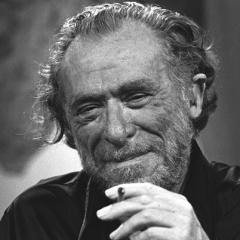
Author

Charles Bukowski
Charles Bukowski

Charles Bukowski, born on August 16, 1920, was an influential American poet. Known for his unique style and profound depiction of the lives of the underclass in America, he is considered one of the representatives of the Beat Generation. more

You May Also Like

“Kate Gompert’s always thought of this anhedonic state as a kind of radical abstracting of everything, a hollowing out of stuff that used to have affective content. Terms the undepressed toss around and take for granted as full and fleshy—happiness, joie de vivre, preference, love—are stripped to their skeletons and reduced to abstract ideas. They have, as it were, denotation but not connotation. The anhedonic can still speak about happiness and meaning et al., but she has become incapable of feeling anything in them, of understanding anything about them, of hoping anything about them, or of believing them to exist as anything more than concepts. Everything becomes an outline of the thing. Objects become schemata. The world becomes a map of the world. An anhedonic can navigate, but has no location. I.e. the anhedonic becomes, in the lingo of Boston AA, Unable To Identify.”

“When people call it [depression] I always get pissed off because I always think depression sounds like you just get like really sad, you get quiet and melancholy and just like sit quietly by the window sighing or just lying around. A state of not caring about anything. A kind of blue kind of peaceful state … Well this - isn’t a state. This is a feeling. I feel it all over. In my arms and legs … All over. My head, throat, butt. In my stomach. It’s all over everywhere. I don’t know what to call it. It’s like I can’t get enough outside it to call it anything. It’s like horror more than sadness. It’s more like horror. It’s like something horrible is about to happen, the most horrible thing you imagine – no, worse than you can imagine because there’s the feeling that there’s something you have to do right away to stop it but you don’t know what it is you have to do, and then it’s happening, too, the whole horrible time, it’s about to happen and also it’s happening, all at the same time. … Everything gets horrible. Everything you see gets ugly. Lurid is the word. … That’s the right word for it. And everything sounds harsh, spiny and harsh-sounding, like every sound you hear all of a sudden has teeth. And smelling like I smell bad even after I just got out of the shower. It’s like what’s the point of washing if everything smells like I need another shower.”

“It’s of some interest that the lively arts of the millennial U.S.A. treat anhedonia and internal emptiness as hip and cool. It’s maybe the vestiges of the Romantic glorification of Weltschmerz, which means world-weariness or hip ennui. Maybe it’s the fact that most of the arts here are produced by world-weary and sophisticated older people and then consumed by younger people who not only consume art but study it for clues on how to be cool, hip — and keep in mind that, for kids and younger people, to be hip and cool is the same as to be admired and accepted and included and so Unalone. Forget so-called peer-pressure. It’s more like peer-hunger. No? We enter a spiritual puberty where we snap to the fact that the great transcendent horror is loneliness, excluded encagement in the self. Once we’ve hit this age, we will now give or take anything, wear any mask, to fit, be part-of, not be Alone, we young. The U.S. arts are our guide to inclusion. A how-to. We are shown how to fashion masks of ennui and jaded irony at a young age where the face is fictile enough to assume the shape of whatever it wears. And then it’s stuck there, the weary cynicism that saves us from gooey sentiment and unsophisticated naïveté. Sentiment equals naïveté on this continent (at least since the Reconfiguration). One of the things sophisticated viewers have always liked about J. O. Incandenza’s The American Century as Seen Through a Brick is its unsubtle thesis that naïveté is the last true terrible sin in the theology of millennial America. And since sin is the sort of thing that can be talked about only figuratively, it’s natural that Himself’s dark little cartridge was mostly about a myth, viz. that queerly persistent U.S. myth that cynicism and naïveté are mutually exclusive. Hal, who’s empty but not dumb, theorizes privately that what passes for hip cynical transcendence of sentiment is really some kind of fear of being really human, since to be really human (at least as he conceptualizes it) is probably to be unavoidably sentimental and naïve and goo-prone and generally pathetic, is to be in some basic interior way forever infantile, some sort of not-quite-right-looking infant dragging itself anaclitically around the map, with big wet eyes and froggy-soft skin, huge skull, gooey drool. One of the really American things about Hal, probably, is the way he despises what it is he’s really lonely for: this hideous internal self, incontinent of sentiment and need, that pules and writhes just under the hip empty mask, anhedonia. 281 281 - This had been one of Hal’s deepest and most pregnant abstractions, one he’d come up with once while getting secretly high in the Pump Room. That we’re all lonely for something we don’t know we’re lonely for. How else to explain the curious feeling that he goes around feeling like he misses somebody he’s never even met? Without the universalizing abstraction, the feeling would make no sense.”

“The key to the problem, I would come to understand, was this: I lacked both spiritual guidelines, and an ability to enjoy anything. But at the same time, I was also an excitement addict. This is such a toxic combination I can't even. I didn't know this at the time, of course, but if I was not in the act of searching for excitement, being excited, or drunk, I was incapable of enjoying anything. The fancy word for that is "anhedonia," a word and feeling I would spend millions in therapy and treatment centers to discover and understand. Maybe that's why I won tennis matches only when I was a set down and within points of losing. Maybe that's why I did everything I did. "Anhedonia," by the way, was the original working title of my favorite movie, the one my mother and I had enjoyed together, "Annie Hall". Woody gets it. Woody gets me.”