Quotessence
Home / Quotes / Quote by Noam Chomsky

Quote by Noam Chomsky

“Hume's paradox does hold: power is in the hands of the governed. If they refuse to accept it, you're in trouble, no matter how many guns you have.”

Quote by Noam Chomsky

Author
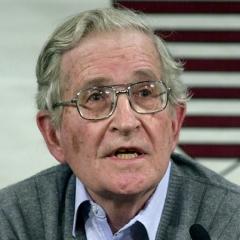
Noam Chomsky
Noam Chomsky

Noam Chomsky, born on December 7, 1928, is a renowned linguist from the United States. His research in generative grammar and transformational grammar has had a profound impact on modern linguistics. Chomsky's academic achievements extend beyond linguistics, as he is also an active political commentator and philosopher, known for his unique perspective and profound insights. more

You May Also Like

“There have, for years, been comparative studies of religious fanaticism and factors that correlate with it. By and large, it tends to decline with increasing industrialization and education. The US, however, is off the chart, ranking near devastated peasant societies. About 1/2 the population believe the world was created a few thousand years ago: the justification for the belief is that that is what they were ordered to believe by authority figures to whom they were taught one must subordinate oneself. And on, and on.”

“Do I believe in God? Can't answer, I'm afraid. I'm not being flippant, but I don't understand the question. What is it that I am supposed to believe or not believe in? Are you asking whether I believe there is something not in the universe (or the universes, if there are (maybe infinitely) many of them), and that somehow stands above them? I've never heard of any reason for believing that.”

“I don't see how one can "believe in organized religion." What does it mean to believe in an organization? One can join it, support it, oppose it, accept its doctrines or reject them. There are many kinds of organized religion. People associate themselves with some of them, or not, for all sorts of reasons, maybe belief in some of their doctrines.”

“Who wrote the Bible? Current scholarship, to my knowledge, assumes that the material that constitutes the Old Testament was put together from various oral and folk traditions (many of them going far back) in the Hellenistic period. That was one of several currents, of which the collection that formed the New Testament was another.”

“Biblical archaeology was developed early in this century in an effort to substantiate the authenticity of the Biblical account. It's by now generally recognized in Biblical scholarship that it has done the opposite. The Bible is not a historical text, and has only vague resemblances to what took place, as far as can be reconstructed. For example, whether Israel ever existed is not clear; if so, it was probably a small kingdom somewhere in the hills, apparently virtually unknown to the Egyptians.”

“Elements of the Christian fundamentalist right are one of the strongest components of "support for Israel" - support in an odd sense, because they presumably want to see it destroyed in a cosmic battle at Armageddon, after which all the proper souls will ascend to heaven - or so I understand, again, not from close reading.”

“One of the Christian fundamentalists' goals seems to be to rebuild the Temple, which means destroying the Al-Aqsa Mosque, which presumably means war with the Arab world - one of the goals, perhaps, in fulfilling the prophecy of Armageddon. So they strongly support Israeli power and expansionism, and help fund it and lobby for it; but they also support actions that are very harmful and objectionable to most of its population - as do Jewish fundamentalist groups, mostly rooted in the US, which, after all, is one of the most extreme religious fundamentalist societies in the world.”