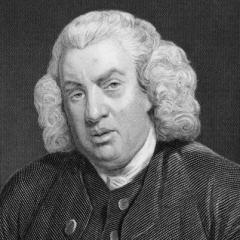
“The diversion of baiting an author has the sanction of all ages and nations, and is more lawful than the sport of teasing other animals, because, for the most part, he comes voluntarily to the stake, furnished, as he imagines, by the patron powers of literature, with resistless weapons, and impenetrable armour, with the mail of the boar of Erymanth, and the paws of the lion of Nemea.”
Quote by Samuel Johnson
“Critics ought never to be consulted, but while errors may yet be rectified or insipidity suppressed. But when the book has once been dismissed into the world, and can be no more retouched, I know not whether a very different conduct should not be prescribed, and whether firmness and spirit may not sometimes be of use to overpower arrogance and repel brutality.”
Source: Selected essays
“The animadversions of critics are commonly such as may easily provoke the sedatest writer to some quickness of resentment and asperity of reply.”
Source: The Rambler
“He that condemns himself to compose on a stated day will often bring to his task attention dissipated, a memory embarrassed, an imagination overwhelmed, a mind distracted with anxieties, a body languishing with disease: he will labour on a barren topic till it is too late to change it; or, in the ardour of invention, diffuse his thoughts into wild exuberance, which the pressing hour of publication cannot suffer judgment to examine or reduce.”
Source: The Works of Samuel Johnson: An essay on the life and genius of Dr. Johnson [by A. Murphy] Poems.- v. 2-4. The rambler.- v. 5. The idler. History of Rasselas, prince of Abissinia.- v. 6-8. The lives of the English poets.- v. 9. Lives of eminent persons. Letters, selected from the collection of Mrs. Piozzi and others. Prayers and meditations.- v. 10. Philological tracts, &c.- v. 11. Miscellaneous tracts, &c. Dedications. Reviews and criticisms. Tales of imagination. The adventurers.-
“To read, write, and converse in due proportions, is, therefore, the business of a man of letters.”
Source: The Wisdom of the Rambler, Adventurer, and Idler
“There are certain topicks which are never exhausted. Of some images and sentiments the mind of man may be said to be enamoured; it meets them, however often they occur, with the same ardour which a lover feels at the sight of his mistress, and parts from them with the same regret when they can no longer be enjoyed.”
Source: The Works of Samuel Johnson, LL.D.
“Western business people often don't get the importance of establishing human relationships.”
“When a poet mentions the spring, we know that the zephyrs are about to whisper, that the groves are to recover their verdure, the linnets to warble forth their notes of love, and the flocks and herds to frisk over vales painted with flowers: yet, who is there so insensible of the beauties of nature, so little delighted with the renovation of the world, as not to feel his heart bound at the mention of the spring?”
Source: The Works of Samuel Johnson, LL.D.: With Murphy's Essay
“General irregularities are known in time to remedy themselves. By the constitution of ancient Egypt, the priesthood was continually increasing, till at length there was no people beside themselves; the establishment was then dissolved, and the number of priests was reduced and limited. Thus among us, writers will, perhaps, be multiplied, till no readers will be found, and then the ambition of writing must necessarily cease.”
Source: The Works of Samuel Johnson, LL.: D., with an Essay on His Life and Genius
“It is, however, not necessary, that a man should forbear to write, till he has discovered some truth unknown before; he may be sufficiently useful, by only diversifying the surface of knowledge, and luring the mind by a new appearance to a second view of those beauties which it had passed over inattentively before.”
Source: Samuel Johnson: Selected Writings
“To write is, indeed, no unpleasing employment, when one sentiment readily produces another, and both ideas and expressions present themselves at the first summons; but such happiness, the greatest genius does not always obtain; and common writers know it only to such a degree, as to credit its possibility. Composition is, for the most part, an effort of slow diligence and steady perseverance, to which the mind is dragged by necessity or resolution, and from which the attention is every moment starting to more delightful amusements.”
Source: The Works of Samuel Johnson: The Adventurer and Idler