Quotessence
Home / Quotes / Quote by Gregory of Nazianzus

Quote by Gregory of Nazianzus

Author

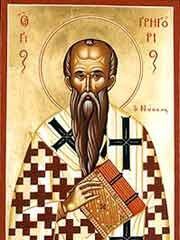
Gregory of Nazianzus

Gregory of Nazianzus (330-390 AD) was an influential Christian saint, theologian, and poet. He is renowned for his contributions to the doctrine of the Trinity within Christian theology. Born in Nazianzus, Asia Minor, he was the brother of Basil of Caesarea, another prominent theologian. His writings and sermons are still widely referenced in the Christian church today. more

You May Also Like

“If you see the fury and hear the howling of the tempest, or read of shipwrecks, think of the storm of human passions causing daily groans and disturbance in the hearts of men, wrecking the spiritual ship of the soul or the ship of human society; and pray fervently to the Lord that He may subdue the tempest of sins, as He once subdued the tempest at sea by His word, and that He may root our passions from our hearts, and re-establish in them unceasing tranquility.”

“Truth is not something you can appropriate easily and quickly. You certainly cannot sleep or dream yourself to the truth. No, you must be tried, do battle, and suffer if you are to acquire the truth for yourself. It is a sheer illusion to think that in relation to the truth there is an abridgement, a short cut that dispenses with the necessity for struggling for it.”

“Given that we desire long life, should we not take eternal life into account? If we long for a kingdom which, however enduring, has an end, and glory and joy which, great as they are, will fade, and wealth that will perish with this present life, and we labour for the sake of such things; ought we not to seek the kingdom, glory, joy and riches which, as well as being all-surpassing, are unfading and endless, and ought we not to endure a little constraint in order to inherit it?”

“...we know that God arranges the opportunities for salvation in different ways. Our situation is that we respond eagerly or in a laggardly manner to these opportunities made available by God to us. God made the call come out of your homeland; Abraham by coming out was exercising obedience. There was the instruction come into the land; it was done, and that was the work of obedience. But the addition which I shall show you has to do with the grace of God, who gave a command - and a promise.”

“...when seeking material light, remember the spiritual light which is indispensable for the soul, and without which it remains in the darkness of the passions, in the darkness of spiritual death. 'I am come as a light into the world,' says the Lord, 'that whosoever believeth on Me, should not abide in darkness' (Jn. 12:46).”

“...we are not without hope of salvation, nor is it at all the right time for us to despair. All our life is a season of repentance, for God 'desires not the death of the sinner', as it is written, 'but that the wicked turn from his way and live' (cf. Ez. 33:11 LXX). For, if there were no hope of turning back, why would death not have followed immediately on disobedience, and why would we not be deprived of life as soon as we sin? For where there is hope of turning back, there is no room for despair.”

“No one has yet discovered or ever shall discover what God is in His nature and essence... we shall, in time to come, 'know as we are known' (I Cor 13:12). But for the present what reaches us is a scant emanation, as it were a small beam from a great light - which means that any one who 'knew' God or whose 'knowledge' of Him has been attested to in the Bible, has a manifestly more brilliant knowledge than others not equally illuminated. This superiority was reckoned knowledge in the full sense, not because it really was so, but by the contrast of relative strengths.”

“...when we abandon visible riches... it is strange goods and not our own that we are leaving. And this is so even if we boast that we acquired them through our own efforts or that they were passed on to us as an inheritance. I say nothing is ours except what is in our hearts, what belongs to our souls, what cannot be taken away by anyone.”

“...if you wish to get pure air into your room, or if you go for a walk in the fresh air, think of the pure and of the unclean heart. Many of us like to have pure air in the room (and this is an excellent habit), or are fond of walking in the fresh air, but they do not even think of the necessity of the purity of the spirit or heart (of, so to say, spiritual air, the breath of life); and, living in the fresh air, they allow themselves to indulge in impure thoughts, impure movements of the heart, and even impurity of language, and most impure carnal actions.”