Quotessence
Home / Quotes / Quote by Stephen Jay Gould

Quote by Stephen Jay Gould

“I love to read the dedications of old books written in monarchies for they invariably honor some (usually insignificant) knight or duke with fulsome words of sycophantic insincerity, praising him as the light of the universe (in hopes, no doubt, for a few ducats to support future work); this old practice makes me feel like such an honest and upright man, by comparison, when I put a positive spin, perhaps ever so slightly exaggerated, on a grant proposal.”

Quote by Stephen Jay Gould

Author
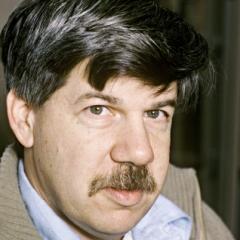
Stephen Jay Gould
Stephen Jay Gould

Stephen Jay Gould was a renowned paleontologist, evolutionary theorist, science writer, and academic. He is known for his work in ornithology, paleontology, evolutionary theory, and speciation. Gould's writings and papers have had a profound impact on the scientific community, and he was a long-time contributor to the journal 'Nature'. more

You May Also Like

“Throughout his last half-dozen books, for example, Arthur Koestler has been conducting a campaign against his own misunderstanding of Darwinism. He hopes to find some ordering force, constraining evolution to certain directions and overriding the influence of natural selection. [...] Darwinism is not the theory of capricious change that Koestler imagines. Random variation may be the raw material of change, but natural selection builds good design by rejecting most variants while accepting and accumulating the few that improve adaptation to local environments.”

“Zoocentrism is the primary fallacy of human sociobiology, for this view of human behavior rests on the argument that if the actions of "lower" animals with simple nervous systems arise as genetic products of natural selection, then human behavior should have a similar basis.”

“We live in an essential and unresolvable tension between our unity with nature and our dangerous uniqueness. Systems that attempt to place and make sense of us by focusing exclusively either on the uniqueness or the unity are doomed to failure. But we must not stop asking and questing because the answers are complex and ambiguous.”

“[E]volutionists sometimes take as haughty an attitude toward the next level up the conventional ladder of disciplines: the human sciences. They decry the supposed atheoretical particularism of their anthropological colleagues and argue that all would be well if only the students of humanity regarded their subject as yet another animal and therefore yielded explanatory control to evolutionary biologists.”

“Historical science is not worse, more restricted, or less capable of achieving firm conclusions because experiment, prediction, and subsumption under invariant laws of nature do not represent its usual working methods. The sciences of history use a different mode of explanation, rooted in the comparative and observational richness in our data. We cannot see a past event directly, but science is usually based on inference, not unvarnished observation (you don't see electrons, gravity, or black holes either).”

“The contingency of history (both for life in general and for the cultures of Homo sapiens ) and human free will (in the factual rather than theological sense) are conjoined concepts, and no better evidence can be produced than the "experimental" production of markedly different solutions in identical environments.”

“I am not [...] asserting that humans are either genial or aggressive by inborn biological necessity. Obviously, both kindness and violence lie within the bounds of our nature because we perpetrate both, in spades. I only advance a structural claim that social stability rules nearly all the time and must be based on an overwhelmingly predominant (but tragically ignored) frequency of genial acts, and that geniality is therefore our usual and preferred response nearly all the time. [...] [T]he center of human nature is rooted in ten thousand ordinary acts of kindness that define our days.”

“[T]ruly grand and powerful theories [...] do not and cannot rest upon single observations. Evolution is an inference from thousands of independent sources, the only conceptual structure that can make unified sense of all this disparate information. The failure of a particular claim usually records a local error, not the bankruptcy of a central theory. [...] If I mistakenly identify your father's brother as your own dad, you don't become genealogically rootless and created de novo. You still have a father; we just haven't located him properly.”