Quotessence
Home / Quotes / Quote by Jon Lee Anderson

Quote by Jon Lee Anderson

“One day in May 1930, Celia took her twoyear- old son for a swim at the yacht club, but it was already the onset of the Argentine winter, cold and windy. That night, the little boy had a coughing fit. A doctor diagnosed him as suffering from asthmatic bronchitis and prescribed the normal remedies, but the attack lasted for several days. Ernestito had developed chronic asthma, which would afflict him for the rest of his life and irrevocably change the course of his parents’ lives.”

Quote by Jon Lee Anderson

Author
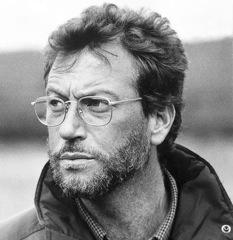
Jon Lee Anderson
Jon Lee Anderson

Jon Lee Anderson is a renowned biographer, born on January 15, 1957. His works are known for their in-depth research and vivid storytelling, focusing on political, historical, and social issues. more

You May Also Like

“We have been trained to think of patterns, with the exception of those of music, as fixed affairs. It is easier and lazier that way but, of course, all nonsense. In truth, the right way to begin to think about the pattern which connects is to think of it as primarily (whatever that means) a dance of interacting parts and only secondarily pegged down by various sorts of physical limits and by those limits which organisms characteristically impose.”

“I want to use this practice: Whenever I express my views, thoughts or anything I deeply believe, I will welcome any opposing view or thought. I will listen with caring attention to what the other says, accepting it no matter how different or antagonistic it seems to be. I will also deeply and sincerely thank them. I will abstain from feeling accused or judged. I will acknowledge the other as my shadow, an integral part of me who has accepted to relate with me. I believe that a vision in order to manifest requires its opposite, the other polarity. If my vision is truly holistic, I am not in a condition to oppose any alternative vision. I intend to learn to accept what appears to be opposite, no matter how unpleasant or contrary it is. I believe that only in the paradox of this acceptance, in releasing the urge to be right, unity can be experienced and manifested. I have tried all other options, and they have not worked, and this is the only I have left. And for this purpose I am open to be patient, promoting the gestation of this healing process, for I know that all is one.”

“We have come to understand the phenomena of life only as an assemblage of the lifeless. We take the mechanistic abstractions of our technical calculation to be ultimately concrete and "fundamentally real," while our most intimate experiences are labelled "mere appearance" and something having reality only within the closet of the isolated mind. Suppose however we were to invert this whole scheme, reverse the order in which it assigns abstract and concrete. What is central to our experience, then, need not be peripheral to nature. This sunset now, for example, caught within the network of bare winter branches, seems like a moment of benediction in which the whole of nature collaborates. Why should not these colours and these charging banners of light be as much a part of the universe as the atoms and molecules that make them up? If they were only "in my mind," then I and my mind would no longer be a part of nature. Why should the pulse of life toward beauty and value not be a part of things? Following this path, we do not vainly seek to assemble the living out of configurations of dead stuff, but we descend downwards from more complex to simpler grades of the organic. From humans to trees to rocks; from "higher grade" to "lower grade" organisms. In the universe of energy, any individual thing is a pattern of activity within the flux, and thereby an organism at some level.”

“The properties of mind are not purely mental: They are shaped in crucial ways by the body and brain and how the body can function in everyday life. The embodied mind is thus very much of this world. Our flesh is inseparable from what Merleau-Ponty called the "flesh of the world" and what David Abram refers to as "the-more-than-human-world." Our body is intimately tied to what we walk on, sit on, touch, taste, smell, see, breathe, and move within. Our corporeality is part of the corporeality of the world.”

“My Lord God, I have no idea where I am going. I do not see the road ahead of me. I cannot know for certain where it will end. Nor do I really know myself, and the fact that I think that I am following your will does not mean that I am actually doing so. But I believe that the desire to please you does in fact please you. And I hope I have that desire in all that I am doing. I hope that I will never do anything apart from that desire. And I know that if I do this you will lead me by the right road though I may know nothing about it. Therefore will I trust you always though I may seem to be lost and in the shadow of death. I will not fear, for you are ever with me, and you will never leave me to face my perils alone.”

“God’s perfection lies in the domain of Being. In the domain of Becoming, he is totally fragmented and on a mission to put himself back together again. God shatters himself into infinite pieces then puts them all back together again to make a perfect whole. We are all tiny images or reflections of God. We are all cells of God. We are all mirrors of God.”

“The idea that there is something necessarily wrong with circular logic is itself a logical fallacy. If there is nothing wrong with the starting premises then the conclusions are necessarily correct too. In fact, only circular logic can be correct. Only such logic can offer total holistic coherence and analytic closure, i.e. perfect tautology – provided it is the correct circular logic, which means it must have the correct starting premise: the PSR itself.”