Quotessence
Home / Quotes / Quote by James Joyce

Quote by James Joyce

Work

Selected letters of James Joyce

This book presents a selection of letters from James Joyce, offering insight into his personal life, literary aspirations, and the social and cultural context of his time. more

Author
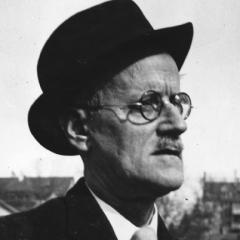
James Joyce
James Joyce

James Joyce, born on February 2, 1882, and died on January 13, 1941, was an Irish novelist and one of the greatest writers of the 20th century. Known for his unique narrative techniques and profound psychological insights, Joyce is celebrated for his contributions to modernist literature. His most famous work is 'Ulysses', which is considered one of the greatest literary works of the 20th century. Other notable works include 'Dubliners' and 'Finnegans Wake'. more

You May Also Like

“On the street, cars hurtled toward their destinations in a symphony of sound. Trees lined the pavement in a powerful show of survival: here they stood in this urban landscape, long-limbed and capable. And green, so green, sunlight pierced through their leaves and marked the concrete with dappled grays. I made my way home to my family, one among a million travelers crossing the city’s great canvas in quick strokes. Everywhere there were colors by the thousands—tint upon tint, shade after shade—of everything the spectrum of beauty satisfied. Everywhere, there were signs of the renewal and restoration of life.”

“Many a time he had caught himself saying: "I can't live without God, but I can live without religion." He may have abandoned the practice of religion which was part of his boyhood, and which taught him how to interpret the world, and his surroundings, and his feelings, but he did so because he would not reconcile his life and his mysticism. He did so because his quest for God was sexual as well as emotional. At the same time he saw religion being practised in a weak and mawkish way, in a way that was emasculated and enfeebled, lacking the fertile passion and the violent receptivity of femininity or the exuberance of virility. A religion without sex for people who are afraid of the passions and the power of love. An accommodating, bourgeois religion, that is more often than not hypocritical. At the same time, on the other hand, even in his silent prayers, he was aware of putting his entire sexuality on the line. This is why he read Hosea. Because in those pages there was not an exclusively mental or spiritual vision of the relationship between God and His people. Rather, there was a representation of bodies, a representation of prostitution and wantonness, of the frenzy of separation, of wrath and of paternal protection. As has always been the case since time immemorial between people who love one another.”

“At times he had prayed while he was making love. His eyes strayed over the naked object of his desire with a most chaste, even virginal, reverence. He was aware of the miracle of having beside him the beauty of creation, and the wonder of being able to gaze upon it in silence. The wonder of being able to touch it with the rapt tips of his fingers, just as his eyes could stroke mountains at sunset. There was not the remotest notion of possessing the other, or having dominion over him. He did not want to steal anything, claim anything, or take anything away. He wanted everything to stay intact as it was in a feeling of gratitude and fullness. Hours could pass by in these insightful moments in which the loved one's body became the universe, with its various constellations and its various worlds.”