Quotessence
Home / Quotes / Quote by Thales

Quote by Thales

“If there is a change, there must be some thing that changes, yet does not change”

Quote by Thales

Author
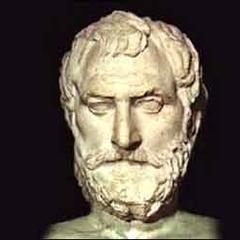
Thales
Thales

Thales, a renowned philosopher of ancient Greece, is considered one of the founders of Western philosophy. Born in 624 BC and died in 546 BC, Thales is known for his observations of natural phenomena and rational thinking. He posed many fundamental questions about the universe and nature, which had a profound impact on subsequent philosophers. more

You May Also Like

“In conclusion, it is appropriate to say something about the destiny of the face, in the world that we have entered – a world in which eros is being rapidly detached from inter-personal commitments and redesigned as a commodity. The first victim of this process is the face, which has to be subdued to the rule of the body, to be shown as overcome, wiped out or spat upon. The underlying tendency of erotic images in our time is to present the body as the focus and meaning of desire, the place where it all occurs, in the momentary spasm of sensual pleasure of which the soul is at best a spectator, and no part of the game. In pornography the face has no role to play, other than to be subjected to the empire of the body. Kisses are of no significance, and eyes look nowhere since they are searching for nothing beyond the present pleasure. All this amounts to a marginalization, indeed a kind of desecration, of the human face. And this desecration of the face is also a cancelling out of the subject. Sex, in the pornographic culture, is not a relation between subjects but a relation between objects. And anything that might enter to impede that conception of the sexual act – the face in particular – must be veiled, marred or spat upon, as an unwelcome intrusion of judgement into a sphere where everything goes. All this is anticipated in the pornographic novel, Histoire d’O, in which enslaved and imprisoned women are instructed to ignore the identity of the men who enjoy them, to submit their faces to the penis, and to be defaced by it. A parallel development can be witnessed in the world of sex idols. Fashion models and pop stars tend to display faces that are withdrawn, scowling and closed. Little or nothing is given through their faces, which offer no invitation to love or companionship. The function of the fashion-model’s face is to put the body on display; the face is simply one of the body’s attractions, with no special role to play as a focus of another’s interest. It is characterized by an almost metaphysical vacancy, as though there is no soul inside, but only, as Henry James once wrote, a dead kitten and a ball of string. How we have arrived at this point is a deep question that I must here pass over. But one thing is certain, which is that things were not always so. Sex symbols and sex idols have always existed. But seldom before have they been faceless. One of the most famous of those symbols, Simonetta Vespucci, mistress of Lorenzo da Medici, so captured the heart of Botticelli that he used her as the model for his great painting of the Birth of Venus. In the central figure the body has no meaning other than the diffusion and outgrowth of the soul that dreams in the face – anatomically it is wholly deformed, and a girl who actually looked like this would have no chance in a modern fashion parade. Botticelli is presenting us with the true, Platonic eros, as he saw it – the face that shines with a light that is not of this world, and which invites us to transcend our appetites and to aspire to that higher realm where we are united to the forms – Plato’s version of a world in which the only individuals are souls. Hence the body of Botticelli’s Venus is subservient to the face, a kind of caricature of the female anatomy which nevertheless takes its meaning from the holy invitation that we read in the eyes above.”

“Desire is the endless search for one’s “lost” substantial being within a differentiated field of insubstantial meaning fundamentally structured in such a way as to make pure substantiality impossible to attain—we chase after our “lost” plentitude in the very network of signifiers that alienated us from it in the first place.”

“The general impression left on the medieval mind by its official teachers was that all love - at least all such passionate and exalted devotion as a courtly poet thought worthy of the name - was more or less wicked. And this impression, combining with the nature of feudal marriage as I have already described it, produced in the poets a certain wilfulness, a readiness to emphasize rather than conceal the antagonism between their amatory and their religious ideals. Thus if the Church tells them even that the ardent lover of his own wife is in mortal sin, they presently reply with the rule that true love is impossible in marriage. If the Church says that the sexual act can be 'excuse' only by the desire for offspring, then it becomes the mark of a true lover, like Chauntecleer, that he served Venus "More for delyt than world to multiplye".”

“I fell because the surroundings in which I found myself saw in this degrading thing only a legitimate function, useful to the health; because others saw in it simply a natural amusement, not only excusable, but even innocent in a young man. I did not understand that it was a fall, and I began to give myself to those pleasures (partly from desire and partly from necessity) which I was led to believe were characteristic of my age, just as I had begun to drink and smoke. And yet there was in this first fall something peculiar and touching. I remember that straightway I was filled with such a profound sadness that I had a desire to weep, to weep over the loss forever of my relations with woman.”

“As he crossed the square, walking homeward, the light laughter of a girl reached his burning ear. The frail gay sound smote his heart more strongly than a trumpet-blast, and, not daring to lift his eyes, he turned aside and gazed, as he walked, into the shadow of the tangled shrubs. Shame rose from his smitten heart and flooded his whole being. The image of Emma appeared before him, and under her eyes the flood of shame rushed forth anew from his heart. If she knew to what his mind had subjected her or how his brutelike lust had torn and trampled upon her innocence! Was that boyish love? Was that chivalry? Was that poetry? The sordid details of his orgies stank under his very nostrils. The sootcoated packet of pictures which he had hidden in the flue of the fireplace and in the presence of whose shameless or bashful wantonness he lay for hours sinning in thought and deed; his monstrous dreams, peopled by apelike creatures and by harlots with gleaming jewel eyes; the foul long letters he had written in the joy of guilty confession and carried secretly for days and days only to throw them under cover of night among the grass in the corner of a field or beneath some hingeless door in some niche in the hedges where a girl might come upon them as she walked by and read them secretly. Mad! Mad! Was it possible he had done these things? A cold sweat broke out upon his forehead as the foul memories condensed within his brain.”

“We are full of things that impel us outwards. Our instinct makes us feel that our happiness must be sought outside ourselves. Our passions drive us outwards, even without objects to excite them. External objects tempt us in themselves and entice us even when we do not think about them. Thus it is no good philosophers telling us: Withdraw into yourselves and there you will find your good. We do not believe them, and those who do believe them are the most empty and silly of all.”