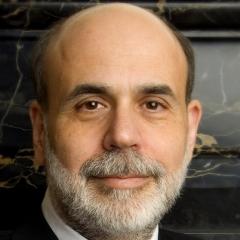
“We’ve never had a decline in house prices on a nationwide basis. So, what I think what is more likely is that house prices will slow, maybe stabilize, might slow consumption spending a bit. I don’t think it’s going to drive the economy too far from its full employment path, though.” ThinkingMightHouseBitsEconomyPathBasesSpendingEmploymentDeclineConsumptionHouse Prices Author:Ben Bernanke
“If you are asking me if I would advocate that the Chinese go to greater flexibility in their exchange rate, I certainly would.” IfsGreaterAskingRateChineseFlexibility Author:Ben Bernanke
“Under a cold turkey strategy, at each policy meeting the Federal Open Market Committee would make its best guess about where it ultimately wants the funds rate to be and would move to that rate in a single step.” WantMovingStepsPolicyColdStrategyMeetingsRateFundCommitteesTurkeysSingle StepCold Turkey Author:Ben Bernanke
“To avoid large and unsustainable budget deficits, the nation will ultimately have to choose among higher taxes, modifications to entitlement programs such as Social Security and Medicare, less spending on everything else from education to defense, or some combination of the above.” NationsSocialSecurityHigherTaxesProgramSpendingDefenseCombinationBudgetsSocial SecurityDeficitEntitlementMedicareModificationEntitlement ProgramsBudget Deficit Author:Ben Bernanke
“The more important reason is that the research itself provides an important long-run perspective on the issues that we face on a day-to-day basis.” LongImportantReasonRunningFacesIssuesPerspectiveResearchBasesLong RunsDay To Day Author:Ben Bernanke
“I assure this committee that, if I am confirmed, I will be strictly independent of all political influences... essential to that institution's ability to function effectively and achieve its mandated objectives.” IfsPoliticalAbilityEconomyInfluenceAchieveEssentialsFunctionIndependentInstitutionsObjectivesCommitteesPolitical Influence Author:Ben Bernanke
“Our mission, as set forth by the Congress is a critical one: to preserve price stability, to foster maximum sustainable growth in output and employment, and to promote a stable and efficient financial system that serves all Americans well and fairly.” WellsGrowthEconomyFinancialCongressMissionsCriticalEmploymentPreservesStabilityEfficientStableMaximumOutputFinancial SystemPrice Stability Author:Ben Bernanke
“The risk exists that, with aggregate demand exhibiting considerable momentum, output could overshoot its sustainable path, leading ultimately in the absence of countervailing monetary policy action to further upward pressure on inflation.” ActionEconomyPathRiskPolicyDemandPressureAbsenceInflationMomentumMonetaryOutputMonetary Policy Author:Ben Bernanke
“The more guidance a central bank can provide the public about how policy is likely to evolve the greater the chance that market participants will make appropriate inferences.” ChanceGreaterPolicyEvolveGuidanceAppropriateParticipantsCentral BanksInference Author:Ben Bernanke
“The best approach here, if at all possible, is to use supervisory and regulatory methods to restrain undue risk-taking and to make sure the system is resilient in case an asset-price bubble bursts in the future.” IfsUseCasesRiskApproachMethodInvestingAssetsBubblesResilientRisk-taking Author:Ben Bernanke
“...the Federal Reserve has the capacity to operate in domestic money markets to maintain interest rates at a level consistent with our economic goals” GoalInterestLevelsEconomicCapacityRateInvestingConsistentReservesFederal ReserveInterest Rate Author:Ben Bernanke
“September and October of 2008 was the worst financial crisis in global history, including the Great Depression.” WorstCrisisIncludingFinancialSeptemberOctoberGreat DepressionFinancial Crisis Author:Ben Bernanke
“Investment banks manage to go bankrupt through their investment-banking activities, commercial banks manage to go bankrupt through their commercial-banking activities.” ActivityInvestmentManageBankingInvestment BankingCommercial Banks Author:Ben Bernanke
“The crisis in Europe has affected the US economy by acting as a drag on our exports, weighing on business and consumer confidence and pressuring US financial markets and institutions.” ActingEconomyEuropeCrisisInstitutionsFinancialConsumersAffectedDragWeighingFinancial MarketsConsumer Confidence Author:Ben Bernanke
“Both humanity's capacity to innovate and the incentives to innovate are greater today than at any other time in history.” TodayHumanityGreaterCapacityIncentives Author:Ben Bernanke
“Under current law, on January 1, 2013, there's going to be a massive fiscal cliff of large spending cuts and tax increases.” ImportantLawCuttingTaxesPercentIncreaseCurrentsSpendingMassiveCliffsJanuaryTax IncreasesGangnam StyleSpending CutsJanuary 1stFiscal Cliff Author:Ben Bernanke
“I'd throw dollars out of helicopters if I had to, to stimulate the economy.” IfsEconomyDollarsHelicopters Author:Ben Bernanke
“If Wall Street crashes, does Main Street follow? Not necessarily.” IfsDoeStreetsWallCrashMain Street Author:Ben Bernanke
“A meritocracy is a system in which the people who are the luckiest in their health and genetic endowment; luckiest in terms of family support, encouragement and, probably, income; luckiest in their educational and career opportunities; and luckiest in so many other ways difficult to enumerate - these are the folks who reap the largest rewards.” PeopleWayOpportunityDifficultTermCareersSupportEncouragementRewardsFolksEducationalIncomeReapEndowmentMeritocracyFamily SupportCareer OpportunitiesNatural Endowment Author:Ben Bernanke
“[Virtual Currencies] may hold long-term promise, particularly if the innovations Promote a faster, more secure and more efficient payment system.” IfsMayLongTermPromiseInnovationSecureFasterLong TermEfficientCurrencyPayment Author:Ben Bernanke
“I think that having good data, good statistics-and the United States generally has better macroeconomic statistics than most countries-and having good economists to interpret those data and present the policy alternatives, has a substantially beneficial effect on policymaking in the United States.” ThinkingCountryStatesUnitedUnited StatesEffectsPolicyDataAlternativesStatisticsEconomistBeneficialMacroeconomics Author:Ben Bernanke
“The people who best use their advantages, or overcome adversity, and work honestly are those most worthy of admiration.” PeopleUseAdvantageOvercomingAdversityWorthyHonestlyAdmirationOvercoming Adversity Author:Ben Bernanke
“Inflation is certainly low and stable and, measured in unemployment and labour-market slack, the economy has made a lot of progress. The pace of growth is disappointingly slow, mostly because productivity growth has been very slow, which is not really something amenable to monetary policy. It comes from changes in technology, changes in worker skills and a variety of other things, but not monetary policy, in particular.” GrowthTechnologyEconomyProgressPolicyProductivityVarietyInflationMonetary Author:Ben Bernanke
“Weaker currencies abroad mean a strong dollar, and a stronger dollar, together with a weak global environment, is a drag on the U.S. economy. So it's important, as it affects overall levels of production and employment in the U.S. There are many domestic industries doing well in the United States, notwithstanding a strong dollar.” MeanImportantTogetherStrongEconomyEnvironmentWeakStrongerCurrency Author:Ben Bernanke
“The lesson of history is that you do not get a sustained economic recovery as long as the financial system is in crisis.” LongEconomicLessonsCrisisFinancialRecoveryFinancial SystemEconomic Recovery Author:Ben Bernanke
“I served seven years as the chair of the Princeton economics department where I had responsibility for major policy decisions, such as whether to serve bagels or doughnuts at the department coffee hour.” YearsHoursDecisionResponsibilityPolicyMajorsEconomicsSevenCoffeeDepartmentChairsSeven YearsDoughnutPrincetonBagels Author:Ben Bernanke
“Achieving price stability is not only important in itself, it is also central to attaining the Federal Reserve's other mandate objectives of maximum sustainable employment and moderate long-term interest rates.” LongImportantTermInterestEconomyAchieveRateObjectivesEmploymentLong TermStabilityReservesModeratesMaximumMandatesFederal ReserveInterest RatePrice Stability Author:Ben Bernanke
“Importantly, in the 1930s, in the Great Depression, the Federal Reserve, despite its mandate, was quite passive and, as a result, financial crisis became very severe, lasted essentially from 1929 to 1933.” ResultsCrisisFinancialDespitePassiveReservesSevereMandatesGreat Depression1930sFederal ReserveFinancial Crisis Author:Ben Bernanke
“The crisis and recession have led to very low interest rates, it is true, but these events have also destroyed jobs, hamstrung economic growth and led to sharp declines in the values of many homes and businesses.” HomeJobsValuesGrowthInterestEconomicEventsLowsCrisisRateDestroyedDeclineEconomic GrowthRecessionsInterest RateMany Homes Author:Ben Bernanke
“Developments in financial markets can have broad economic effects felt by many outside the markets.” FeltEconomicEffectsDevelopmentFinancialBroadsFinancial Markets Author:Ben Bernanke
“A gold standard doesn't imply stability in the prices of the goods and services that people buy every day, it implies a stability in the price of gold itself.” PeopleStandardsGoldGoodsStabilityGoods And ServicesGold Standard Author:Ben Bernanke
“Every effort needs to be made to try and offset the costs of Katrina and Rita by reductions in other government programs, especially those that are wasteful, duplicative and ineffective.” NeedsTryingMadeGovernmentEffortEconomyCostProgramReductionKatrinaGovernment Programs Author:Ben Bernanke
“If I am confirmed, I am confident that my colleagues on the Federal Open Market Committee and I will maintain the focus on long-term price stability as monetary policy's greatest contribution to general economic prosperity and maximum employment.” IfsLongTermFocusEconomicPolicyProsperityEmploymentLong TermContributionStabilityCommitteesColleaguesMaximumMonetaryMonetary PolicyEconomic ProsperityPrice Stability Author:Ben Bernanke
“The basic prescription for preventing deflation is therefore straightforward, at least in principle: Use monetary and fiscal policy as needed to support aggregate spending, in a manner as nearly consistent as possible with full utilization of economic resources and low and stable inflation. In other words, the best way to get out of trouble is not to get into it in the first place.” WayFirstsUseBusinessPrinciplesSupportEconomyTroubleEconomicPolicyNeededLowsResourcesEconomicsSpendingBest WayFinanceConsistentStableInflationStraightforwardMonetaryPrescriptionsPreventingUtilizationDeflationFiscal PolicyEconomic Resources Author:Ben Bernanke
“If you want to understand geology, study earthquakes. If you want to understand the economy, study the Depression.” IfsWantEconomyStudyDepressionEarthquakesGeology Author:Ben Bernanke
“If your uniform isn't dirty, you haven't been in the game.” IfsGamesHavensDirtyUniformsGraduationGreat GraduationCollege Graduation Author:Ben Bernanke
“Over the years, the U.S. economy has shown a remarkable ability to absorb shocks of all kinds, to recover, and to continue to grow. Flexible and efficient markets for labor and capital, an entrepreneurial tradition, and a general willingness to tolerate and even embrace technological and economic change all contribute to this resiliency.” YearsKindGrowsChangeAbilityTechnologyEconomyEconomicEconomicsTraditionLaborEmbraceEntrepreneurAll KindsShockRemarkableWillingnessEfficientTolerateTechnologicalFlexibleEntrepreneurialResiliencyEfficient MarketsLabor And CapitalEconomic Change Author:Ben Bernanke
“Education - lifelong education for everyone - from toddlers to workers well advanced in their careers - is indeed an excellent investment for individuals and society as a whole.” WellsWholeIndividualMoneyEducationCareersInvestmentWorkersExcellentLifelongToddlerIndividuals And Society Author:Ben Bernanke
“It is not the responsibility of the Federal Bank - nor would it be appropriate - to protect lenders and investors from the consequences of their decisions” DecisionResponsibilityProtectConsequenceEconomicsAppropriateInvestorsLenders Author:Ben Bernanke
“The sources of deflation are not a mystery. Deflation is in almost all cases a side effect of a collapse of aggregate demand.. a drop in spending so severe that producers must cut prices on an ongoing basis in order to find buyers.” OrderSidesCasesEconomyCuttingMysteryEffectsSourceDemandEconomicsBasesSpendingProducersFinanceCollapseSevereOngoingBuyersSide EffectsDeflation Author:Ben Bernanke
“There's no denying that a collapse in stock prices today would pose serious macroeconomic challenges for the United States. Consumer spending would slow, and the U.S. economy would become less of a magnet for foreign investors. Economic growth, which in any case has recently been at unsustainable levels, would decline somewhat. History proves, however, that a smart central bank can protect the economy and the financial sector from the nastier side effects of a stock market collapse.” StatesTodaySidesGrowthChallengesLevelsUnitedCasesUnited StatesEconomyEconomicEffectsSeriousProtectProveSmartEconomicsFinancialSpendingFinanceConsumersInvestorsDeclineCollapseEconomic GrowthMagnetSide EffectsCentral BanksMacroeconomicsStock Price Author:Ben Bernanke
“The economic repercussions of a stock market crash depend less on the severity of the crash itself than on the response of economic policymakers, particularly central bankers.” EconomyEconomicDependsEconomicsResponseCrashBankersRepercussionsSeverityMarket CrashStock Market Crash Author:Ben Bernanke
“A collapse in U.S. stock prices certainly would cause a lot of white knuckles on Wall Street. But what effect would it have on the broader U.S. economy? If Wall Street crashes, does Main Street follow? Not necessarily.” IfsDoeCausesWhiteEconomyStreetsEffectsWallEconomicsInvestingCollapseCrashKnucklesMain StreetStock Price Author:Ben Bernanke
“Indeed, in general, healthy investment returns cannot be sustained in a weak economy, and of course it is difficult to save for retirement or other goals without the income from a job.” JobsCoursesDifficultGoalEconomyReturnHealthyWeakInvestmentIncomeRetirement Author:Ben Bernanke
“Given the central role of effective, firmwide risk management in maintaining strong financial institutions, it is clear that supervisors must redouble their efforts to help organizations improve their risk-management practices...We are also considering the need for additional or revised supervisory guidance regarding various aspects of risk management, including further emphasis on the need for an enterprise-wide perspective when assessing risk.” NeedsHelpingStrongGivenEffortRolesPracticeClearRiskPerspectiveAspectOrganizationManagementInstitutionsIncludingFinancialVariousWideGuidanceEnterpriseConsideringEmphasisMaintainingRisk ManagementFinancial InstitutionsSupervisorsAssessing Author:Ben Bernanke
“Like gold, U.S. dollars have value only to the extent that they are strictly limited in supply. But the U.S. government has a technology, called a printing press (or, today, its electronic equivalent), that allows it to produce as many U.S. dollars as it wishes at essentially no cost. By increasing the number of U.S. dollars in circulation, or even by credibly threatening to do so, the U.S. government can also reduce the value of a dollar in terms of goods and services, which is equivalent to raising the prices in dollars of those goods and services.” GovernmentTodayValuesWishTermNumbersTechnologyProduceCostGoldPressesDollarsGoodsThreateningPrintingCirculationPrinting PressGoods And Services Author:Ben Bernanke
“The U.S. government has a technology, called a printing press (or, today, its electronic equivalent), that allows it to produce as many U.S. dollars as it wishes at essentially no cost.” GovernmentTodayWishTechnologyProduceCostPressesDollarsPrintingPrinting Press Author:Ben Bernanke
“House prices have risen by nearly 25 percent over the past two years. Although speculative activity has increased in some areas, at a national level these price increases largely reflect strong economic fundamentals.” YearsTwoPastHouseStrongLevelsEconomicActivityPercentAreasIncreaseFundamentalsTwo YearsRisenOver The PastHouse Prices Author:Ben Bernanke