Quotessence
Home / Authors / Bram Stoker
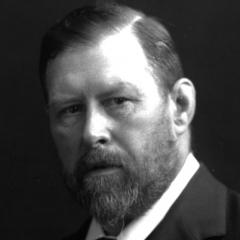
Bram Stoker

Bram Stoker Quotes

Novelist

Filter quotes by topic

Famous Bram Stoker Quotes

“Everything is grey—except the green grass, which seems like emerald amongst it; grey earthy rock; grey clouds, tinged with the sunburst at the far edge, hang over the grey sea, into which the sand-points stretch like grey fingers. The sea is tumbling in over the shallows and the sandy flats with a roar, muffled in the sea-mists drifting inland. The horizon is lost in a grey mist. All is vastness; the clouds are piled up like giant rocks, and there is a “brool” over the sea that sounds like some presage of doom. Dark figures are on the beach here and there, sometimes half shrouded in the mist, and seem “men like trees walking.” The fishing-boats are racing for home, and rise and dip in the ground swell as they sweep into the harbour, bending to the scuppers.”

“There was something so strange in all this, something so weird and impossible to imagine, that there grew on me a sense of my being in some way the sport of opposite forces - the mere vague idea of which seemed in a way to paralyse me. I was certainly under some form of mysterious protection. From a distant country had come, in the very nick of time, a message that took me out of the danger of the snow-sleep and the jaws of the wolf.”

“A noi nobili della Transilvania non piace pensare che le nostre ossa riposino fra quelle dei comuni mortali. Non cerco allegrezza né letizia, né la luminosa voluttà del sole o delle acque chiare che tanto piacciono ai giovani e agli spensierati. Non sono più giovane, e il mio cuore dopo gravosi anni di lutto per i miei morti non è incline all'allegria. Inoltre, le mura del mio castello sono diroccate; molto sono le ombre e il vento soffia freddo fra le merlature e i battenti. Amo la semi-oscurità e le ombre e restare solo con i miei pensieri quando è possibile.”

“Nous nous tûmes l'un et l'autre ; pendant que nous attendions, je l'examinai. Un homme petit et râblé, brun comme un grain de café, ayant peut-être une tendance à engraisser, mais pour le moment excessivement mince. Les rides profondes de son visage et de son cou n'étaient pas seulement dues aux années et aux intempéries : elles indiquaient à ne pas s'y tromper les endroits où la chair ou la graisse avait fondu et où la peau s'était détendue. Le cou était simplement une surface où s'entrecroisaient les sillons et les rides et portait les traces laissées par le soleil brûlant du désert. L'Extrême-Orient, les Tropiques, le désert, chaque région laissait sa marque colorée. Mais toutes les trois étaient différentes ; et un œil qui avait su une fois pouvait ainsi les distinguer aisément. La pâleur bistrée pour le premier ; le brun rouge et violent pour la seconde ; et pour le troisième, le hâle sombre et profond qui avait pris, semblait-il, le caractère d'une coloration permanente. Mr. Corbeck avait une grosse tête pleine et massive ; avec des cheveux en désordre, d'un brun-rouge foncé, dégarnis sur les tempes. Son front était beau, haut et large ; et pour employer les termes de la physiognomonie, le sinus frontal était hardiment marqué. Sa forme carrée traduisait l'esprit raisonneur ; et la plénitude sous les yeux le don des langues. Il avait le nez court et large qui dénote l'énergie ; le menton carré - qu'on discernait malgré la barbe épaisse et non soignée - et la mâchoire massive qui montrent l'esprit de décision. « Un homme pas mal pour le désert ! » me disais-je en le regardant.”

“Permítame que le aconseje, mi querido joven amigo; no, permítame que le advierta con toda seriedad que en caso de que usted deje estos cuartos, por ningún motivo se quede dormido en cualquier otra parte del castillo. Es viejo y tiene muchas memorias, y hay muchas pesadillas para aquellos que no duermen sabiamente. ¡Se lo advierto! En caso de que el sueño lo dominase ahora o en otra oportunidad o esté a punto de dominarlo, regrese deprisa a su propia habitación o a estos cuartos, pues entonces podrá descansar a salvo. Pero no siendo usted cuidadoso a este respecto, entonces… —terminó su discurso de una manera horripilante, pues hizo un movimiento con las manos como si se las estuviera lavando.”

“Voi non lasciate che vostri occhi vedano né vostre orecchie sentano, e ciò che è fuori da vostra vita ordinaria non vi tocca. Voi non credete che ci siano cose che non potete capire, ed invece esse ci sono; e che esistano certe persone in grado di vedere cose che altri non possono? Ma esistono cose vecchie e nuove che non possono esser contemplate da occhi di uomini, perché essi sanno – o credono di sapere – cose che altri uomini hanno detto a loro. Ah, questa è pecca di nostra scienza che ha pretesa di capire tutto, mentre, se non ci riesce, allora dice che non c’è niente da spiegare! Ma noi vediamo ogni giorno da ogni parte spuntare nuove credenze, che si reputano essere nuove, ma che non sono altro che cose vecchie travestite da giovani! – come belle signore nell’opera. (Van Helsing)”

“The first step was to restore confidence, so I asked him, speaking pretty loud so that he would hear me through his closed ears, "Would you like some sugar to get your flies around again?" He seemed to wake up all at once, and shook his head. With a laugh he replied, "Not much! Flies are poor things, after all!" After a pause he added, "But I don't want their souls buzzing round me, all the same." "Or spiders?" I went on. "Blow spiders! What's the use of spiders? There isn't anything in them to eat or…" He stopped suddenly as though reminded of a forbidden topic. "So, so!" I thought to myself, "this is the second time he has suddenly stopped at the word 'drink'. What does it mean?" Renfield seemed himself aware of having made a lapse, for he hurried on, as though to distract my attention from it, "I don't take any stock at all in such matters. 'Rats and mice and such small deer,' as Shakespeare has it, 'chicken feed of the larder' they might be called. I'm past all that sort of nonsense. You might as well ask a man to eat molecules with a pair of chopsticks, as to try to interest me about the less carnivora, when I know of what is before me." "I see," I said. "You want big things that you can make your teeth meet in? How would you like to breakfast on an elephant?" "What ridiculous nonsense you are talking?" He was getting too wide awake, so I thought I would press him hard. "I wonder," I said reflectively, "what an elephant's soul is like!" The effect I desired was obtained, for he at once fell from his high-horse and became a child again. "I don't want an elephant's soul, or any soul at all!" he said. For a few moments he sat despondently. Suddenly he jumped to his feet, with his eyes blazing and all the signs of intense cerebral excitement. "To hell with you and your souls!" he shouted. "Why do you plague me about souls? Haven't I got enough to worry, and pain, to distract me already, without thinking of souls?" He looked so hostile that I thought he was in for another homicidal fit, so I blew my whistle.”

“It is a strange world, a sad world, a world full of miseries, and woes, and troubles. And yet when King Laugh come, he make them all dance to the tune he play. Bleeding hearts, and dry bones of the churchyard, and tears that burn as they fall, all dance together to the music that he make with that smileless mouth of him. Ah, we men and women are like ropes drawn tight with strain that pull us different ways. Then tears come, and like the rain on the ropes, they brace us up, until perhaps the strain become too great, and we break. But King Laugh he come like the sunshine, and he ease off the strain again, and we bear to go on with our labor, what it may be.”

“Oh that I could give any idea of the scene; of that sweet, sweet, good, good woman in all the radiant beauty of her youth and animation, with the red scar on her forehead of which she was conscious, and which we saw with grinding of our teeth- remembering whence and how it came; her loving kindness against our grim hate; her tender faith against all our fears and doubting; and we, knowing that so far as symbols went, she with all her goodness and purity and faith, was outcast from God.”

“Besides, I know you loved my Lucy . . ." Here he turned away and covered his face with his hands. I could hear the tears in his voice. Mr. Morris, with instinctive delicacy, just laid a hand for a moment on his shoulder, and then walked quietly out of the room. I suppose there is something in a woman's nature that makes a man free to break down before her and express his feelings on the tender or emotional side without feeling it derogatory to his manhood. For when Lord Godalming found himself alone with me he sat down on the sofa and gave way utterly and openly. I sat down beside him and took his hand. I hope he didn't think it forward of me, and that if her ever thinks of it afterwards he never will have such a thought. There I wrong him. I know he never will. He is too true a gentleman.I said to him, for I could see that his heart was breaking, "I loved dear Lucy, and I know what she was to you, and what you were to her. She and I were like sisters, and now she is gone, will you not let me be like a sister to you in your trouble? I know what sorrows you have had, though I cannot measure the depth of them. If sympathy and pity can help in your affliction, won't you let me be of some little service, for Lucy's sake?" In an instant the poor dear fellow was overwhelmed with grief. It seemed to me that all that he had of late been suffering in silence found a vent at once. He grew quite hysterical,and raising his open hands, beat his palms together in a perfect agony of grief. He stood up and then sat down again, and the tears rained down his cheeks. I felt an infinite pity for him, and opened my arms unthinkingly. With a sob he laid his head on my shoulder and cried like a wearied child, whilst he shook with emotion. We women have something of the mother in us that makes us rise above smaller matters when the mother spirit is invoked. I felt this big sorrowing man's head resting on me, as though it were that of a baby that some day may lie on my bosom, and I stroked his hair as though he were my own child. I never thought at the time how strange it all was. After a little bit his sobs ceased, and he raised himself with an apology, though he made no disguise of his emotion. He told me that for days and nights past, weary days and sleepless nights, he had been unable to speak with any one, as a man must speak in his time of sorrow. There was no woman whose sympathy could be given to him, or with whom, owing to the terrible circumstance with which his sorrow was surrounded, he could speak freely. "I know now how I suffered," he said, as he dried his eyes, "but I do not know even yet, and none other can ever know, how much your sweet sympathy has been to me today. I shall know better in time, and believe me that, though I am not ungrateful now, my gratitude will grow with my understanding. You will let me be like a brother, will you not, for all our lives, for dear Lucy's sake?" "For dear Lucy's sake," I said as we clasped hands."Ay, and for your own sake," he added, "for if a man's esteem and gratitude are ever worth the winning, you have won mine today. If ever the future should bring to you a time when you need a man's help,believe me, you will not call in vain. God grant that no such time may ever come to you to break the sunshine of your life, but if it should ever come, promise me that you will let me know." He was so earnest, and his sorrow was so fresh, that I felt it would comfort him, so I said, "I promise.”

“As I came along the corridor I say Mr. Morris looking out of a window. He turned as he heard my footsteps. "How is Art?" he said. Then noticing my red eyes, he went on,"Ah, I see you have been comforting him. Poor old fellow! He needs it. No one but a woman can help a man when he is in trouble of the heart, and he had no one to comfort him." He bore his own trouble so bravely that my heart bled for him. I saw the manuscript in his hand, and I knew that when he read it he would realize how much I knew, so I said to him,"I wish I could comfort all who suffer from the heart. Will you let me be your friend, and will you come to me for comfort if you need it? You will know later why I speak." He saw that I was in earnest,and stooping, took my hand, and raising it to his lips, kissed it. It seemed but poor comfort to so brave and unselfish a soul, and impulsively I bent over and kissed him. The tears rose in his eyes, and there was a momentary choking in his throat. He said quite calmly,"Little girl, you will never forget that true hearted kindness, so long as ever you live!" Then he went into the study to his friend. "Little girl!" The very words he had used to Lucy, and, oh, but he proved himself a friend.”