Quotessence
Home / Authors / Charlie Munger
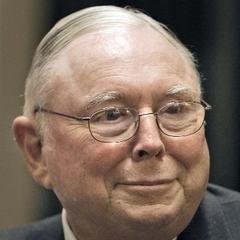
Charlie Munger

Charlie Munger Quotes

Business person

Filter quotes by topic

Famous Charlie Munger Quotes

“I’d say that Berkshire Hathaway’s system is adapting to the nature of the investment problem as it really is. We’ve really made the money out of high quality businesses. In some cases, we bought the whole business. And in some cases, we just bought a big block of stock. But when you analyze what happened, the big money’s been made in the high quality businesses. And most of the other people who’ve made a lot of money have done so in high quality businesses.”

“In investment management today, everybody wants not only to win, but to have a yearly outcome path that never diverges very much from a standard path except on the upside. Well, that is a very artificial, crazy construct. That's the equivalent in investment management to the custom of binding the feet of Chinese women”

“So you can get very remarkable investment results if you think more like a winning pari-mutuel player. Just think of it as a heavy odds against game full of craziness with an occasional mispriced something or other. And you're probably not going to be smart enough to find thousands in a lifetime. And when you get a few, you really load up. It's just that simple.”

“'Crowd folly', the tendency of humans, under some circumstances, to resemble lemmings, explains much foolish thinking of brilliant men and much foolish behavior - like investment management practices of many foundations represented here today. It is sad that today each institutional investor apparently fears most of all that its investment practices will be different from practices of the rest of the crowd.”

“The Berkshire-style investors tend to be less diversified than other people. The academics have done a terrible disservice to intelligent investors by glorifying the idea of diversification. Because I just think the whole concept is literally almost insane. It emphasizes feeling good about not having your investment results depart very much from average investment results. But why would you get on the bandwagon like that if somebody didn't make you with a whip and a gun?”

“If you're going to be an investor, you're going to make some investments where you don't have all the experience you need. But if you keep trying to get a little better over time, you'll start to make investments that are virtually certain to have a good outcome. The keys are discipline, hard work, and practice. It's like playing golf - you have to work on it.”

“The general culture of investment banking has deteriorated over the years. We did a $6 million deal years ago for Diversified Retailing and we were rigorously and intelligently screened. They bankers cared and wanted to protect their clients. The culture now is that anything that can be sold for a profit will be. 'Can you sell it?' is the moral test, and that's not an adequate test.”

“When we were young, there weren't very many smart people in the investment world. You should have seen the people in the bank trust departments. Now, there are armies of smart people at private investment funds, etc . If there were a crisis now, there would be a lot more people with a lot of money ready to take advantage.”

“It's my guess that something like 5% of GDP goes to money management and itsattendant friction. I define it broadly - annuities, incentive pay, all trading, etc. Nobody else has used figures that high, but that's my guess. Worst of all, the people doing this are among the best and the brightest. Hundreds and thousands of engineers, etc. are going into hedge funds and investment banking. That is not an intelligent allocation of the brainpower of the civilization.”

“I think the reason why we got into such idiocy in investment management is best illustrated by a story that I tell about the guy who sold fishing tackle. I asked him, "My God, they're purple and green. Do fish really take these lures?" And he said, "Mister, I don't sell to fish." Investment managers are in the position of that fishing tackle salesman.”

“Finding a single investment that will return 20% per year for 40 years tends to happen only in dreamland. In the real world, you uncover an opportunity, and then you compare other opportunities with that. And you only invest in the most attractive opportunities. That's your opportunity cost. That's what you learn in freshman economics. The game hasn't changed at all. That's why Modern Portfolio Theory is so asinine.”

“If you're going to buy something which compounds for 30 years at 15% per annum and you pay one 35% tax at the very end, the way that works out is that after taxes, you keep 13.3% per annum. In contrast, if you bought the same investment, but had to pay taxes every year of 35% out of the 15% that you earned, then your return would be 15% minus 35% of 15%-or only 9.75% per year compounded. So the difference there is over 3.5%. And what 3.5% does to the numbers over long holding periods like 30 years is truly eye-opening.”

“We believe that almost all really good investment records will involve relatively little diversification. The basic idea that it was hard to find good investments and that you wanted to be in good investments, and therefore, you'd just find a few of them that you knew a lot about and concentrate on those seemed to me such an obviously good idea. And indeed, it's proven to be an obviously good idea. Yet 98% of the investing world doesn't follow it. That's been good for us.”