Quotessence
Home / Authors / George Orwell
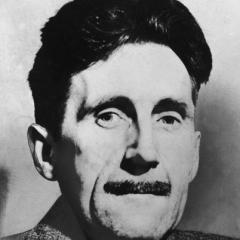
George Orwell

George Orwell Quotes

Novelist

Filter quotes by topic

Famous George Orwell Quotes

“Literature is doomed if liberty of thought perishes. Not only is it doomed in any country which retains a totalitarian structure; but any writer who adopts the totalitarian outlook, who finds excuses for persecution and the falsification of reality, thereby destroys himself as a writer. There is no way out of this... At some time in the future, if the human mind becomes something totally different from what it is now, we may learn to separate literary creation from intellectual honesty. At present we know only that the imagination, like certain wild animals, will not breed in captivity. Any writer or journalist who denies that fact — and nearly all the current praise of the Soviet Union contains or implies such a denial — is, in effect, demanding his own destruction.”

“In our age, the idea of intellectual liberty is under attack from two directions. On the one side are its theoretical enemies, the apologists of totalitarianism, and on the other its immediate, practical enemies, monopoly and bureaucracy. Any writer or journalist who wants to retain his integrity finds himself thwarted by the general drift of society rather than by active persecution. The sort of things that are working against him are the concentration of the press in the hands of a few rich men, the grip of monopoly on radio and the films, the unwillingness of the public to spend money on books, making it necessary for nearly every writer to earn part of his living by hackwork, the encroachment of official bodies… Everything in our age conspires to turn the writer, and every other kind of artist as well, into a minor official, working on themes handed down from above and never telling what seems to him the whole of the truth. But in struggling against this fate he gets no help from his own side; that is, there is no large body of opinion which will assure him that he’s in the right.”

“All writers are vain, selfish, and lazy, and at the very bottom of their motives there lies a mystery. Writing a book is a horrible, exhausting struggle, like a long bout of some painful illness. One would never undertake such a thing if one were not driven on by some demon whom one can neither resist nor understand. For all one knows that demon is simply the same instinct that makes a baby squall for attention. And yet it is also true that one can write nothing readable unless one constantly struggles to efface one's own personality. Good prose is like a windowpane.”

“Literature has sometimes flourished under despotic regimes, but, as has often been pointed out, the despotisms of the past were not totalitarian. Their repressive apparatus was always inefficient, their ruling classes were usually either corrupt or apathetic or half-liberal in outlook, and the prevailing religious doctrines usually worked against perfectionism and the notion of human infallibility. Even so it is broadly true that prose literature has reached its highest levels in periods of democracy and free speculation. What is new in totalitarianism is that its doctrines are not only unchallengeable but also unstable. They have to be accepted on pain of damnation, but on the other hand, they are always liable to be altered on a moment’s notice. Consider, for example, the various attitudes, completely incompatible with one another, which an English Communist or ‘fellow-traveler’ has had to adopt toward the war between Britain and Germany. For years before September, 1939, he was expected to be in a continuous stew about ‘the horrors of Nazism’ and to twist everything he wrote into a denunciation of Hitler: after September, 1939, for twenty months, he had to believe that Germany was more sinned against than sinning, and the word ‘Nazi’, at least as far as print went, had to drop right out of his vocabulary. Immediately after hearing the 8 o’clock news bulletin on the morning of June 22, 1941, he had to start believing once again that Nazism was the most hideous evil the world had ever seen. Now, it is easy for the politician to make such changes: for a writer the case is somewhat different. If he is to switch his allegiance at exactly the right moment, he must either tell lies about his subjective feelings, or else suppress them altogether. In either case he has destroyed his dynamo. Not only will ideas refuse to come to him, but the very words he uses will seem to stiffen under his touch. Political writing in our time consists almost entirely of prefabricated phrases bolted together like the pieces of a child’s Meccano set. It is the unavoidable result of self-censorship. To write in plain, vigorous language one has to think fearlessly, and if one thinks fearlessly one cannot be politically orthodox. Totalitarianism, however, does not so much promise an age of faith as an age of schizophrenia…to be corrupted by totalitarianism one does not have to live in a totalitarian country. The mere prevalence of certain ideas can spread a kind of poison that makes one subject after another impossible for literary purposes. Wherever there is an enforced orthodoxy…good writing stops.”

“The nationalist not only does not disapprove of atrocities committed by his own side, but he has a remarkable capacity for not even hearing about them.”

“The existence of good bad literature—the fact that one can be amused or excited or even moved by a book that one's intellect simply refuses to take seriously—is a reminder that art is not the same thing as cerebration.”

“Scientific education for the masses will do little good, and probably a lot of harm, if it simply boils down to more physics, more chemistry, more biology, etc to the detriment of literature and history. Its probable effect on the average human being would be to narrow the range of his thoughts and make him more than ever contemptuous of such knowledge as he did not possess.”