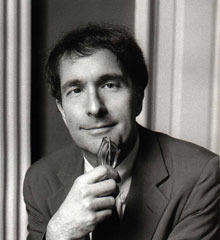
“Anything that is worth teaching can be presented in many different ways. These multiple ways can make use of our multiple intelligences.” WayDifferentUseTeachingDifferent WaysMultipleMultiple Intelligences Author:Howard Gardner
“Most people (by the time they have become adults ) can't change their minds because their neural pathways have become set... the longer neural pathways have been running one way the harder it is to rewire them.” PeopleWayMindHas BeensRunningAdultsHarderOne WayPathwaysCan't Change Author:Howard Gardner
“Our way of managing and leading, rewarding and judging people is totally out of tune with the fact that we are all individuals.” PeopleWayFactsIndividualJudgingTunesJudging People Author:Howard Gardner
“An intelligence is the biological and psychological potential to analyze information in specific ways, in order to solve problems or to create products that are valued in a culture.” WayProblemOrderCultureInformationProductsSolvePsychological Author:Howard Gardner
“When a child is thriving, there is no reason to spend time assessing intelligences. But when a child is NOT thriving - in school or at home - that is the time to apply the lens of multiple intelligences and see whether one can find ways to help the child thrive in different environments.” WayChildrenDifferentReasonHelpingHomeSchoolEnvironmentThriveNo ReasonMultipleEnd TimesLensesSpend TimeAssessingDifferent EnvironmentsMultiple Intelligences Author:Howard Gardner
“I don't think that it is necessary to rethink curricular goals. But it is certainly worth thinking about whether these goals can be reached in multiple ways.” ThinkingWayGoalMultiple Author:Howard Gardner
“I am relieved that, in my own teaching, I don't have to moderate between high stake teaching and education for the virtues. If I did, I would give students the tools to take the tests but not spend an inordinate amount of time on test prep nor on 'teaching to the test.' If the students, or their parents, want drill in testing, they'd have to go elsewhere. As a professional, my most important obligation is to teach the topic, skills, and methods in ways that I feel are intellectually legitimate.” IfsWayWantGivingFeelsImportantParentMy OwnTeachVirtueTeachingStudentsAmountSkillsToolsTestsMethodObligationStakesElsewhereTopicsTestingModeratesRelievedDrillsTeaching And EducationPreps Author:Howard Gardner
“I think that every educator, indeed every human being, is concerned with what is true and what is not; what experiences to cherish and which ones to avoid; and how best to relate to other human beings. We differ in how conscious we are of these questions; how reflective we are about our own stances; whether we are aware of how these human virtues are threatened by critiques (philosophical, cultural) and by technologies (chiefly the digital media). A good educator should help us all to navigate our way in this tangled web of virtues.” ThinkingWayShouldHumansHelpingHuman BeingsTechnologyVirtueMediaConsciousConcernedPhilosophicalRelateDigitalCherishThreatenedCritiqueEducatorStanceNavigateTangledDigital MediaTangled Webs Author:Howard Gardner
“Don't assume that the way that one searches and researches is the same from one era to another - it isn't. In the 19th century, most research was done by amateurs: either individuals who were rich or individuals who had a day job. In the 20th century, most researchers worked at universities or think tanks and received money from the government or from foundations to pursue their work. In our time, the sources of support and the locations for research may be quite different.” ThinkingWayMayDifferentDoneGovernmentJobsIndividualSupportRichCenturySourceResearchFoundationAssumingUniversityPursueErasOur TimeLocation20th CenturyTanks19th CenturyResearchersDay Jobs Author:Howard Gardner
“The wonderful thing about the theater is that it can emphasize BOTH our diversity AND our common humanity. In many ways, the world of Shakespeare (or Aeschylus or Racine) is totally different from our world; and yet any human being can look through the differences in dress and mores and discover our common problems, passions, and potentials.” WorldWayHumansLooksDifferentProblemHumanityPassionDifferencesHuman BeingsCommonWonderfulDiversityTheaterDressesOur WorldWonderful ThingsCommon Humanity Author:Howard Gardner
“Perhaps, indeed, there are no truly universal ethics: or to put it more precisely, the ways in which ethical principles are interpreted will inevitably differ across cultures and eras. Yet, these differences arise chiefly at the margins. All known societies embrace the virtues of truthfulness, integrity, loyalty, fairness; none explicitly endorse falsehood, dishonesty, disloyalty, gross inequity. (Five Minds for the Future, p136)” WayMindCultureDifferencesKnownPrinciplesVirtueFiveIntegrityEthicsUniversalEmbraceLoyaltyAriseErasEthicalFairnessFalsehoodGrossDishonestyMarginsTruthfulnessDisloyaltyEthical Principles Author:Howard Gardner
“The biggest mistake of past centuries in teaching has been to treat all students as if they were variants of the same individual and thus to feel justified in teaching them all the same subjects the same way.” IfsWayInspirationalFeelsHas BeensPastIndividualMistakeEducationTeachingSubjectsCenturyStudentsTreatsJustifiedBiggest Mistake Author:Howard Gardner
“We've got to do fewer things in school. The greatest enemy of understanding is coverage... You've got to take enough time to get kids deeply involved in something so they can think about it in lots of different ways and apply it.” ThinkingWayDifferentEnoughKidsSchoolUnderstandingEnemyLearningTeachingInvolvedDifferent WaysFewerEnough TimeCoverage Author:Howard Gardner
“While we may continue to use the words smart and stupid, and while IQ tests may persist for certain purposes, the monopoly of those who believe in a single general intelligence has come to an end. Brain scientists and geneticists are documenting the incredible differentiation of human capacities, computer programmers are creating systems that are intelligent in different ways, and educators are freshly acknowledging that their students have distinctive strengths and weaknesses.” WayBelieveHumansMayDifferentEndsUsePurposeCertainBrainStupidStudentsComputerCreatingSmartWeaknessCapacityTestsScientistIntelligentIncrediblesDifferent WaysPersistMonopolyProgrammersEducatorDistinctiveStrength And WeaknessComputer ProgrammersDifferentiationHuman Capacity Author:Howard Gardner
“But once we realize that people have very different kinds of minds, different kinds of strengths -- some people are good in thinking spatially, some in thinking language, others are very logical, other people need to be hands on and explore actively and try things out -- then education, which treats everybody the same way, is actually the most unfair education.” PeopleThinkingWayNeedsTryingMindKindDifferentHandsLanguageRealizingTreatsLogicalDifferent KindsUnfair Author:Howard Gardner
“We should spend less time ranking children and more time helping them to identify their natural competencies and gifts and cultivate these. There are hundreds and hundreds of ways to succeed and many, many different abilities that will help you get there.” WayShouldChildrenDifferentHelpingNaturalAbilitySucceedMore TimeRankingCompetencies Author:Howard Gardner